Hotel Water Damage - Louisville KY

A water loss in a hotel is not a single repair. It is a revenue problem, a guest-safety problem, and a brand problem happening at the same time. When a guest bathroom overflows on the fourth floor or a fire sprinkler head discharges in a corridor, water does not stay in one room. It travels through floor assemblies, drops into the rooms below, saturates corridor carpet pad, and wicks into the demising walls between units. Bear Restoration, owned by Emery, holds IICRC WRT, ASD, and AMRT certifications and has worked Louisville commercial properties for years, including downtown hotels near the Ohio River and along the Waterfront. Our number is (502) 200-6968, answered 24/7, because a hotel water loss almost never happens during business hours.

The core difference between a hotel water loss and a residential one is that every hour a block of rooms stays offline is lost revenue you can never recover. A 120-room property running $140 average daily rate loses roughly $16,800 in revenue for every night an entire floor is out of service. That math is why our entire approach to hotels is built around drying rooms in place and returning them to inventory in waves, rather than gutting a wing and waiting weeks.

Call (502) 200-6968

Why Louisville Hotels Face Specific Water Risks

Louisville’s hotel stock spans a wide age range, and each era brings its own failure pattern. The older properties downtown and in Old Louisville often have cast-iron and galvanized supply lines that corrode from the inside, eventually pinholing behind walls on upper floors. When that happens above an occupied room, the first sign is frequently a stained ceiling tile two floors down, which means water has already been migrating through the assembly for hours or days. Newer limited-service properties near the airport and along the I-264 corridor tend to use PEX and copper, but they pack mechanical rooms, ice machines, and stacked bathroom plumbing into tight chases, so a single failed supply line floods multiple stacked units at once.

Fire sprinkler discharge is the loss type that catches hotel operators most off guard. A single activated sprinkler head delivers between 18 and 26 gallons per minute under NFPA 13 design standards. If a head is knocked off by a luggage cart or activated by a small in-room fire, a corridor can take on hundreds of gallons before the system is shut down at the riser. That water is also pressurized and dispersed widely, so it does not pool neatly. It saturates corridor carpet, runs under door sweeps into guest rooms, and finds the floor penetrations around plumbing stacks. More often than not, the fire itself is minor and the water is the real damage.

Winter is its own category here. Louisville’s freeze-thaw cycles routinely burst supply lines in exterior walls and in unconditioned spaces above top-floor rooms. A hotel that drops its heat in a vacant wing to save energy can return from a cold snap to a burst line that ran all night. Because the property was closed off, nobody hears it, and the water has hours to spread.

Downtime Minimization: Drying in Place, Returning Rooms in Waves

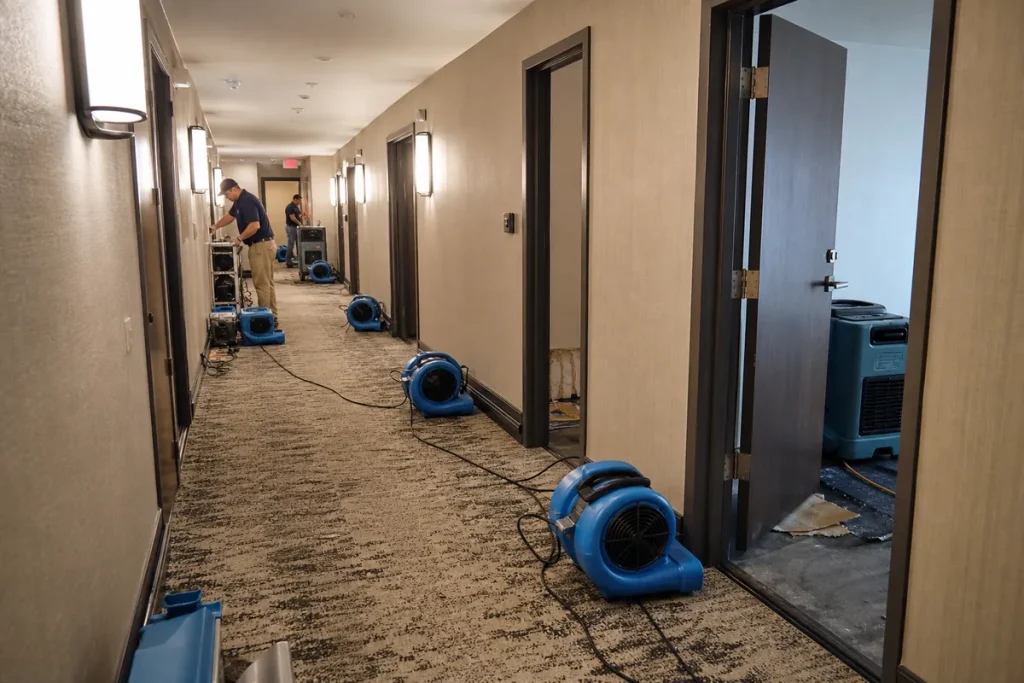
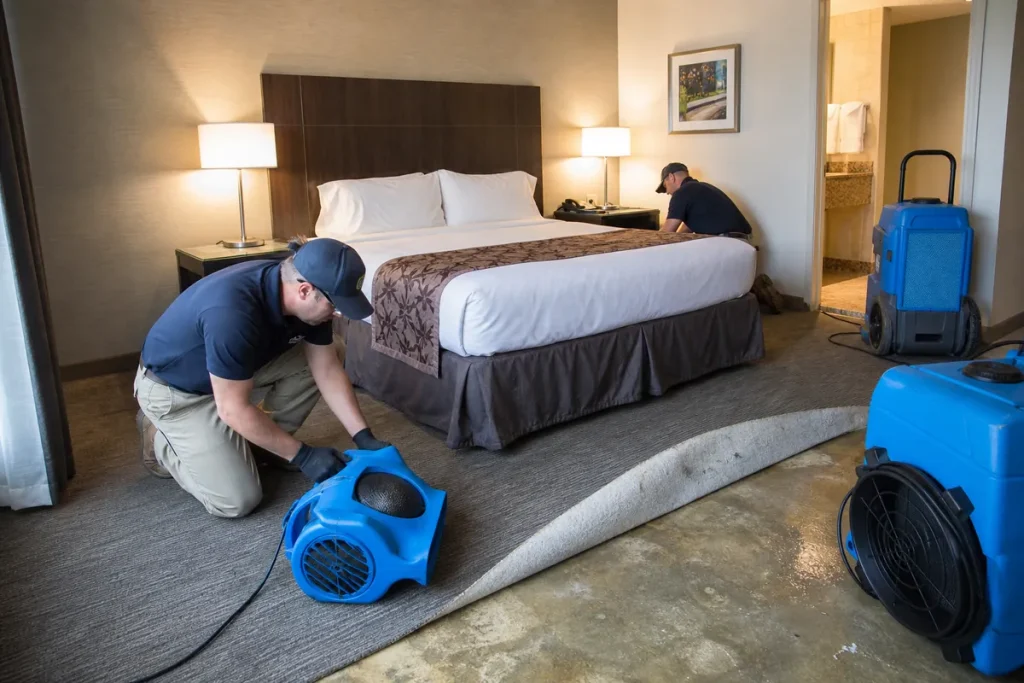
Our priority on every hotel job is keeping as many rooms in sellable inventory as possible while we dry the affected ones. That starts with rapid extraction. Before any dehumidifier runs, we pull standing water with truck-mounted and portable extraction units, because every gallon we physically remove is a gallon the drying equipment does not have to evaporate. On carpeted guest-room floors, we use weighted extraction tools that compress the carpet and pad to pull bound water that a wet-vac leaves behind. Removing 90 percent of the water mechanically rather than through evaporation can cut total dry time by days.

Next we map the moisture. Using thermal imaging cameras and penetrating moisture meters, we identify exactly which rooms and which wall cavities are wet, rather than assuming the whole floor is compromised. In practice, a fourth-floor supply break might only affect six rooms in a vertical column plus the corridor, while the rest of the floor is dry and can stay open. We isolate the wet rooms behind containment, set up drying, and let the front desk keep selling the rest.

Then we stage the return. Rooms dry at different rates depending on how much water reached them, so we re-inspect with moisture meters daily and hand back rooms to housekeeping the moment they hit dry standard, rather than waiting for the entire affected area to finish. This wave-based return is the single most important thing a restoration contractor can do for a hotel’s bottom line, and it is the part national franchises most often get wrong by treating the whole floor as one undifferentiated project.

After-Hours Mitigation and the First-Hour Response

Hotel losses cluster at night and on weekends, which is exactly when in-house maintenance is thinnest. The first hour determines how big the job becomes. When you call, we walk your night manager through shutting off water at the riser or the affected fixture’s stop valve, moving the sprinkler riser to the off position if a head has discharged and the fire department has cleared the scene, and protecting electronics and luggage in affected rooms. We dispatch a crew with extraction equipment immediately, because the difference between a two-hour response and a six-hour response is often the difference between drying a room and demolishing it.

We coordinate directly with your night audit and engineering staff so guests can be relocated cleanly. A water loss is a guest-experience event as much as a building event, and a calm, fast response protects your reviews as much as your drywall. We work quietly, contain the work zone, and keep corridors passable for the guests still in house.
Hotel Water Damage - Louisville KY

Commercial Extraction and Large-Scale Drying Equipment

Hotel drying requires equipment scaled well beyond what a house needs. The science is governed by the ANSI/IICRC S500 Standard for Professional Water Damage Restoration, which sets the framework for drying goals, equipment ratios, and documentation. For a multi-room hotel loss, we deploy low-grain refrigerant (LGR) dehumidifiers, which pull moisture from air even at low humidity levels where standard refrigerant units stall. A commercial LGR unit removes well over 100 pints of water per day under load. For very large losses, such as a fully saturated corridor and a column of rooms, we bring in desiccant dehumidification, which uses a silica-gel rotor to drive humidity far lower than refrigerant units can reach, then ducts dry air directly into the wet spaces.

Air movement matters as much as dehumidification. We place centrifugal air movers to create laminar airflow across wet surfaces, sweeping the moisture-laden boundary layer off carpet, baseboards, and wall cavities so the dehumidifiers can capture it. For wet wall cavities, we use injection drying systems that force conditioned air behind the drywall through small ports, which lets us dry the cavity without demolishing finished walls in guest rooms. Saving the wall finish is saving room nights, so this technique pays for itself immediately on a hotel.

Call (502) 200-6968

Documentation, Insurance Coordination, and Business Interruption

Hotels carry commercial property policies that almost always include business interruption coverage, and that coverage is only as good as the documentation behind the claim. From the first hour, we record moisture readings room by room, photograph every affected area, and log equipment placement and run times. We document the drying progress daily so there is a defensible record of when each room became unsellable and when it returned to inventory, which is the exact data a business interruption adjuster needs to value the lost-revenue portion of the claim.

We produce our scope and pricing in Xactimate, the estimating platform most carriers use, which speeds approval and reduces back-and-forth with the adjuster. We coordinate directly with your carrier and, when there is a sprinkler or supply-line manufacturer at fault, we preserve the failed component for any subrogation the carrier may pursue. Most general managers do not want to manage a claim on top of a displaced wing, so we handle the adjuster relationship and keep you informed rather than buried in it.

Business Continuity for the Property

The goal is a hotel that keeps operating through the loss. That means containment that keeps the lobby and unaffected floors guest-ready, drying equipment that runs quietly enough not to disrupt adjacent occupied rooms, and a return schedule your revenue manager can actually plan around. We give you a daily projected return date per room so the front desk can manage inventory and rebook displaced guests instead of guessing. For a property running tight occupancy during Derby week or a major Kentucky International Convention Center event, that predictability is worth as much as the drying itself.

Bear Restoration serves hotels across the Louisville metro, including downtown, the Waterfront, the airport corridor, Jeffersonville, and the surrounding counties. If you manage a property and want a mitigation plan on file before a loss happens, we will walk your engineering team through shutoff locations and a response protocol. For commercial losses we also handle commercial water extraction and multi-property restoration for management companies.

Call Bear Restoration for Hotel Water Damage

Every hour a floor sits offline is revenue you cannot recover, so the response has to be fast and the drying has to be smart. Bear Restoration brings commercial-scale extraction, LGR and desiccant drying, and adjuster-ready documentation to Louisville hotels, with a wave-based return schedule built to protect your occupancy. Call (502) 200-6968 any hour for emergency hotel water damage mitigation across the Louisville metro.

Call (502) 200-6968

Frequently Asked Questions

We answer our emergency line at (502) 200-6968 around the clock and dispatch a crew immediately for hotel losses. For downtown and airport-corridor properties, our crews are typically on site within the hour. The first hour of extraction is what keeps a room loss from becoming a demolition.

In most cases, yes. We use injection drying systems that push conditioned air into wall cavities through small ports, which dries the cavity while preserving the finished drywall, paint, and wallcovering. This keeps rooms returnable instead of forcing a full rebuild, which matters when every room is revenue.

A single NFPA 13 sprinkler head can release 18 to 26 gallons per minute, so even a brief discharge floods a corridor and the rooms around it. Once the fire department clears the scene and the riser is shut, we extract immediately, then dry the corridor and affected rooms. The water damage from sprinklers is usually larger than the fire itself.

Most commercial hotel policies include business interruption coverage, but the lost-revenue claim depends on documentation showing exactly when rooms became unsellable and when they returned. We log moisture readings and room status daily so your adjuster has the defensible record needed to value that portion of the claim.

We map moisture room by room so only genuinely wet rooms are taken offline, contain the work zone to keep corridors and the lobby guest-ready, and return rooms to inventory in waves as each one hits dry standard. Your front desk gets daily projected return dates so the rest of the property keeps selling.