Retail Store Water Damage - Louisville KY

For a retail store, water damage threatens two things at once: the merchandise on the floor and the customer experience that brings people through the door. A burst pipe over a sales floor does not just wet drywall. It soaks inventory that has to be sold, ruins fixtures and signage, and closes a storefront during the exact hours it makes its money. In a shopping center, it can also trigger a dispute over whether the loss is the tenant’s responsibility or the landlord’s. Bear Restoration, owned by Emery, holds IICRC WRT, ASD, and AMRT certifications and has restored retail spaces across the Louisville metro, from Bardstown Road and Frankfort Avenue storefronts to mall and strip-center tenants near Oxmoor and along Shelbyville Road. Our 24/7 line is (502) 200-6968.

The retail challenge is recovering merchandise and reopening the sales floor before the lost revenue and the empty storefront do lasting damage to the location. That requires fast salvage decisions, drying that protects fixtures and finishes, and a clear answer to the landlord-tenant question, all moving at once.

Call (502) 200-6968

How Retail Spaces Flood in Louisville

The most common retail loss is water arriving from above, because retail tenants rarely control what is over their ceiling. In strip centers and malls, the failure is often a shared roof leak, an HVAC unit on the roof, or a plumbing line serving a neighboring tenant that runs through the common ceiling space. Water enters above the drop ceiling and rains down onto the sales floor, the stockroom, and the merchandise. In multistory mixed-use buildings downtown and along Frankfort Avenue, a residential or office tenant above the ground-floor retail space is a frequent culprit.

Storefront and slab water is the second pattern. Heavy Ohio Valley storms drive water under entry doors and through storefront glazing systems, and ground-level retail in older Louisville commercial districts sits on slabs that take on water during high-rain periods. Strip-center units with rear stockrooms below grade or at grade behind the building catch runoff that the parking lot sheds toward the structure.

Then there is the building’s own plumbing. Retail spaces have restrooms, break-room sinks, and sometimes food-service or salon plumbing that fails after hours. Winter freeze-thaw in Louisville bursts supply lines in exterior walls and in the unconditioned space above dropped ceilings, and a line that lets go on a closed Sunday floods the sales floor and stockroom before the Monday open. Because retail spaces are unoccupied overnight, these losses run for hours undetected.

Merchandise Salvage in the First Hours

Inventory is usually the largest recoverable loss in a retail water event, and it is the most time-sensitive. Our first move alongside extraction is merchandise triage with your team. Different goods have different salvage windows: textiles and apparel can sometimes be recovered if dried and cleaned quickly but stain and develop odor fast, paper goods and packaging are usually a loss once saturated, and electronics are a documentation-and-disposal question. Cardboard packaging wicks water and fails, so boxed product on lower shelves and in the stockroom often needs assessment even when the item inside is intact.

We photograph and log affected merchandise by category and value because a documented inventory loss is a recoverable claim line, and we help move dry stock out of the water’s migration path to protect it. Getting salvageable inventory dried and separated from total losses in the first hours is often where the largest dollars in a retail claim are won or lost.

After-Hours Mitigation to Protect the Sales Floor

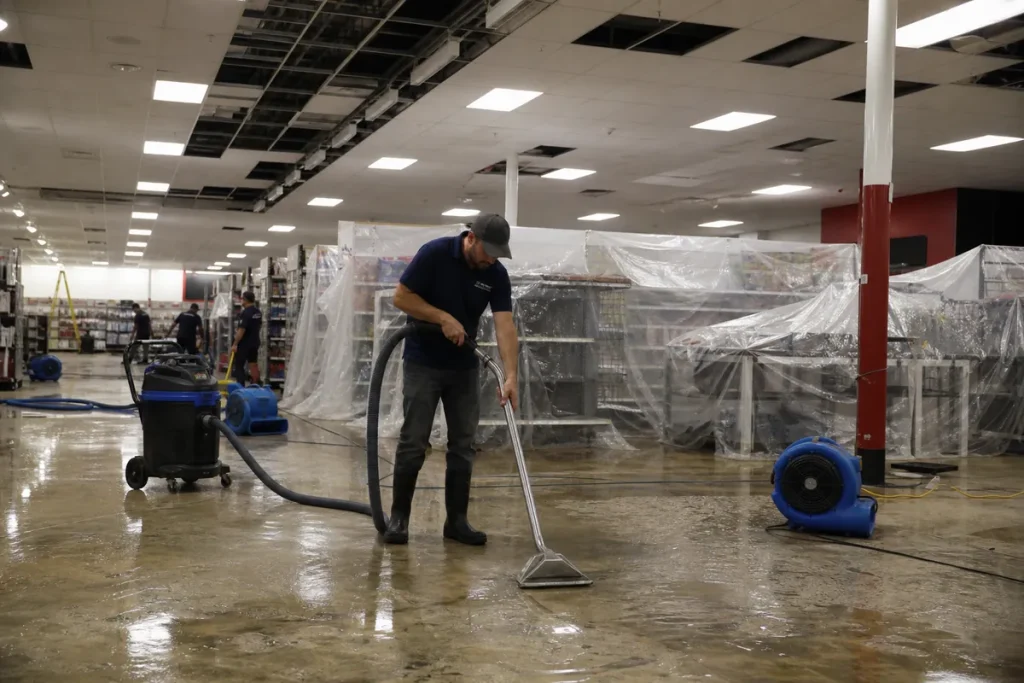
Most retail losses surface at open or are caught by an alarm or a neighboring tenant overnight, so the response window is tight against the next business day. When you call, we walk your manager through shutting off water at the fixture or main, and we dispatch immediately with extraction equipment. The priority is pulling standing water off the sales floor and out of the stockroom before it spreads into more merchandise and wicks up display fixtures and walls.

We contain the affected zone so that, where possible, part of the store can reopen while we dry the rest, and we work to protect fixtures, point-of-sale equipment, and signage that are expensive to replace and slow to reorder. For a store in a mall or busy center, a fast, contained response also limits the visual disruption that makes shoppers walk past, which matters as much as the drywall.
Retail Store Water Damage - Louisville KY

Commercial Extraction and Fixture-Conscious Drying

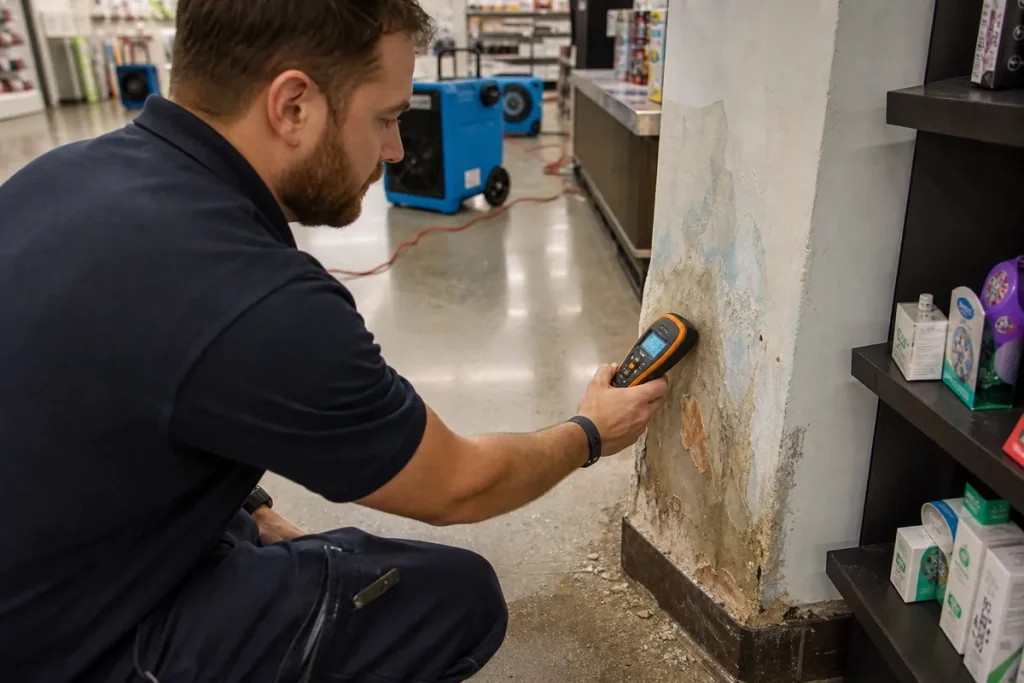
Retail drying has to protect the finishes and fixtures that make the space sellable, so it is more surgical than a warehouse job. We extract with truck-mounted and portable units, then deploy low-grain refrigerant (LGR) dehumidifiers to dry the space. For saturated wall cavities behind fixtures and slatwall, and for the cavities above dropped ceilings, we use injection and cavity drying to dry the structure without ripping out finished walls and built-in displays wherever the materials allow. Saving the buildout is saving reopening time and capital.

Air movers create the surface airflow that lifts moisture off the floor, fixtures, and walls, and for dense flooring such as polished concrete or tile over mortar we bring desiccant dehumidification to reach the low humidity those materials need. The ANSI/IICRC S500 standard guides our equipment ratios and dry-standard verification, and we check with moisture meters before calling any surface dry. We run the equipment to minimize disruption to any portion of the store still operating, and we monitor daily so you get an accurate count of hours to full reopen.

Call (502) 200-6968

The Landlord-Tenant Question and Lease Documentation

Retail water claims frequently turn on a single question: whose loss is it? In a multi-tenant center, a roof or common-area plumbing failure is typically the landlord’s responsibility, while a failure inside the leased premises may be the tenant’s, and the lease and the commercial property policy define the line. From arrival we document the source of loss precisely, including whether water originated in the common ceiling space, a neighboring tenant, the roof, or within your premises, because that determination drives who pays and which policy responds.

We produce the scope and estimate in Xactimate, coordinate with your carrier’s adjuster and, where relevant, the landlord’s, and keep your tenant-improvement and merchandise documentation separated so costs allocate cleanly. For a retail tenant, having an independent, dated record of the source and category of loss is the strongest protection against being stuck with a bill that belongs to the landlord or a neighbor.

Documentation, Insurance, and Business Continuity

Retail policies typically cover the structure or tenant improvements, the inventory, and business interruption for lost sales days. Each needs documentation. We record source and water category, photograph and log affected merchandise and fixtures, document moisture readings and equipment run times, and maintain a dated record of when the sales floor went offline and when it reopened, which is what supports the business interruption portion. We coordinate the adjuster relationship so your managers can focus on staff, reordering, and reopening.

Continuity for a retail store means the shortest path back to a sellable, presentable sales floor. We sequence the work to clear and dry the customer-facing area and the highest-value merchandise zones first, contain the rest, and give you a projected reopen date you can use to schedule staff and communicate with the landlord and mall management. Bear Restoration serves retail tenants across the Louisville metro, including Bardstown Road, Frankfort Avenue, the Highlands, Shelbyville Road and Oxmoor area centers, downtown storefronts, and Jeffersonville. For multi-location retailers, see our property management restoration services and our commercial extraction team.

Call Bear Restoration for Retail Store Water Damage

A closed storefront loses sales and a wet sales floor loses merchandise, so the response has to protect both fast. Bear Restoration brings merchandise triage, fixture-conscious drying, precise source documentation for the landlord-tenant question, and adjuster-ready records to Louisville retail tenants, sequenced to get your customer-facing floor reopened first. Call (502) 200-6968 any hour for emergency retail water damage mitigation across the Louisville metro.


Call (502) 200-6968

Frequently Asked Questions

It usually depends on the source and the lease. A roof leak, rooftop HVAC failure, or a neighboring tenant’s plumbing in the common ceiling space is typically the landlord’s responsibility, while a failure inside your leased premises may be yours. We document the precise source on arrival so the determination is based on evidence, not argument.

Some of it, depending on the goods and how fast we respond. Apparel and textiles can sometimes be recovered if dried and cleaned quickly, while saturated paper goods and packaging are usually a loss. We triage and document affected merchandise in the first hours, which is where the largest dollars in a retail claim are decided.

Often yes. We contain the affected zone and sequence the customer-facing area first so that, where the layout allows, you can reopen part of the floor while we dry the rest.

Not if we can avoid it. We use injection and cavity drying to dry walls and ceiling spaces without removing finished walls and built-in displays wherever the materials allow, because preserving the buildout saves reopening time and capital. Removal is only when materials are unsalvageable or the water is contaminated.

Most commercial retail policies include business interruption coverage, but the claim depends on a dated record of when the sales floor went offline and reopened. We maintain that record along with merchandise and fixture documentation so your adjuster can value the loss.