How Warehouses Flood in Louisville’s Climate and Corridor
The most common large-warehouse loss is the roof. Low-slope membrane and built-up roofs over big-box distribution space pond water, and Louisville’s heavy spring and summer storms, including the derecho-type wind events that periodically tear through the Ohio Valley, lift seams and flashings and open the roof to thousands of gallons in a single storm. Water enters at the high bay, runs along structural members, and rains down onto racking and palletized product across a wide area. By the time staff notice ceiling drips, product on the top racks may already be soaked.
Fire-suppression systems are the second major source. Large warehouses use ESFR (early suppression, fast response) sprinkler systems designed to dump enormous volumes of water quickly to control a fire among combustible storage. A single accidental ESFR head activation, often from a forklift strike to a head or a pipe, releases far more water than a standard system, and the design intent is volume. The result is rapid, widespread flooding of the floor and any product staged beneath the activated heads.
Slab and groundwater events round out the picture. Louisville’s proximity to the Ohio River and its high water table mean that low-lying industrial areas near Riverport experience hydrostatic pressure and slab moisture intrusion during high-river periods and heavy rain. Loading docks and dock-leveler pits flood, and water migrates across the slab into staging areas. In winter, freeze-thaw bursts the exposed wet-system piping that runs through unheated high-bay space, and a burst line over a storage aisle can run for a long time before anyone in a quarter-million-square-foot building notices.
Inventory Triage in the First Hours
In a warehouse, the building can wait but the product cannot. Our first move alongside extraction is inventory triage with your operations team: identifying what is wet, what is salvageable, and what has to be documented and removed. Cardboard and corrugated packaging wick water fast and lose structural integrity, so palletized goods in compromised packaging often need repackaging or disposal even when the product itself is fine. Electronics, paper goods, food product, and pharmaceuticals each have their own salvage thresholds and their own documentation requirements for an insurance claim.
We photograph and log affected inventory by location and SKU where your WMS allows, because a documented inventory loss is a recoverable claim line item and an undocumented one is an argument. Moving dry product out of the migration path and getting it to a safe staging area is often the single most valuable thing that happens in the first hour, and we coordinate that with your forklift operators rather than working around them.
After-Hours Mitigation at Scale
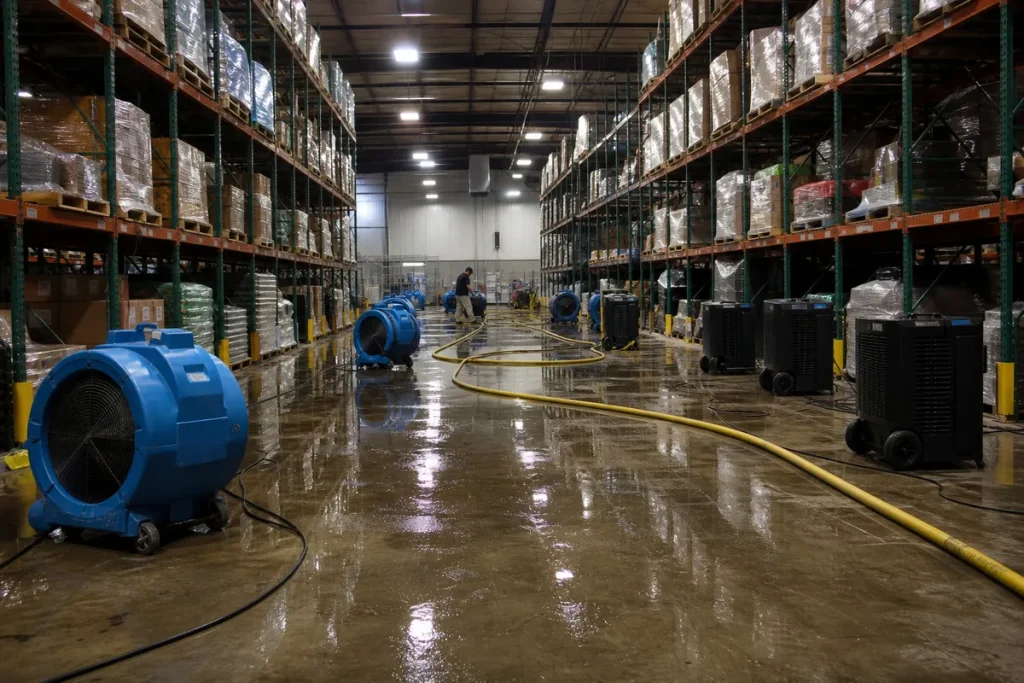
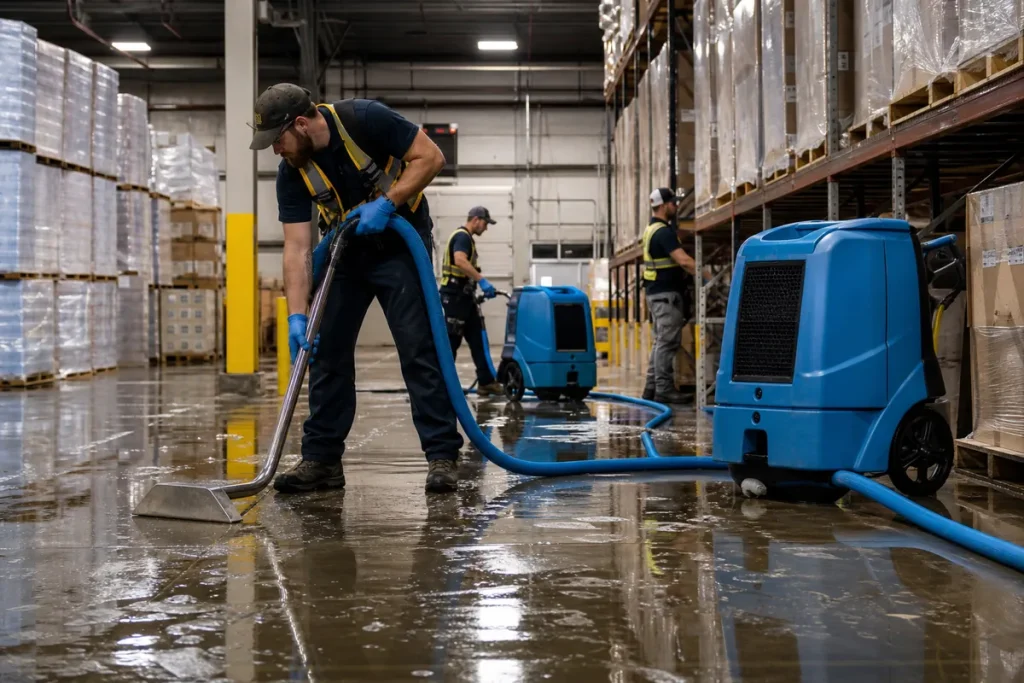
Distribution centers run around the clock or close to it, so a loss can happen mid-shift or in the gap between shifts when the floor is thin. When you call, we coordinate with your facilities team to shut the sprinkler riser or the failed supply, and we mobilize a crew and equipment package sized to a large-footprint loss, which is a different mobilization than a typical commercial call. The first priority is extraction and containment: pulling standing water off the slab and isolating the wet zone so operations in the rest of the building can continue.
Because the affected area in a big warehouse is often only a fraction of the total floor, the right containment lets you keep shipping from the unaffected zones while we dry the rest. We set up so forklift traffic and dock operations route around the work area safely, and we keep your facilities manager updated on the drying footprint so the operations plan can adjust day by day.