Professional Water Extraction From Flooded Basement in Louisville

A flooded basement in Louisville is rarely a single-cause water damage event. Between Ohio River backflow during high-water years, freeze-thaw pipe ruptures in January, sump pump failures during summer derecho events, and the slow seepage Old Louisville’s 1880s limestone foundations have been doing for 140 years, the basement is the lowest point of failure in almost every home in Jefferson County. 

That combination matters because a flooded basement is rarely just a water problem. By the time the homeowner calls, it is usually a Category 2 or Category 3 water damage contamination event with secondary microbial growth already underway in the wall cavities.

This page covers what flooded basement cleanup actually involves, how the IICRC S500 standard governs the work, the equipment and drying science we deploy, what insurance will and will not cover, and the specific failure patterns we see across Louisville neighborhoods. If your basement is actively flooding right now, call (502) 200-6968 and skip to the emergency section below.

Unfinished vs Finished Basement Flooding in Louisville, KY

When a basement floods, the extent of the damage and how water spreads throughout the space largely depend on whether the basement is unfinished or fully finished. 

In an unfinished basement, water damage typically spreads across the concrete slab and begins absorbing into the porous surface. Concrete and block walls hold moisture internally, especially at seams, cracks, and wall-floor joints. Even after the water is pumped out, moisture remains trapped inside the slab and block cavities. Wood framing, sill plates, and anything stored on the floor can absorb that moisture, and because basements naturally stay cooler and more humid, drying takes longer if not handled with proper dehumidification and airflow control.

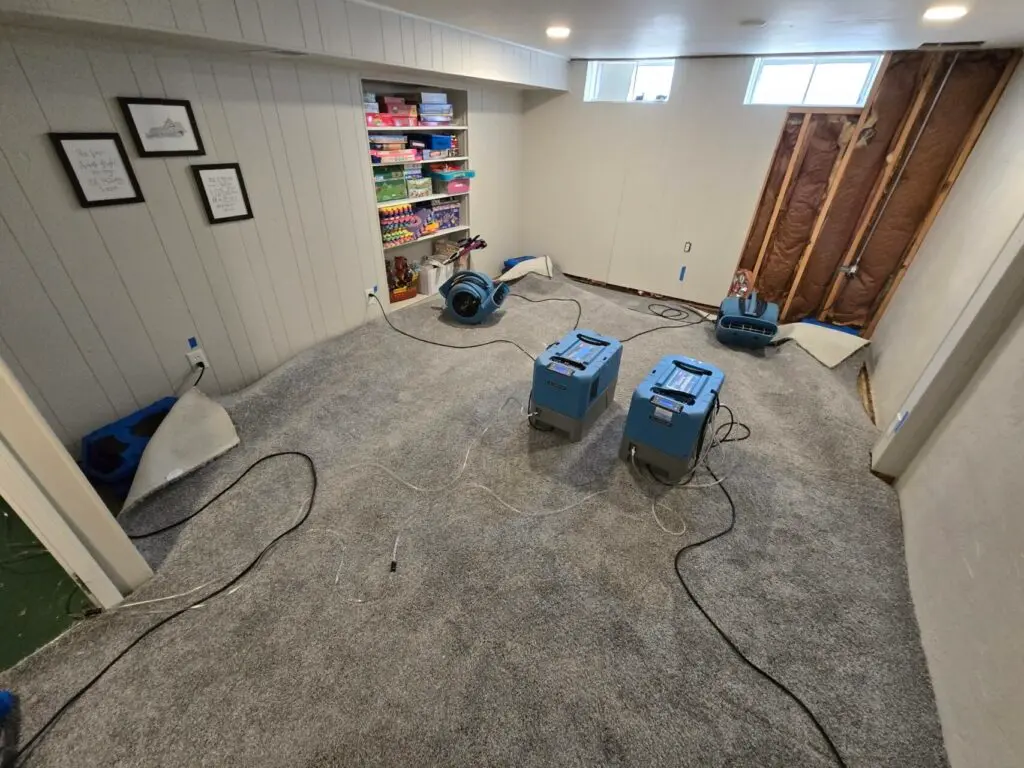
In a finished basement, the situation becomes far more complex. Water doesn’t just sit on the surface—it gets pulled into drywall, insulation, baseboards, and flooring systems. Drywall can wick moisture upward, insulation traps it inside wall cavities, and flooring like carpet, laminate, or vinyl can hold water underneath even when the surface appears dry. This creates hidden moisture pockets behind walls and under floors, which are prime conditions for mold growth if not properly opened and dried. What looks like a small amount of water on the floor is often a much larger issue behind the scenes, requiring controlled demolition, cavity drying, and full moisture verification before the space can be safely restored.

call (502) 200-6968
Emergency Sewage Cleanup and Basement Restoration in Shively, KY
Basement Water Heater Leak 3 Louisville KY
Residential Basement Water Leak Response & Reconstruction in Hurstbourne, KY

Our Flooded Basement Cleanup Process

Step 1: Find the Source and Check Safety Risks

We first identify where the water damage came from, whether it was a sump pump failure, heavy rain intrusion, burst pipe, sewer backup, or a foundation leak. This matters because clean water, groundwater, and sewage-contaminated water all require different cleanup procedures. We also check for electrical hazards, wet appliances, damaged outlets, and unsafe structural conditions before work begins.

Step 2: Remove Standing Water Fast

Once the area is safe, we use pumps and professional extraction equipment to remove standing water from the basement. In unfinished basements, this often means pumping water off the concrete slab and out of low spots. In finished basements, we also focus on carpet edges, flooring seams, closets, and wall lines where water collects and hides.

Step 3: Map Hidden Moisture

After the visible water is removed, we inspect the basement with moisture meters and thermal imaging to see where water traveled. Basement water often moves under flooring, into drywall, behind baseboards, inside block walls, and along the wall-floor joint. This step prevents hidden moisture from being missed after the space looks dry.

Step 4: Remove Unsalvageable Materials

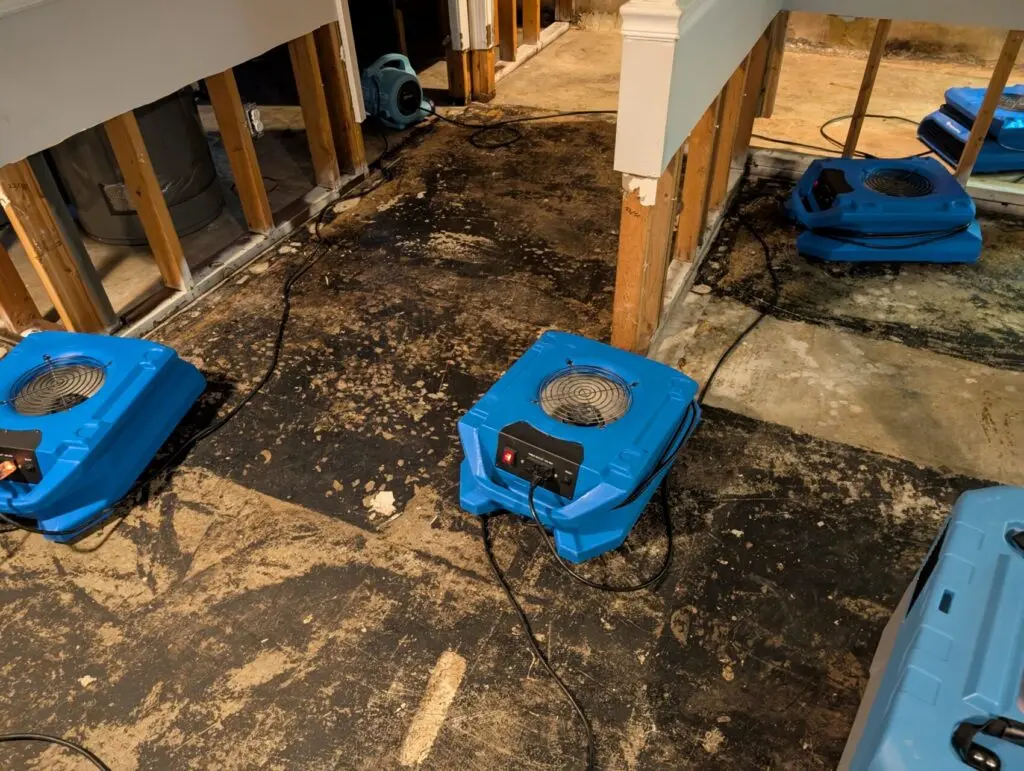
If carpet padding, drywall, insulation, baseboards, or flooring are too saturated, they may need to be removed. In finished basements, wet insulation and drywall can trap moisture inside wall cavities and create mold risk. We remove only what is necessary so the structure can dry properly without unnecessary demolition.

Step 5: Set Up Professional Drying Equipment

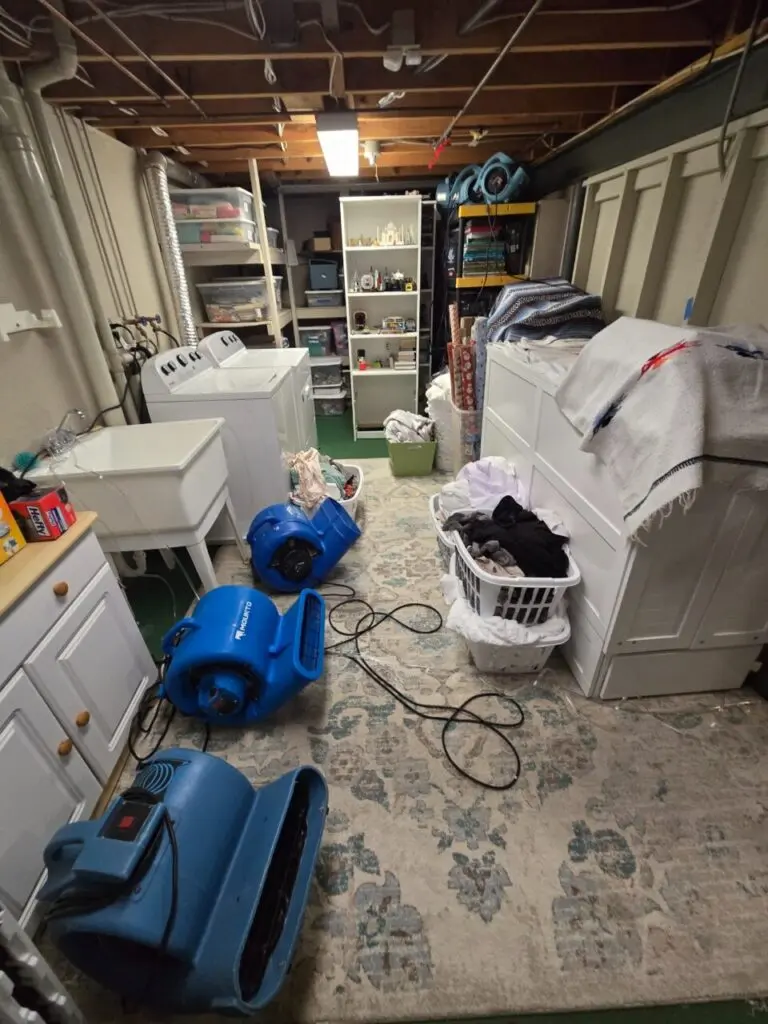
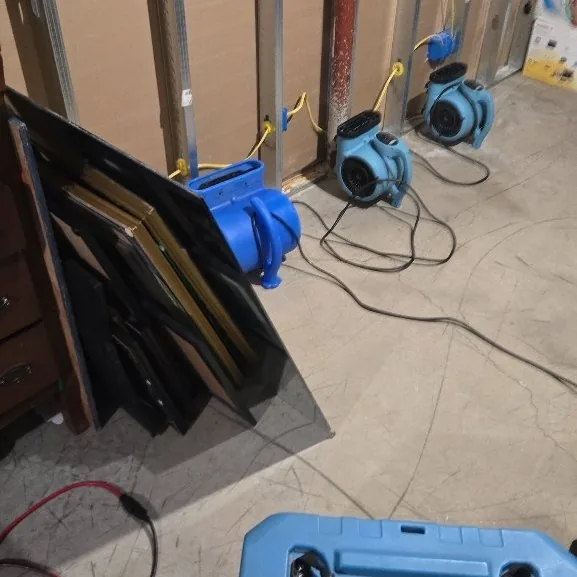
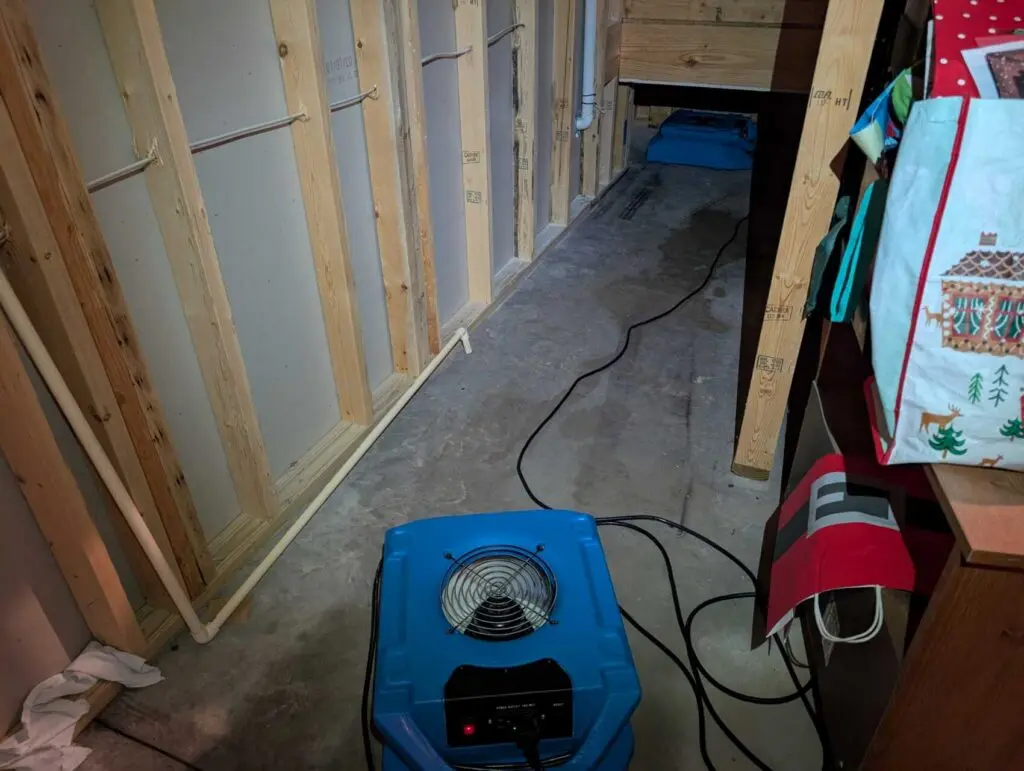
We place commercial air movers and dehumidifiers based on the size of the basement, the materials affected, and how far the water spread. Air movers push moisture out of wet surfaces, while dehumidifiers pull that moisture from the air. This creates a controlled drying environment instead of simply blowing air around the room.

Step 6: Dry Walls, Floors, Concrete, and Framing

Basements dry differently than upstairs rooms because concrete, block walls, and lower-level framing hold moisture longer. In finished basements, we may direct airflow into wall cavities and under flooring edges. In unfinished basements, we focus on the slab, block walls, sill plates, framing, and other areas where moisture can linger.

Step 7: Monitor Moisture Daily

Drying is measured, not guessed. We track humidity, temperature, and moisture levels in affected materials each day. If an area is not drying correctly, we adjust equipment placement, increase dehumidification, or open additional areas to improve airflow.

Step 8: Treat Odors and Reduce Mold Risk

Once the basement is drying, we clean affected areas and apply antimicrobial treatment when needed. This helps reduce microbial growth risk and address musty odors at the source. HEPA air scrubbers may also be used if demolition dust, odor, or air quality concerns are present.

Step 9: Verify the Basement Is Fully Dry

The job is not finished just because the floor looks dry. We confirm that drywall, framing, concrete, flooring, and other affected materials have returned to safe moisture levels. Final moisture verification is especially important before rebuilding a finished basement.

Step 10: Restore the Basement

After the space is dry and safe, repairs can begin. This may include replacing drywall, trim, flooring, insulation, and other damaged materials. The goal is to return the basement to a clean, dry, stable condition without trapping moisture behind new finishes.

Basement room with gray carpet drying equipment and partially removed wall paneling.

Why Basements Flood So Easily In Louisville, KY

If you’ve lived in Kentucky long enough, you already know—our weather and our soil don’t always play nice together. We get heavy rains, quick temperature swings, and a lot of homes built decades ago with systems that weren’t designed for today’s conditions.

Most basement floods we see come from:

  • Sump pumps quit during a storm
  • Water is pushing in through the foundation cracks
  • Gutters and downspouts are not moving water far enough away
  • Sewer systems are getting overloaded
  • Groundwater rising after long rain stretches

And once water gets in, your basement is the first place it’s going to settle. That’s just how these homes are built.

call (502) 200-6968

Is the water in my basement clean, gray, or black?

This is the question that determines what can stay and what has to go. The IICRC S500 standard classifies water into three categories, and a flooded basement can involve any of them depending on the source.

If the water came from a clean supply line or a rain driven seep through a foundation wall, it usually starts as Category 1 clean water, and quick cleanup can save most materials. The catch is that basement floodwater rarely stays clean.

Once it pools on a slab, picks up dirt, sits overnight, or mixes with whatever was stored down there, it degrades into Category 2 gray water within roughly 48 hours. If the flooding came from a sewer backup through the floor drain, or from outdoor floodwater that ran across the ground before entering, it is Category 3 black water from the start, a biohazard that requires the protocols described on our sewage backup cleanup page. Porous materials that absorbed Category 3 water, including carpet, pad, and the bottom of drywall, are removed and discarded rather than dried. Identifying the category correctly protects your family’s health and prevents us from drying in contamination that should have been removed.

What Do We Typically See When A Basement Floods in Louisville?

In a typical Louisville home, a sump pump fails overnight during a heavy storm, leaving a few inches of water across the basement floor by morning. What looks manageable at first—wet carpet, some standing water—has already spread deeper than you can see. In the unfinished areas, the concrete slab and block walls are holding moisture internally, slowly releasing it back into the air. In the finished sections, water has wicked up drywall, soaked insulation, and slipped under flooring, creating hidden moisture pockets behind walls.

Within 24 hours, humidity spikes and that damp, musty smell starts creeping in. If it’s not properly dried, mold can begin forming inside those wall cavities within a couple of days. What seems like a simple cleanup quickly turns into a much bigger water damage emergency if the moisture isn’t fully found and removed.

Need Flooded Basement Cleanup in Louisville? Let’s Get It Handled.

If your basement’s flooded, don’t sit on it hoping it dries out. It won’t—not the way it needs to. Emery and the team are out helping folks across Louisville, plus Jeffersontown, St. Matthews, Middletown, Prospect, and even across the river in Jeffersonville.

Give us a call—24/7! We’ll get the water out, dry it down, and get your basement back to normal without dragging it out or cutting corners.

Flooded Basement Cleanup in Louisville, KY – FAQ

Not always. Clean water from a pipe is less hazardous at first, but groundwater or sewage is contaminated. Even clean water can become unsafe if it sits too long.

It depends on how saturated it is. Lightly affected drywall may be dried, but heavily soaked drywall and insulation usually need removal to prevent mold.


Sometimes, if the water is clean and removed quickly. However, carpet padding is usually replaced because it traps moisture and bacteria.

Fans help with surface drying but won’t remove moisture trapped inside walls, floors, or concrete. Professional equipment is needed for full drying.

Absolutely. Our team is on standby for same-day and after-hours basement flooding emergencies across Louisville. We bring pumps, extractors, and drying equipment to start immediately.

Even one inch of standing water is enough to destroy carpet padding, wick moisture 12–18 inches up drywall through capillary action, and begin saturating the bottom plate of wall framing. At two inches, laminate and engineered flooring start to delaminate. At six inches, electrical outlets and HVAC returns are submerged, creating safety hazards and contamination.

The depth matters less than the duration. Water sitting for 48 hours or more causes significantly more material loss than the same depth removed within hours.

Most basement flooding comes from sewer backup, sump failure, or surface water intrusion—all classified as Category 2 or Category 3 water, meaning they contain bacteria, chemicals, or sewage. Even if the water appears relatively clear, dissolved organic matter and microorganisms begin producing hydrogen sulfide and other volatile compounds within hours.

This is why professional extraction includes antimicrobial treatment of all affected surfaces, not just removing the visible water. Odor control requires eliminating the source bacteria, not masking the smell.