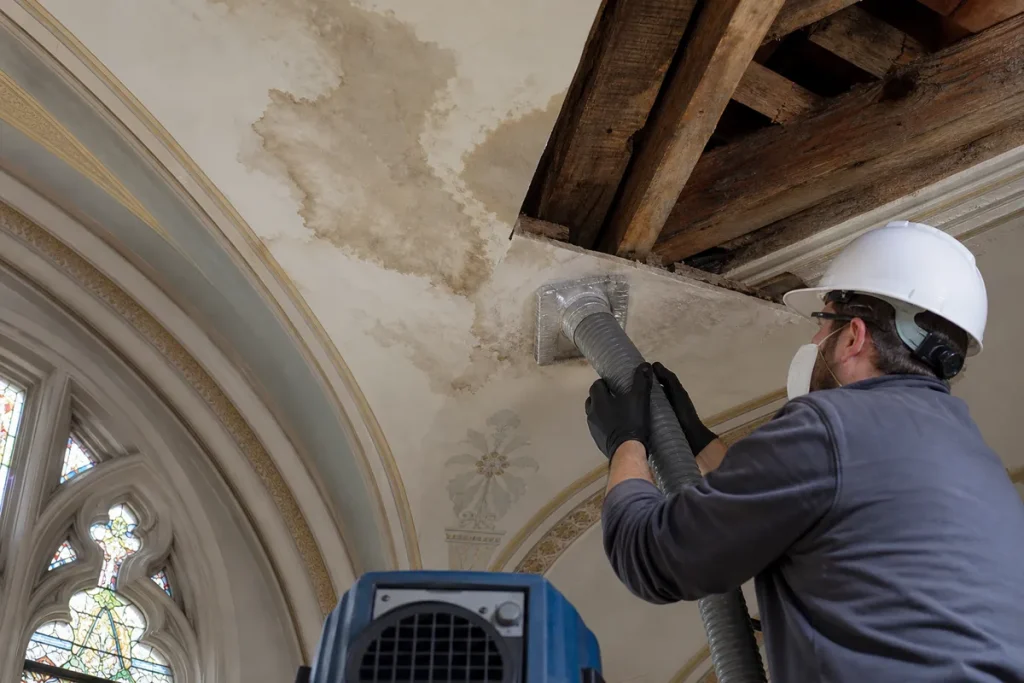
Church Water Damage - Louisville KY

A church water loss is rarely just a building loss. It is often a loss to something irreplaceable: a historic sanctuary, a pipe organ, hand-laid millwork, stained glass surrounds, plaster ceilings, a hardwood fellowship floor, or decades of records and instruments stored in a basement. Churches also operate on tight budgets with volunteer leadership, so the response has to be both careful with the historic fabric and honest about cost. Louisville is a city of old congregations, and many of its churches are masonry buildings a century old or more, with materials no longer made and details that cannot be replaced with a trip to the supply house. Bear Restoration, owned by Emery, holds IICRC WRT, ASD, and AMRT certifications and has restored houses of worship across the Louisville metro, including the historic congregations of Old Louisville and the urban core. Our 24/7 line is (502) 200-6968.

What a church needs is a restoration approach that prioritizes preservation over demolition, treats the building’s history as the asset it is, and works with a board and a budget rather than against them.

Call (502) 200-6968

How Churches Flood in Louisville

Roofs are the leading source, and church roofs are uniquely vulnerable. Steep slate and tile roofs, bell towers, steeples, and the complex valleys and flashings of an old sanctuary all fail with age, and Louisville’s heavy Ohio Valley storms and derecho-type wind events drive water through compromised flashing into the structure below. Water enters at the roof or tower and travels down through plaster ceilings, into the sanctuary, and onto floors, pews, and finishes. Because many of these spaces are tall and only occasionally occupied, a leak can saturate plaster and structure before anyone is in the building to notice.

Aging plumbing is the second major source. Century-old churches have galvanized and cast-iron supply and drain lines that corrode and fail, often in restrooms, baptistries, or kitchen and fellowship-hall areas, and a failure can release water into finished spaces below. Winter freeze-thaw is especially harsh on churches, because these buildings are large, hard to heat evenly, and frequently set back to minimal heat between services, which is exactly the condition that bursts supply lines in exterior walls and unheated towers and attics during a cold snap.

Basement and ground-water intrusion rounds it out. Old Louisville churches often have basement fellowship halls, classrooms, and archive storage, and these below-grade spaces take on water during high-rain periods and from foundation seepage in old masonry. The basement is frequently where a congregation stores its records, its choir robes and music, and its history, which makes a basement flood a loss of memory as much as material.

Preservation First: Why Church Drying Is Different

The defining principle of church restoration is that you dry to save, not gut to replace, because the materials often cannot be replaced. Old-growth wood pews and millwork, lath-and-plaster ceilings, original hardwood floors, and historic finishes respond to drying very differently than modern gypsum and engineered materials, and aggressive demolition destroys value that careful drying preserves. We approach a historic sanctuary with controlled, monitored drying that brings these materials back gradually, using the ANSI/IICRC S500 standard as the framework while adjusting for the slower, gentler drying that antique wood and plaster require.

Wood and plaster dried too fast crack, cup, and split, so we control the rate. We use moisture meters calibrated for wood to track pews, flooring, and millwork as they release moisture, and we keep the environment within a range that dries the material without shocking it. Pipe organs, pianos, and historic instruments demand particular care, because they are sensitive to both moisture and rapid humidity change, and we stabilize the environment around them rather than forcing them dry. The whole philosophy is patience in service of preservation, which is the opposite of the rip-and-replace approach that works on a modern office.

After-Hours Mitigation for Houses of Worship

Church losses are often discovered by a volunteer, a custodian, or a member arriving for a service or a meeting, and the building may have been empty for days. When the call comes, we coordinate to shut water at the main or fixture and dispatch a crew, and the first priority is extraction and protecting the irreplaceable: moving water away from the organ, the altar area, historic furnishings, and any archive or record storage, then pulling standing water before it spreads into more of the historic fabric.

We work around the worship schedule wherever possible, sequencing the sanctuary so a congregation can return for services while we continue work in contained areas, and we treat the building with the respect a sacred space deserves. For a congregation, continuity of worship matters as much as the building repair, and we plan the work to disrupt services as little as the loss allows.

Church Water Damage - Louisville KY

Commercial Extraction and Controlled Drying for Historic Structures

Drying a tall, masonry, historically finished building requires the right equipment used with restraint. We extract with truck-mounted and portable units, then deploy low-grain refrigerant (LGR) dehumidifiers and, for large sanctuaries and dense masonry and plaster assemblies, desiccant dehumidification that can reach the low humidity those materials need while we control the rate. The tall volume of a sanctuary is its own challenge, because moisture rises and collects high in the space, so we set equipment to manage the full vertical volume rather than just the floor.

Air movers create gentle, directed airflow rather than the high-velocity drying that would stress antique surfaces, and where water sat long enough to risk microbial growth in plaster, wood, or basement materials we set up HEPA-filtered negative air and remediate under the S520 standard with EPA-registered antimicrobials. For wall and ceiling cavities behind historic plaster, injection and cavity drying lets us dry the structure without destroying irreplaceable finishes. We monitor with moisture meters throughout and verify the material has reached dry standard before calling the space restored, because a church dried too fast or not fully is a church damaged twice.

Call (502) 200-6968

Documentation, Insurance, and Working With a Board

Churches typically carry commercial property policies, sometimes through denominational or specialty insurers familiar with historic structures, and the documentation has to support a claim that may include irreplaceable or specially valued items. From arrival we record the source and category of loss, moisture readings throughout, photographs of all affected areas and furnishings, and equipment logs, and we produce scopes and estimates in Xactimate for the carrier’s adjuster. Where historic or specially insured items are affected, we document their condition carefully for the appraisal portion of the claim.

We understand that churches make decisions through boards, councils, and volunteer leadership on limited budgets, so we communicate clearly, explain the preservation-versus-replacement tradeoffs in plain terms, and coordinate the adjuster relationship so the leadership is not buried in claim mechanics. Where a roofing defect or a failed component caused the loss, we preserve evidence for any subrogation the carrier may pursue. A church’s restoration is a stewardship decision as much as a repair, and we treat the congregation’s resources accordingly.

Business Continuity for the Congregation

Continuity for a church means worship continues and the building’s history survives. We sequence the work to return the sanctuary and worship-critical spaces first where possible, contain ongoing work so services and ministries can proceed, and give the leadership a projected timeline per space so the calendar of services, programs, and events can be planned with real information. For a congregation, knowing when the sanctuary will be back is as important as the drying itself.

Bear Restoration serves churches, temples, and houses of worship across the Louisville metro, including Old Louisville, the urban core, the South End, the East End, and Jeffersonville. We bring a preservation-first approach to historic congregations and a respect for the building’s meaning to the work. For related historic and large-structure work, see our commercial extraction services and our multi-building restoration coverage.

Call Bear Restoration for Church Water Damage

A church loss can be a loss of history, so the response has to preserve, not just repair. Bear Restoration brings preservation-first controlled drying, care for organs and historic finishes, HEPA containment where mold is a risk, and documentation that supports a historic-structure claim to Louisville houses of worship, sequenced to keep worship going. Call (502) 200-6968 any hour for emergency church water damage mitigation across the Louisville metro.


Call (502) 200-6968

Frequently Asked Questions

Often yes, with controlled drying. Old-growth wood and plaster respond to gentle, monitored drying that brings the moisture out gradually without cracking or cupping, which is the opposite of aggressive demolition. We use wood-calibrated moisture meters to track these materials and dry to save rather than gut to replace.

Organs and historic instruments are sensitive to both moisture and rapid humidity change, so we stabilize the environment around them rather than forcing them dry. Protecting the organ and other irreplaceable furnishings is among the first priorities when we arrive, and we control the drying rate to avoid shocking them.

It depends on how saturated and how long, but rapid response improves the odds significantly. We prioritize moving and protecting records, robes, music, and stored history in the first hours and stabilize the basement environment to limit further damage. The faster we reach archive storage, the more can be saved.

We sequence the sanctuary and worship-critical spaces first where possible and contain ongoing work so services and ministries can continue, and we work around the worship schedule. We give leadership a projected timeline per space so the calendar can be planned with real information.

We communicate in plain terms, explain the preservation-versus-replacement tradeoffs so the board can make informed stewardship decisions, and coordinate the insurance adjuster relationship so volunteer leadership is not buried in claim mechanics. Documentation is structured to support the claim, including any specially insured historic items.