Why Louisville Hotels Face Specific Water Risks
Louisville’s hotel stock spans a wide age range, and each era brings its own failure pattern. The older properties downtown and in Old Louisville often have cast-iron and galvanized supply lines that corrode from the inside, eventually pinholing behind walls on upper floors. When that happens above an occupied room, the first sign is frequently a stained ceiling tile two floors down, which means water has already been migrating through the assembly for hours or days. Newer limited-service properties near the airport and along the I-264 corridor tend to use PEX and copper, but they pack mechanical rooms, ice machines, and stacked bathroom plumbing into tight chases, so a single failed supply line floods multiple stacked units at once.
Fire sprinkler discharge is the loss type that catches hotel operators most off guard. A single activated sprinkler head delivers between 18 and 26 gallons per minute under NFPA 13 design standards. If a head is knocked off by a luggage cart or activated by a small in-room fire, a corridor can take on hundreds of gallons before the system is shut down at the riser. That water is also pressurized and dispersed widely, so it does not pool neatly. It saturates corridor carpet, runs under door sweeps into guest rooms, and finds the floor penetrations around plumbing stacks. More often than not, the fire itself is minor and the water is the real damage.
Winter is its own category here. Louisville’s freeze-thaw cycles routinely burst supply lines in exterior walls and in unconditioned spaces above top-floor rooms. A hotel that drops its heat in a vacant wing to save energy can return from a cold snap to a burst line that ran all night. Because the property was closed off, nobody hears it, and the water has hours to spread.
Downtime Minimization: Drying in Place, Returning Rooms in Waves
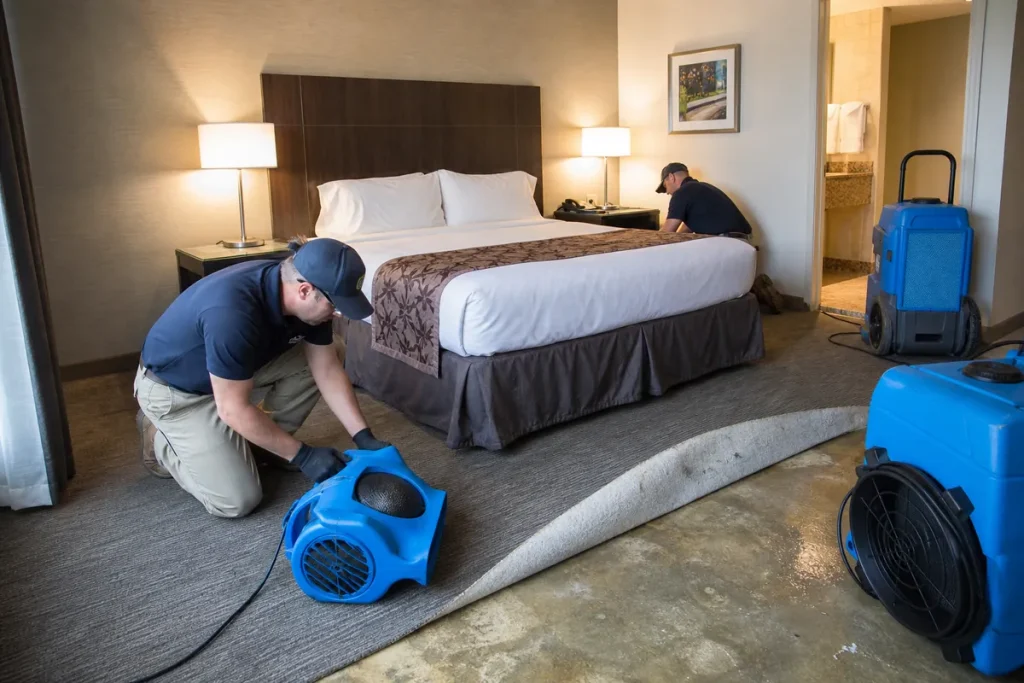
Our priority on every hotel job is keeping as many rooms in sellable inventory as possible while we dry the affected ones. That starts with rapid extraction. Before any dehumidifier runs, we pull standing water with truck-mounted and portable extraction units, because every gallon we physically remove is a gallon the drying equipment does not have to evaporate. On carpeted guest-room floors, we use weighted extraction tools that compress the carpet and pad to pull bound water that a wet-vac leaves behind. Removing 90 percent of the water mechanically rather than through evaporation can cut total dry time by days.
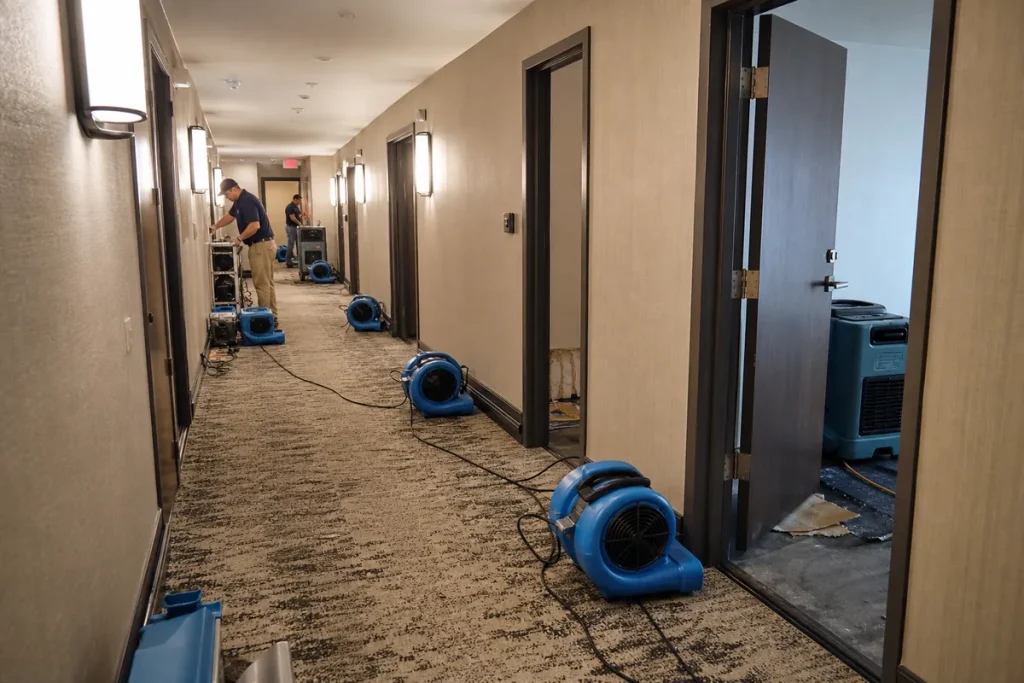
Next we map the moisture. Using thermal imaging cameras and penetrating moisture meters, we identify exactly which rooms and which wall cavities are wet, rather than assuming the whole floor is compromised. In practice, a fourth-floor supply break might only affect six rooms in a vertical column plus the corridor, while the rest of the floor is dry and can stay open. We isolate the wet rooms behind containment, set up drying, and let the front desk keep selling the rest.
Then we stage the return. Rooms dry at different rates depending on how much water reached them, so we re-inspect with moisture meters daily and hand back rooms to housekeeping the moment they hit dry standard, rather than waiting for the entire affected area to finish. This wave-based return is the single most important thing a restoration contractor can do for a hotel’s bottom line, and it is the part national franchises most often get wrong by treating the whole floor as one undifferentiated project.
After-Hours Mitigation and the First-Hour Response
Hotel losses cluster at night and on weekends, which is exactly when in-house maintenance is thinnest. The first hour determines how big the job becomes. When you call, we walk your night manager through shutting off water at the riser or the affected fixture’s stop valve, moving the sprinkler riser to the off position if a head has discharged and the fire department has cleared the scene, and protecting electronics and luggage in affected rooms. We dispatch a crew with extraction equipment immediately, because the difference between a two-hour response and a six-hour response is often the difference between drying a room and demolishing it.
We coordinate directly with your night audit and engineering staff so guests can be relocated cleanly. A water loss is a guest-experience event as much as a building event, and a calm, fast response protects your reviews as much as your drywall. We work quietly, contain the work zone, and keep corridors passable for the guests still in house.