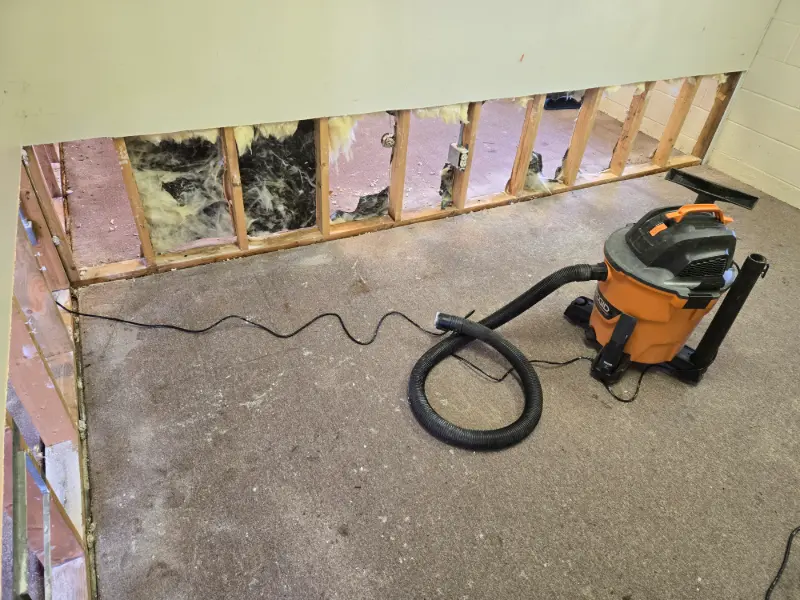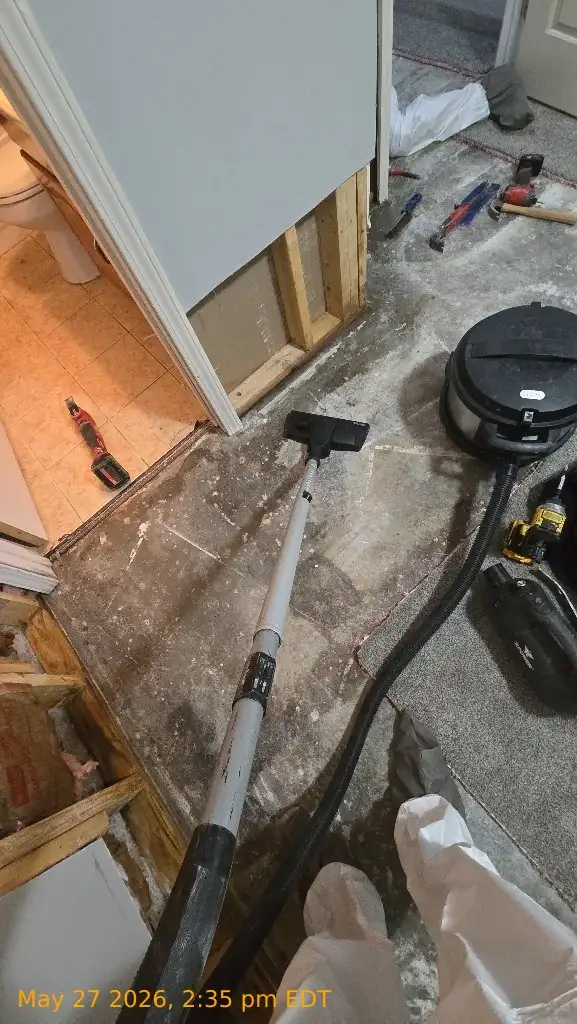
What is structural drying and why isn’t air drying enough?

Structural drying is the controlled removal of moisture that has been absorbed into a building’s materials after a water loss. After standing water is extracted, what remains is bound moisture held inside the pores of drywall, wood, concrete, and insulation, and that moisture does not leave on its own at any useful speed. The IICRC S500 standard describes drying as a process of creating the right conditions for evaporation and then continuously removing the evaporated moisture from the air.

Opening windows and running a household fan fails because it does not control the variables that drive evaporation. Drying depends on the relationship between temperature, humidity, and airflow, often summarized through psychrometrics, the study of moist air. Evaporation only happens when the air near a wet surface is drier than the surface itself. A fan moves air, but if that air is already humid, as Louisville air frequently is, the moisture has nowhere to go and the surface stays wet. Professional drying works by combining air movement to speed evaporation off surfaces with dehumidification to pull that evaporated moisture out of the air, lowering the humidity so the next round of evaporation can occur. It is a balanced system, and removing any one part of it stalls the whole process.

Call (502) 200-6968
structural drying services

How do you know when a structure is actually dry?

By measurement, not by feel. Every material has a normal moisture content for its environment, and the goal of structural drying is to return wet materials to that baseline, known as the dry standard. To establish it, technicians take moisture readings from unaffected materials of the same type elsewhere in the building, which sets the target the wet materials need to reach.

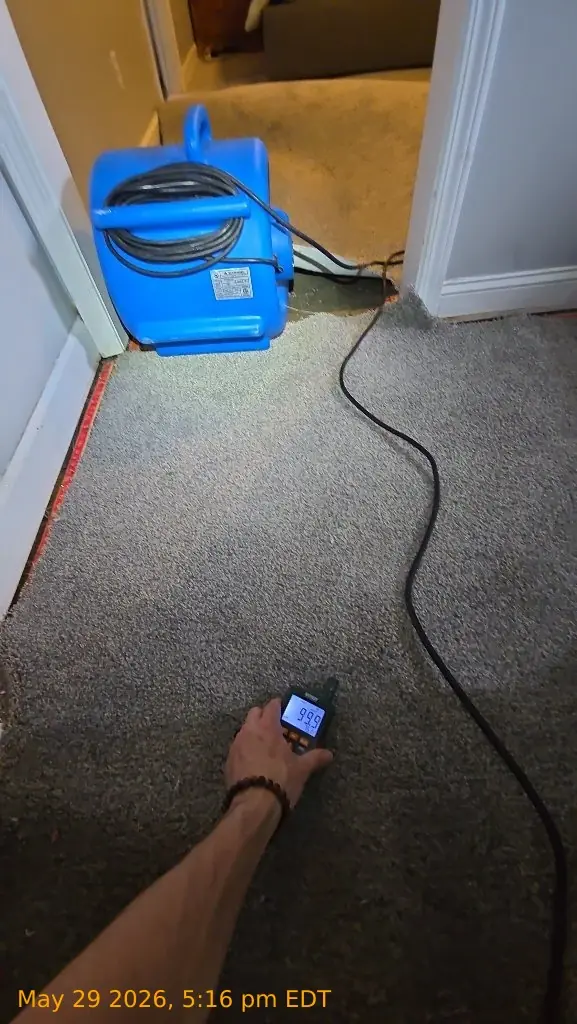
Throughout the drying process, we use penetrating and non-penetrating moisture meters to track the moisture content of affected materials and thermal imaging to locate moisture that has migrated out of sight. We also monitor the temperature and relative humidity of the air in the drying chamber, because those readings tell us whether the equipment is actually creating drying conditions. Materials are not considered dry because three days have passed or because they feel dry. They are considered dry when their measured moisture content matches the dry standard for that material in that building. This is the single most important difference between professional drying and a do-it-yourself attempt: the work is verified with numbers, and those numbers are documented for the record and the insurance claim.

Call (502) 200-6968
structural drying services

What Is the Dry Standard?

The dry standard is the normal moisture content for a given material in a particular building, established by measuring unaffected materials of the same type. Drying is complete when wet materials are returned to that baseline, which is how we confirm the structure is genuinely dry rather than just dry on the surface.

For example, drywall, wood framing, subflooring, and other building materials naturally contain some moisture even under normal conditions. A wood stud may have a normal moisture content between 8% and 14%, while drywall and other materials will vary depending on the property’s age, construction type, and indoor environment. The goal is not to make materials completely moisture-free. The goal is to return them to their normal equilibrium moisture content for that specific structure.

Without establishing a dry standard, there is no scientific way to determine whether a property has been properly dried. What appears dry on the surface may still contain enough hidden moisture to support mold growth, material deterioration, wood movement, odor development, or future restoration issues. The dry standard provides the measurable benchmark that allows restoration professionals to document successful structural drying and reduce the risk of long-term damage.

Call (502) 200-6968

What happens if a structure isn’t dried properly?

The consequences show up later, which is what makes improper drying so insidious. The most common outcome is mold. The EPA notes that mold can begin growing on damp materials within 24 to 48 hours, and a structure that was extracted but never properly dried gives mold exactly the sustained moisture it needs. The growth often takes hold inside wall cavities and under flooring where it is invisible until a musty odor or visible staining appears weeks after everyone thought the job was finished. At that point the homeowner faces mold remediation on top of the original loss, governed by the more demanding S520 standard.

Beyond mold, lingering moisture causes wood to warp, swell, and eventually rot, weakens adhesives and finishes, corrodes fasteners and metal components, and degrades the structural materials it sits in. Trapped moisture in framing and subfloor can compromise the integrity of the very structure that was supposed to be restored. All of this is avoidable, and avoiding it is the entire point of measured, verified structural drying. Drying done right the first time is far less expensive than the mold remediation and reconstruction that follow drying done wrong.

Reliable Drying Services

Professional Structural Drying You Can Trust

Structural drying services, using the latest equipment to ensure every part of your property is thoroughly dried. We begin with a full assessment to identify areas needing attention, then remove water with high-powered extraction tools. Once the water is removed, we use dehumidifiers and air movers to dry the area and ensure no moisture is left behind.

Throughout the process, we continuously monitor moisture levels to guarantee that all areas are completely dry and safe. This helps prevent further damage, protects your property’s structural integrity, and reduces the risk of mold growth. We also provide ongoing communication and updates to ensure you’re always informed. Our goal is to restore your property and protect it for the future. You can trust our team to provide timely, professional service, restoring your home or business, and giving you peace of mind throughout the entire process.

Call (502) 200-6968

Structural Drying FAQ

Fans move air but cannot lower humidity, and in Louisville’s humid climate the surrounding air is often too moist to accept more evaporation, so wet materials stay wet. Open windows can let humid outdoor air in and make things worse. Professional drying combines airflow with dehumidification to control the conditions that actually drive moisture out.

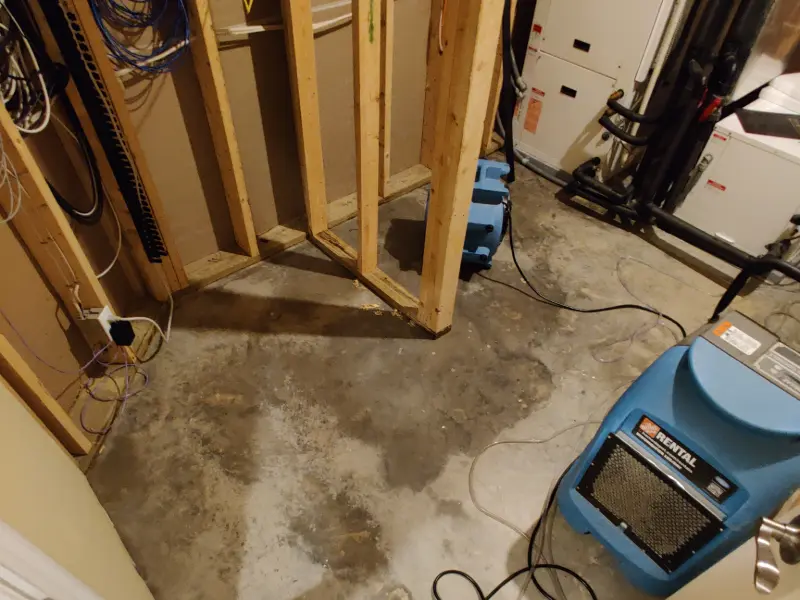
Our standard drying setup includes commercial LGR (low-grain refrigerant) dehumidifiers, high-velocity centrifugal air movers, axial fans for large open areas, and specialty tools like injectidry panels for wall cavities, floor mat systems for hardwood, and desiccant dehumidifiers for extremely low-humidity applications like pharmaceutical or archive facilities.

We also use data-logging thermo-hygrometers that record temperature, humidity, dew point, and grain depression every 15 minutes, giving us a complete picture of drying performance over time.

We use the IICRC S500 drying calculations, which factor in the volume of the affected space (length × width × height), the class of water loss (how much water is present in materials), ambient temperature, relative humidity, and the type of materials wet. A Class 2 loss (water wicking up walls less than 24 inches) in a 500 sq ft room requires different equipment density than a Class 3 loss (water saturating walls, ceilings, and insulation from above).

Undersizing equipment extends dry time and increases the risk of secondary damage. Oversizing wastes energy and money. Getting it right is a science, not a guess.

Grains per pound (GPP) measures the amount of water vapor in the air. Grain depression is the difference between the GPP of the air entering the dehumidifier and the GPP of the air leaving it. A higher grain depression means the dehumidifier is removing more moisture per cycle, which accelerates drying.

In Louisville’s summer, outdoor air can carry 100+ GPP. To dry building materials efficiently, we need to maintain indoor GPP below 40–50. LGR dehumidifiers achieve this even in the most humid conditions, which is why they are the industry standard for structural drying.

Most structural drying jobs take 3–5 days. Class 1 losses (small area, minimal absorption) can be dry in 2–3 days. Class 3 and Class 4 losses (water in ceilings, walls saturated from above, or dense materials like hardwood and plaster) can take 7–10 days or more.

We monitor daily with moisture meters and adjust equipment placement as the drying progresses. The job is not complete until every affected material reads at or below its IICRC dry standard—not when the surface feels dry to the touch.

In many cases, yes—if drying starts within 24–48 hours and the wood has not already cupped or buckled beyond recovery. We use specialty floor drying mats that create a sealed chamber over the floor surface. Warm, dry air is pulled through the system under negative pressure, drawing moisture out of the wood and subfloor without causing further warping.

Hardwood needs to return within 2–4% of its pre-loss moisture content (measured with a pin meter). If it does, the floor can be sanded and refinished rather than replaced, saving thousands of dollars.

Incomplete drying leads to secondary damage: mold growth (starting within 48–72 hours on wet materials), wood rot, delamination of engineered flooring, rust on metal fasteners and ductwork, and musty odors that persist for months. In severe cases, trapped moisture causes structural framing to weaken, creating safety issues.

We have responded to many jobs where a previous company “dried” a space but left moisture trapped behind walls or under flooring. The only way to confirm drying is complete is to verify with instruments—not guesswork, not “it looks dry,” not “the fans ran for three days.”