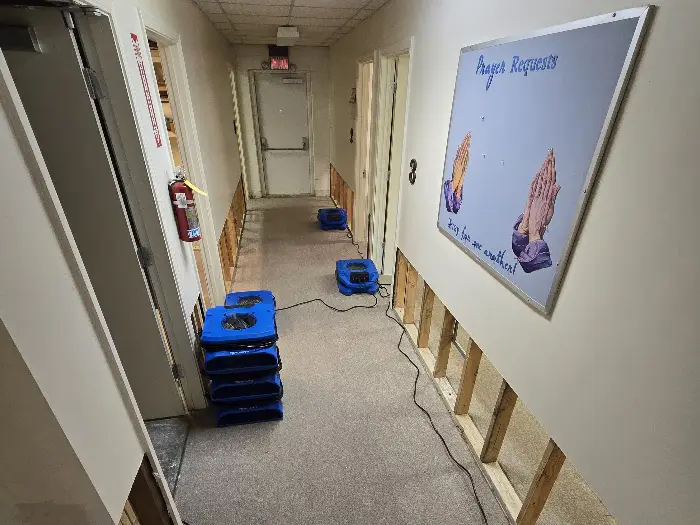
Commercial Hallway Water Mitigation Louisville KY

Why Does Louisville Experience More Residential Water Damage Than Most U.S. Cities?

Louisville sits in the Ohio River Valley at the convergence of three factors that make water damage restoration one of the most in-demand emergency services in the metro area.

First, rainfall. Louisville averages 45.2 inches of precipitation annually, well above the national average of 30.3 inches. That volume concentrates heavily in spring, with March through May delivering roughly 40% of the annual total in intense thunderstorm events that overwhelm drainage systems across Jefferson County.

Second, humidity. Summer relative humidity in Louisville regularly exceeds 75%, which slows natural drying of any moisture that enters a structure. Building materials that might air-dry in an arid climate stay wet indefinitely in Louisville’s conditions, creating ideal environments for mold colonization within 24 to 48 hours of exposure.

Third, infrastructure age. Louisville’s combined sewer system, one of the oldest in the country, handles both sanitary waste and stormwater through shared pipes. During heavy rain, the system surcharges and can push contaminated water back into homes through floor drains and plumbing fixtures, turning a simple rainwater event into a Category 3 biohazard emergency.

These overlapping risks mean Louisville property owners need a water damage company that understands both the science of restoration and the local conditions that make every job unique.

Call (502) 200-6968

What Should You Do in the First 60 Minutes After Discovering Water Damage in Your Louisville Home?

Your actions in the first hour directly determine how much of your home can be preserved. Here is a step-by-step guide for Louisville homeowners facing an active water damage event.

Stop the source. For plumbing failures, close the supply valve behind the fixture (usually a quarter-turn valve under sinks and behind toilets) or shut off the main water supply at the meter. For appliance leaks, unplug the unit and close its dedicated supply valve. Do not enter standing water if it may have reached electrical outlets or energized appliances.

Protect valuables and furniture. Move electronics, documents, and personal items out of the affected area. Lift furniture off wet carpet to prevent tannin stains (from wood legs) and rust marks (from metal frames) that become permanent within hours.

Do not use household equipment. Standard vacuums are not rated for water contact and create electrocution risk. Box fans and consumer dehumidifiers lack the capacity to address structural water damage and may spread contamination if the water is Category 2 or 3.

Call Bear Restoration at (502) 200-6968. We dispatch professional water damage cleanup crews 24 hours a day, 7 days a week across Louisville. Average arrival time to most Jefferson County zip codes is under 60 minutes. Our trucks arrive fully equipped for emergency water extraction, so work begins the moment we reach your property.

How Do We Dry a Louisville Home Using Commercial Equipment and Building Science?

Professional structural drying is applied physics. Every equipment placement decision is based on the relationship between temperature, humidity, and airflow. Here is how our certified water restoration team approaches a Louisville dry-out.

Extraction first. Truck-mounted units pull standing water through weighted wands at over 200 PSI. A single pass on carpet removes 85 to 95% of absorbed water. For hard surfaces, rover extractors recover water from tile, hardwood, and concrete. This phase alone can remove hundreds of gallons per hour from a Louisville home.

Moisture mapping. Flir thermal imaging cameras reveal moisture migration paths that are invisible to the naked eye. Temperature differentials of just 2 to 3 degrees indicate evaporative cooling on hidden wet surfaces. Delmhorst pin-type meters then confirm the actual moisture content inside each building material, establishing baseline readings for tracking progress.

Calculated equipment placement. LGR dehumidifiers lower the grain content of the ambient air, increasing its capacity to pull moisture from saturated materials. Air movers positioned at specific angles create laminar airflow across wet surfaces, disrupting the humid boundary layer and feeding moisture-laden air toward the dehumidifier intakes.

Daily monitoring and adjustment. We record moisture readings from fixed monitoring points across the affected area every day. These readings are plotted against material-specific drying goals: wood framing below 16% moisture content, drywall below 1% on a non-invasive scale, concrete at equilibrium for its age and composition. Equipment stays until every surface verifiably meets its dry standard.

This systematic, data-driven water damage mitigation process is what separates our professional restoration services from contractors who set fans and hope for the best.

Call (502) 200-6968

Which Louisville Neighborhoods Face the Highest Risk for Water Damage?

Water damage risk in Louisville varies significantly by neighborhood, influenced by elevation, drainage infrastructure, construction era, and proximity to waterways. Here is what our emergency water removal data shows across the metro area.

Shively and Southwest Louisville: Low elevation near Pond Creek, combined sewer lines, and post-war construction with concrete block basements create persistent flood water removal needs during spring storms. Sewer backups are more common here than in any other part of the metro.

The Highlands and Germantown: Dense, older neighborhoods with century-old plumbing systems, limited green space for absorption, and homes built close to grade. Basement flooding from overwhelmed storm drains is the primary concern during heavy rain events.

St. Matthews and Middletown: A mix of mid-century and modern construction. Supply-line failures and appliance leaks generate most of the water damage repair calls, with finished basements in split-level homes amplifying the cost when water reaches the lower level.

Prospect and the East End: Custom homes with high-value finishes, finished lower levels, and large footprints. Water damage restoration in these properties requires a preservation-first approach to protect custom millwork, exotic hardwoods, and integrated systems.

Portland and the West End: Many homes near the Ohio River sit in FEMA flood zones. Flood damage events involve Category 3 water with contamination protocols, and many properties require both standard homeowners and NFIP flood policy coordination.

Bear Restoration serves every Louisville neighborhood with the same standard of care. Our water damage contractors understand the specific risks, building types, and restoration challenges unique to each community.

How Do Louisville’s Combined Sewers Increase the Contamination Risk During Water Damage Events?

Louisville’s Metropolitan Sewer District (MSD) operates one of the largest combined sewer systems in the United States. Combined systems carry both household sewage and stormwater in the same pipes, which means that during heavy rain, the system can surcharge and push a mixture of stormwater and raw sewage back into homes through floor drains, basement drains, and even toilet lines.

This backflow automatically classifies the event as Category 3, the highest contamination level under IICRC S500 standards. Category 3 water contains pathogenic bacteria, viruses, and parasites that pose immediate health risks. The water damage cleanup protocol for these events is fundamentally different from a clean-water pipe burst.

Our Category 3 response includes full biohazard containment, HEPA air filtration, removal of all porous materials that contacted contaminated water, antimicrobial treatment of structural surfaces, and verification testing before rebuild begins. We document the contamination source and remediation steps thoroughly for both your health records and your insurance claim.

If you suspect sewer involvement in any Louisville water damage event, do not attempt cleanup yourself. Call Bear Restoration at (502) 200-6968 for certified water damage restoration with proper contamination protocols.
Commercial Hallway Water Mitigation Louisville KY

Why Louisville Homeowners Trust Bear Restoration for Water Damage Emergencies

Emery Bear started Bear Restoration with a simple commitment: treat every Louisville home like our own. That means arriving fast, communicating clearly, drying thoroughly, and documenting everything so your insurance process is as smooth as the restoration itself.

Our team carries IICRC Water Restoration Technician (WRT) and Applied Microbial Remediation Technician (AMRT) certifications. Every project follows IICRC S500 protocols. Every estimate is formatted in Xactimate, the standard used by Kentucky insurance carriers. And every job closes only when objective moisture data confirms the structure is dry.

From the Highlands to Prospect, from Portland to Middletown, Bear Restoration is Louisville’s local water damage restoration company. We live here, we work here, and we are here when you need us most. Call (502) 200-6968 for 24/7 emergency water extraction and complete restoration services.

Call (502) 200-6968

Frequently Asked Questions About Water Damage Restoration in Louisville, KY

Immediately. Not “later today.”

Water begins penetrating materials within minutes:

  • Drywall absorbs and wicks water upward
  • Wood swells and begins structural distortion
  • Flooring traps moisture underneath

Within 24–72 hours, microbial growth begins. The longer it sits, the more the job shifts from simple drying to full remediation and reconstruction.

Not all water is the same, and this changes everything about cleanup.

  1. Category 1 (Clean Water): From clean sources like broken supply lines or sinks
  2. Category 2 (Gray Water): Contains contaminants (appliances, sump pumps)
  3. Category 3 (Black Water): Highly contaminated (sewage, flooding, stormwater)

The category determines:

  • Safety protocols
  • What materials must be removed
  • Whether the structure can be saved or not

Drying is not based on “it feels dry”, it’s based on returning materials to their normal moisture content.

Technicians establish a drying goal by:

  • Measuring unaffected areas (baseline moisture)
  • Comparing wet vs dry readings
  • Monitoring daily until equilibrium is reached

For example, wood flooring may need to return to ~6–12% moisture content depending on environment, not just surface dryness.

Injection drying is used when water is trapped inside wall cavities or under cabinets.

Small holes are drilled, and:

  • Warm, dry air is injected into cavities
  • Moist air is pulled out simultaneously

This allows drying without full demolition, when conditions permit.

Call Bear Restoration right away if:

  • Water is actively entering the property
  • There is standing water
  • You notice swelling, warping, or staining
  • You smell musty or damp air
  • A leak or flood just occurred

Speed is the single biggest factor in reducing damage and cost.

Louisville sits in the Ohio Valley where average relative humidity exceeds 70% from May through September. High humidity slows evaporation, which means wet building materials stay wet longer and mold can colonize within 24–48 hours instead of the typical 48–72 window.

Our IICRC-certified technicians adjust dehumidifier grain-depression targets based on Louisville’s outdoor dew points, which regularly exceed 65°F in summer. Without that adjustment, standard drying calculations underperform and hidden moisture lingers behind walls.

Louisville receives an average of 45 inches of rain per year. Sump pumps in Louisville basements run hard during spring storms, and the number-one cause of basement flooding we respond to is sump pump failure, either from power outages, a burned-out motor, or a stuck float switch.

If your sump fails, standing water begins wicking into drywall and subfloor within minutes. We recommend a battery backup sump system and testing the pump monthly by pouring a bucket of water into the pit to confirm the float triggers correctly.

OTHER SERVICES WE OFFER IN LOUISVILLE, KY

Start now
Start now
Start now