Apartment Complex Flooding - Louisville KY

In a multifamily building, water never affects only the unit where it starts. A supply line that fails in a third-floor bathroom becomes a ceiling collapse in the unit below, a soaked party wall shared with the neighbor, and a saturated stairwell within an hour. The defining challenge of apartment and condo water damage is that one leak is simultaneously several tenants’ emergencies, a habitability issue under Kentucky landlord-tenant law, and a building-systems failure all at once. Bear Restoration, owned by Emery, holds IICRC WRT, ASD, and AMRT certifications and has restored multifamily properties across the Louisville metro, from older garden-style complexes in the Highlands to newer mid-rise communities downtown. Reach us 24/7 at (502) 200-6968.

Property managers and owners do not just need the water gone. They need affected units returned to leasable condition fast, displaced tenants handled with minimal friction, and documentation clean enough to bill the responsible party or file with the master policy. That is the job we are built for.

Call (502) 200-6968

How Water Moves Through a Louisville Multifamily Building

The single most common multifamily loss we see is the unit-above-flooding-the-unit-below scenario. A tenant on the upper floor leaves a tub running, a washing-machine supply hose ruptures, a toilet supply line fails, or a water heater in a closet lets go. Gravity does the rest. The water finds the path of least resistance through the subfloor, follows plumbing and electrical penetrations, and arrives in the unit below as a sagging, stained ceiling. By the time the lower tenant notices, the assembly between the two units, including the subfloor, the joist cavity, and the ceiling drywall, is already saturated.

Stacked plumbing makes this worse. Apartments are designed with bathrooms and kitchens stacked vertically to share plumbing chases, so a failure in one riser can wet a column of units on multiple floors at once. Demising walls, the fire-rated walls between units, are framed cavities that wick water laterally, which is how a leak in one unit shows up as damp baseboards in the unit next door. In older Louisville garden apartments built mid-century, cast-iron drain stacks corrode and crack, releasing Category 2 or Category 3 water into wall cavities where it sits undetected until odor or mold appears.

Louisville’s winters add burst-pipe season. Vacant units between leases often have the heat turned down, and exterior-wall supply lines in those units freeze and split during cold snaps. Because nobody is living there, the line can run for hours before a neighbor reports water coming through a shared wall. The same freeze-thaw pattern hits exposed lines in breezeways, attics, and unconditioned utility closets across the metro every January.

Category Matters: Clean, Gray, and Black Water in Occupied Units

The water’s category drives everything that follows, and in multifamily settings the category is often worse than it first looks. A clean supply-line break starts as Category 1 water, but the ANSI/IICRC S500 standard recognizes that clean water degrades to Category 2 (gray) within hours as it picks up contaminants from carpet, drywall, and building materials, and to Category 3 (black) if it sits or originates from sewage. A toilet overflow or a sewage backup in a stacked drain line is Category 3 from the start and requires removal of porous materials and antimicrobial treatment, not just drying.

This distinction protects tenants. Drying a Category 3 loss as if it were clean leaves contaminated material in an occupied home, which is both a health hazard and a liability. We assess category on arrival, document it, and treat each affected unit according to the standard, applying EPA-registered antimicrobials such as quaternary ammonium compounds where contamination is present and removing unsalvageable porous materials like wet carpet pad and saturated drywall.

After-Hours Mitigation Across Multiple Units

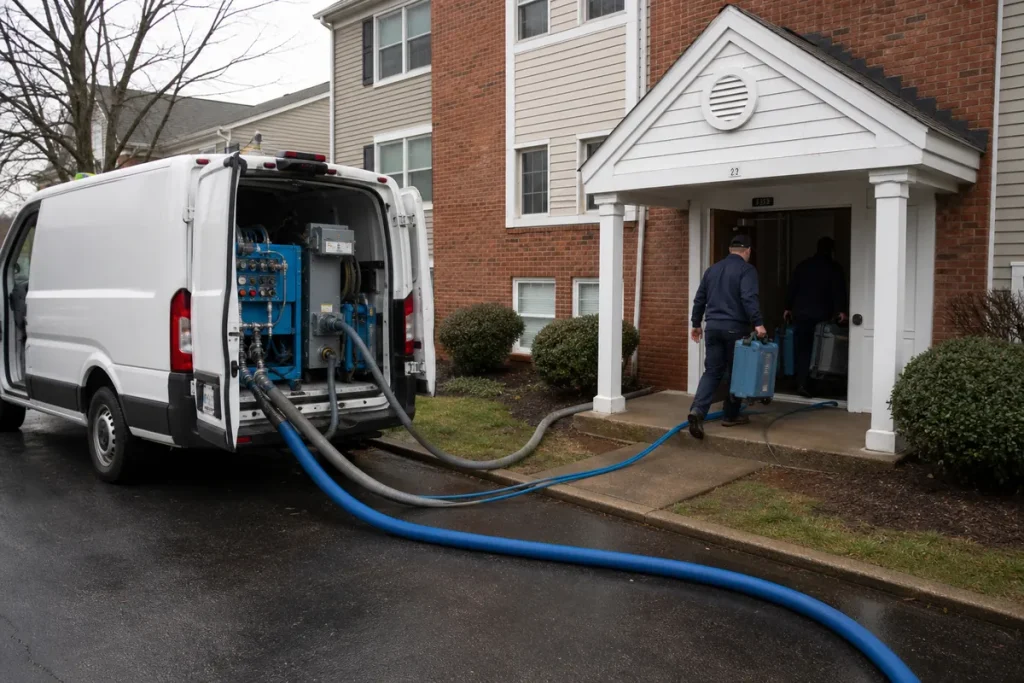
Multifamily losses rarely respect business hours, and they almost always involve tenants who need answers immediately. When you call, we coordinate with your on-call maintenance or property manager to shut water at the unit stop valves or the building riser, and we dispatch a crew sized to the number of units involved. The first move is always extraction, because pulling standing water out of multiple units fast prevents the loss from spreading down another floor.

We work directly with displaced tenants on access and timing, photograph the condition of each unit on arrival, and contain work areas so the rest of the building stays livable. For occupied buildings, quiet operation and clean containment matter, because the tenants in unaffected units are watching how the property handles the emergency. A fast, organized after-hours response protects your renewals as much as your drywall.
Apartment Complex Flooding - Louisville KY

Commercial Extraction and Multi-Unit Drying Setups

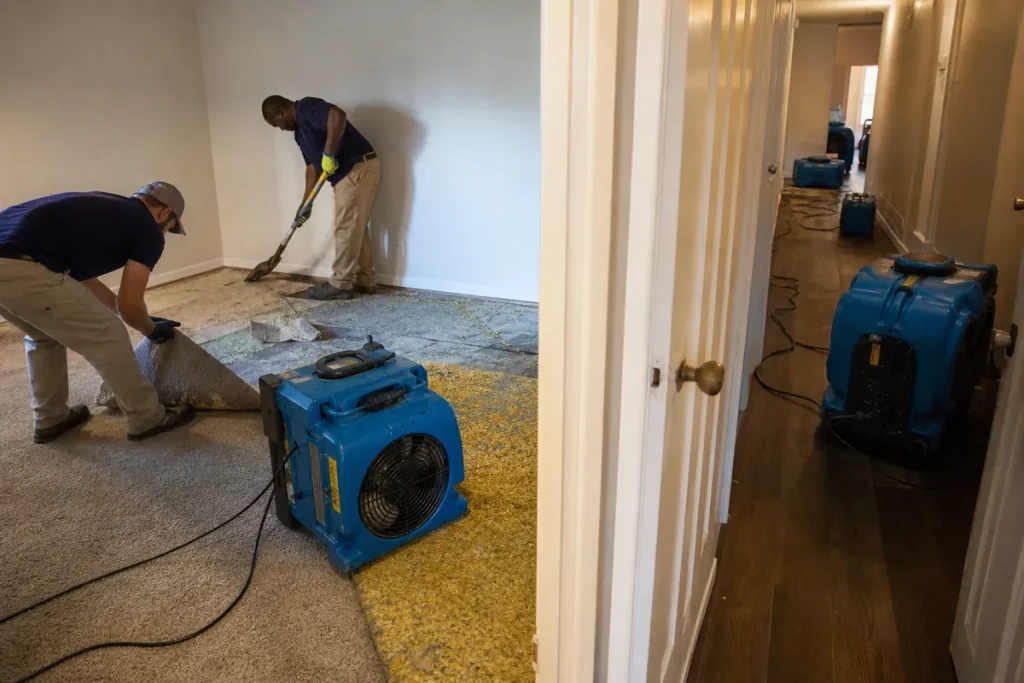
Drying several units at once is a different equipment problem than drying a single home. We bring truck-mounted extraction for volume, then deploy drying equipment scaled to the affected square footage and class of water intrusion. For a column of stacked units, we frequently run low-grain refrigerant (LGR) dehumidifiers in each affected unit plus desiccant dehumidification ducted into the shared assemblies and the saturated demising-wall cavities. Desiccant units drive the air dry enough to pull bound water out of framing and subfloor that refrigerant units alone leave damp.

Air movers create the airflow that lifts moisture off surfaces, and we use injection drying to dry wall cavities and the joist spaces between floors without demolishing finished ceilings in the lower units wherever the structure allows. The S500 standard guides our equipment ratios so each unit gets enough dehumidification and airflow to hit dry standard, and we verify with moisture meters rather than guessing. Because units dry at different rates, we return each one to leasable condition the moment it passes, instead of holding the whole group until the slowest unit finishes.

Call (502) 200-6968

Documentation Built for Subrogation and Master Policies

Multifamily claims have a wrinkle most other property types do not: there is often a responsible party to pursue. When an upstairs tenant’s negligence or a failed appliance caused the loss, the cost of restoring the lower units may be recoverable through subrogation. That only works if the documentation is airtight. From arrival, we record the source of loss, category of water, moisture readings per unit, photographs of every affected area, and equipment logs, and we preserve any failed component, such as a ruptured washer hose or a cracked supply line, for the carrier’s investigation.

We produce scopes and estimates in Xactimate, coordinate directly with the property’s master-policy adjuster, and keep the per-unit documentation separated so costs can be allocated correctly. For management companies juggling multiple owners and a master HOA policy, that clean separation is the difference between a smooth claim and months of dispute over who owes what.

Habitability, Business Continuity, and Tenant Retention

Under Kentucky’s habitability obligations, units have to be returned to livable condition promptly, and tenants displaced by water damage are a retention risk. Our schedule is built to minimize displacement time. We give property managers a projected return date per unit so you can manage temporary relocations, rent abatements, and lease conversations with real information rather than guesses. The faster a unit comes back, the shorter the abatement and the lower the odds a displaced tenant breaks the lease.

Bear Restoration serves multifamily properties throughout Louisville, including the Highlands, Old Louisville, downtown, St. Matthews, the East End, and Jeffersonville across the river. We work with property management companies on standing response agreements so a 2 a.m. call goes to a contractor who already knows your portfolio. For broader portfolio coverage, see our property management restoration services, and for large-volume losses our commercial extraction team.

Call Bear Restoration for Apartment and Condo Water Damage

One leak in a multifamily building is several emergencies at once, and the response has to handle all of them: fast extraction across units, category-correct treatment for tenant safety, drying that preserves finishes, and documentation clean enough to subrogate. Bear Restoration brings all of it to Louisville apartment and condo communities, with per-unit return schedules your leasing office can plan around. Call (502) 200-6968 any hour for emergency multifamily water damage mitigation across the Louisville metro.


Call (502) 200-6968

Frequently Asked Questions

It depends on the cause. If a tenant’s negligence or a failed appliance caused it, the cost of restoring the lower unit may be recoverable through subrogation against that party or their renter’s insurance. We document the source, water category, and per-unit damage from the first hour so your adjuster can pursue recovery if it applies.

We scale crews and equipment to the loss. For a stacked-unit failure, we run LGR dehumidifiers in each affected unit plus desiccant drying ducted into shared assemblies, with enough air movers and extraction capacity to handle a full vertical column at once. Each unit is returned the moment it hits dry standard.

It can be, depending on the source. A clean supply break is Category 1 but degrades to gray water within hours, and a toilet or sewage backup is Category 3 from the start and requires removal of porous materials and antimicrobial treatment. We assess and document the category on arrival and treat each unit to the IICRC S500 standard.

Often, yes. Where the structure allows, we use injection drying to dry the joist cavity and subfloor between units through small ports, preserving the lower unit’s ceiling. When water sat long enough to compromise the drywall or the loss is Category 3, removal is required, and we document why.

We give property managers a projected return date per unit so you can manage relocations and rent abatement with real timelines, and we coordinate access directly with tenants. Returning units in waves as each hits dry standard shortens displacement and protects renewals.