School Flooding Water Damage - Louisville KY

A water loss in a school is a deadline problem. The building has to be safe, dry, and verified clean before students and staff return, and the calendar that defines “when” is not negotiable. A burst pipe over a winter break, a roof leak during summer, or a fixture failure in an occupied wing all share the same constraint: the work has to be finished and the indoor air quality has to be defensible before the doors open. Schools also house a vulnerable population, so the mold and air-quality stakes are higher than in almost any other building type. Bear Restoration, owned by Emery, holds IICRC WRT, ASD, and AMRT certifications and has restored educational facilities across the Louisville metro, including older masonry schools in the urban core and newer buildings in the suburban districts. Our 24/7 line is (502) 200-6968.

What schools need is a contractor who can dry fast against a hard return date, treat the loss to a standard that protects children’s health, and document the indoor air quality well enough to satisfy administrators, parents, and the district’s risk-management office.

Call (502) 200-6968

How Schools Flood in Louisville

The classic school loss is the unoccupied-building burst pipe. Schools are largely empty over winter break, and many districts reduce heat in wings that are not in use, which is exactly the condition that bursts supply lines during a Louisville cold snap. A line that lets go in an empty building over the holidays can run for days before custodial staff discover it, flooding classrooms, corridors, and the rooms below. The same freeze-thaw pattern hits the unconditioned spaces above suspended ceilings and in mechanical rooms.

Roof leaks are the summer counterpart. Many Louisville schools, particularly mid-century and older buildings, have low-slope roofs that pond water, and the heavy storms that move through the Ohio Valley open seams and flashings, sending water into classrooms and gymnasiums during the months the building is least monitored. Older masonry schools in the urban core also face wall and basement moisture intrusion, and below-grade levels that house locker rooms, kitchens, and mechanical space take on water during high-rain periods.

Occupied-building failures round it out: a restroom or fixture failure, a science-lab or kitchen plumbing line, or an HVAC condensate or chilled-water failure that releases water into ceilings and walls during the school day. Because schools combine large square footage with porous finishes, carpet, ceiling tile, and gypsum board, water spreads and absorbs quickly, and the affected area is often larger than the visible wet floor suggests.

Why School Drying Demands an Indoor Air Quality Standard

What sets school restoration apart is that the end state is judged on indoor air quality and the absence of mold, not just on a dry moisture reading, because the occupants are children. Wet gypsum, carpet, and ceiling tile that are not dried within the window the EPA and the ANSI/IICRC S500 standard describe become amplification sites for microbial growth, and a school cannot reopen with that risk in occupied spaces. We assess category and act on the timeline that prevents growth: clean supply water degrades to gray within hours, and any sewage or drain backup is Category 3 from the start, requiring removal of porous materials and antimicrobial treatment under the S520 mold remediation standard where growth is present.

Porous materials that cannot be dried in time, especially saturated carpet pad, wet ceiling tile, and gypsum board that sat in contaminated water, are removed rather than risked, and we treat affected hard surfaces with EPA-registered antimicrobials. The reason is straightforward: a dried-out classroom that still harbors microbial growth in a wall cavity is a health and liability problem that surfaces weeks into the school year. Getting the air quality genuinely right the first time is the entire point of restoring a school correctly.

After-Hours and Off-Calendar Mitigation

School losses often happen when the building is empty, which is both an advantage and a risk: there is room to work without disrupting classes, but the loss may have run undetected for a long time. When the call comes from a custodian, facilities director, or the district, we coordinate to shut water at the main or fixture and dispatch a crew sized to the affected wing. The first move is extraction and containment, because pulling water out fast and isolating the wet zone limits both the spread and the microbial window.

We work around the academic calendar deliberately. A break or a summer is the ideal window to complete a full restoration before students return, and we sequence the work to hit the reopen date. For an occupied-building loss during the school year, we contain the affected classrooms or wing so the rest of the building keeps operating and instruction continues, with the work zone sealed off from student and staff traffic.

School Flooding Water Damage - Louisville KY

Commercial Extraction and Large-Area Drying for Schools

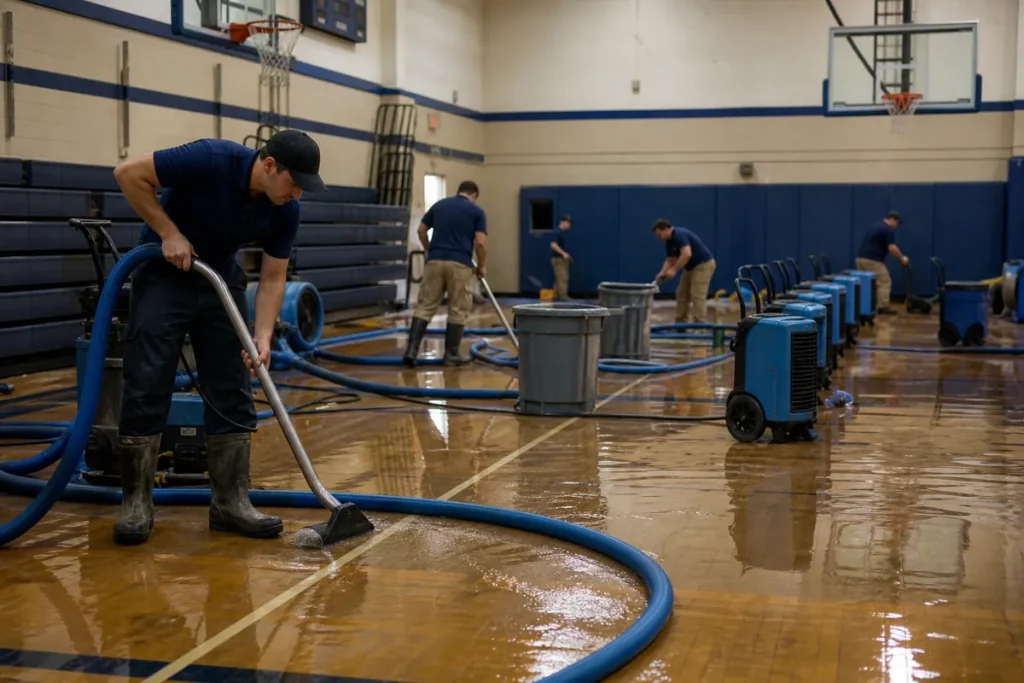
Schools combine large floor areas with the kind of porous finishes that hold water, so drying requires commercial-scale equipment and a containment plan. We extract with truck-mounted and portable units, then deploy low-grain refrigerant (LGR) dehumidifiers across affected classrooms and corridors, with desiccant dehumidification for large gymnasiums, cafeterias, and masonry assemblies that hold bound water. For the cavities above suspended ceilings and inside walls, we use injection and cavity drying to dry the structure where the materials are salvageable.

Air movers establish the surface airflow that lifts moisture off floors and walls, and where microbial growth is present we set up HEPA-filtered negative air machines to contain and filter airborne spores during remediation, which is central to protecting the rest of the building. The S500 and S520 standards govern our equipment ratios, containment, and clearance criteria, and we verify drying with moisture meters and, where remediation occurred, confirm the result before turning the space back over. Returning each classroom or wing to use the moment it passes keeps the disruption to instruction as small as possible.

Call (502) 200-6968

Documentation, Insurance, and Defensible Clearance

School claims involve a district risk-management office, often a public or institutional insurer, and a community of parents who want assurance the building is safe. Documentation has to satisfy all three. From arrival we record the source and category of loss, moisture readings by room, photographs of all affected areas, equipment logs, and where mold remediation occurred, the containment and clearance documentation that demonstrates the space was returned to a safe condition. We produce scopes and estimates in Xactimate for the carrier’s adjuster.

The clearance documentation is what lets administrators tell parents and staff the building is safe with evidence behind the claim, and it is what protects the district if questions arise later. We coordinate with the district’s facilities and risk-management staff and, where a failed component or a contractor’s defect caused the loss, preserve evidence for subrogation. A school’s restoration record is a public-trust document as much as an insurance one, and we treat it that way.

Business Continuity and Hitting the Return Date

Continuity for a school means students and staff back in a safe building on schedule, with the least disruption to instruction along the way. We build the drying and remediation plan around the academic calendar and the return date, sequence work to clear occupied-priority spaces first, and contain the rest so the building keeps functioning during the school year. We give the facilities director a projected clearance date per space so the district can plan staffing, relocations, and parent communication with real timelines.

Bear Restoration serves schools, daycares, and educational facilities across the Louisville metro and surrounding districts, including the urban core, the South End, the East End, the suburban districts, and Jeffersonville across the river. We work with district facilities offices on priority response for losses that hit during breaks or mid-year. For related institutional work, see our multi-building restoration and large-scale commercial extraction services.

Call Bear Restoration for School Water Damage

A school has to be dry, safe, and verified clean before the doors open, and the calendar does not move. Bear Restoration brings large-area drying, child-safety-grade remediation, HEPA containment, and clearance documentation defensible to a district risk office to Louisville schools, sequenced to hit your return date. Call (502) 200-6968 any hour for emergency school water damage mitigation across the Louisville metro and surrounding districts.


Call (502) 200-6968

Frequently Asked Questions

That is exactly what we plan around. A winter break or summer is the ideal window to complete a full restoration, and we sequence extraction, drying, and any remediation to hit the return date. For occupied-building losses during the year, we contain the affected wing so the rest of the school keeps operating.

We treat the loss to an indoor-air-quality standard, not just a dry reading. Porous materials that sat in contaminated water are removed, affected surfaces are treated with EPA-registered antimicrobials, and where mold is present we remediate under the IICRC S520 standard with HEPA negative air containment and document clearance before reopening.

Water that ran undetected spreads far and starts the microbial clock, so we assess the full affected area with moisture meters and thermal imaging rather than just the visible wet floor. Saturated carpet pad, ceiling tile, and gypsum that crossed the microbial window are removed, and we dry and verify the salvageable structure.

Usually not. We contain the affected classrooms or wing and seal the work zone from student and staff traffic so instruction continues in the rest of the building, returning each space to use the moment it passes clearance.

We document source and category of loss, room-by-room moisture readings, photographs, equipment logs, and, where remediation occurred, the containment and clearance records that demonstrate the space is safe. That record is what lets administrators reassure parents and staff with evidence behind it.