mold remediation services

Professional Mold Inspection Company in Louisville, KY & Nearby Areas

Most homeowners in Louisville don’t actually have a mold problem. They have a moisture problem that hasn’t been found yet. And that’s where everything goes wrong.

Because mold is just the symptom. The real issue is always water—where it came from, where it traveled, and where it’s still sitting right now. In a city like Louisville, where humidity stays high and basements are common, moisture doesn’t just dry up on its own. It gets trapped inside walls, under floors, and behind materials you can’t see.

That’s why a real mold inspection isn’t about walking through your home looking for black spots. It’s about understanding how water behaves inside your structure. At Bear Restoration, Emery Bear approaches mold inspections like a science problem first—because that’s exactly what it is.

Call (502) 200-6968

The Difference Between a Real Mold Inspection and a “Free Check”

A lot of companies in Louisville offer “free mold inspections.”

What they’re really offering is a quick walkthrough to find something obvious so they can sell you remediation.

That’s not inspection—that’s sales.

A real mold inspection takes time, equipment, and understanding of building science. It produces clear answers about what’s happening inside your home, not just surface-level observations.

And most importantly, it tells you whether you actually have a problem—or not.

When You Should Get a Mold Inspection (Even If You Don’t See Mold)

You don’t need visible mold to have a real issue.

In fact, most serious mold problems start before anything shows up.

You should consider a professional inspection if your home has a persistent musty smell, if your basement always feels damp, or if you’ve had any kind of water damage in the past—even if it seemed minor at the time.

Changes in indoor air quality, unexplained allergies, or odors when your HVAC system runs are also strong signs that something may be happening behind the scenes.

In Louisville’s climate, waiting for visible mold is usually too late.

Inspection Equipment and the Science Behind It

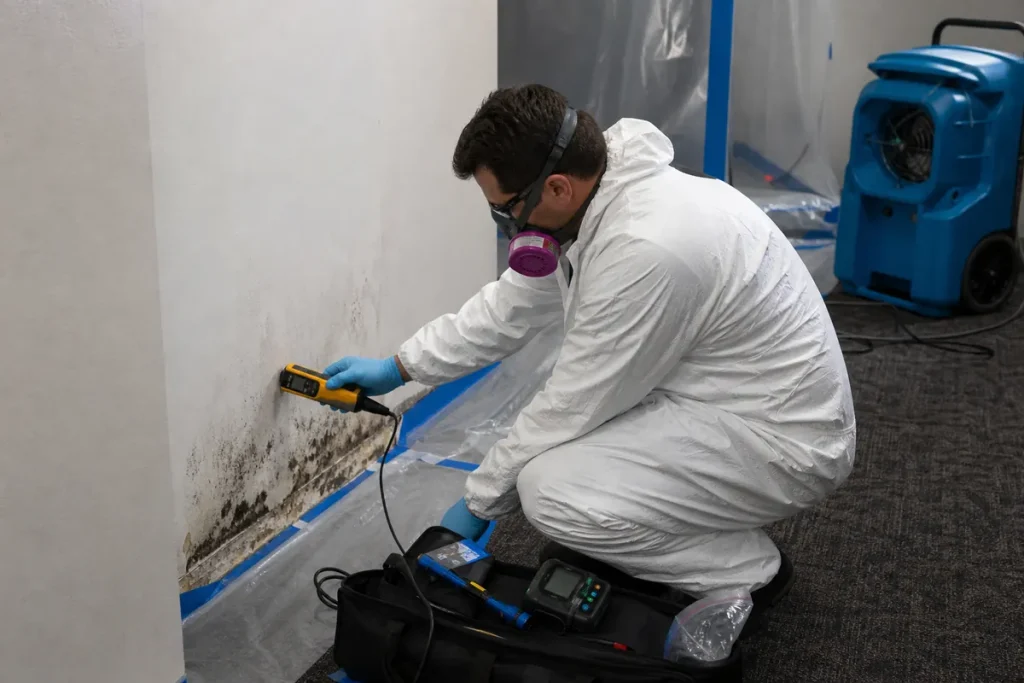
The equipment used during an inspection is what separates a real assessment from a flashlight tour. Each instrument exists because a specific property of moisture or fungal contamination cannot be observed by eye.

Pin and pinless moisture meters

A pin meter (such as the Delmhorst BD-2100) drives two electrodes into the substrate and measures electrical resistance, which correlates to moisture content. A pinless meter (Tramex, Protimeter Surveymaster) uses capacitance and reads up to roughly 3/4 inch into the material without making holes. We use both because pin meters give precise wood moisture content readings (a kiln-dried 2×4 should read 9 to 14 percent, anything above 16 percent indicates active wetting), while pinless meters allow non-destructive scanning across drywall, plaster, and finished surfaces. The dry standard for drywall in most Louisville homes is roughly 0.6 percent on a Tramex scale; readings of 1.0 or higher indicate elevated moisture.

Thermo-hygrometers and psychrometric assessment.

We measure interior and exterior temperature, relative humidity, dew point, and grains per pound (GPP) of moisture in the air. The IICRC S500 standard establishes that drying requires the interior environment to maintain a vapor pressure differential below the wet substrate. In Louisville summers, when outdoor dewpoint can sit at 72°F for weeks, this is critical. Psychrometric data tells us whether the building envelope can be dried at all without dehumidification, and at what capacity.

Infrared thermography

A thermal camera (we use FLIR E76 and similar) detects temperature differentials caused by evaporative cooling on wet substrates. Wet drywall reads colder than adjacent dry drywall, often by 4 to 8°F. This lets us map hidden moisture behind walls, above ceilings, and under flooring without invasive probing. Thermography is not a moisture meter, however. It identifies anomalies that must be confirmed with direct moisture readings, which is why we always pair the camera with pin readings.

Borescopes

When moisture mapping points to a wall cavity but the homeowner does not want full demolition, we drill a 5/16-inch hole and run a fiber-optic borescope to visually inspect the cavity. This often reveals saturated insulation, framing growth, or hidden vapor barrier failures invisible from the surface.

Particle counters and air sampling pumps

When sampling is justified (covered in the next section), we use calibrated sampling pumps with Air-O-Cell or Allergenco-D cassettes pulling 15 liters per minute over a 5 to 10 minute period. Samples are analyzed by an accredited third-party laboratory, never internally. Direct surface samples (tape lifts, swabs) follow ASTM D7910 protocols.

Mold Removal - Louisville KY

Why Mold Inspections Fail in Louisville Homes

Most inspections fail because they stop at what’s visible. In Louisville, that’s a mistake.

Homes in areas like St. Matthews, Middletown, and Jeffersontown often have:

  • Hidden wall cavity moisture from slow plumbing leaks
  • Basement vapor intrusion from hydrostatic pressure
  • HVAC condensation issues in humid months
  • Previous water damage that was never properly dried

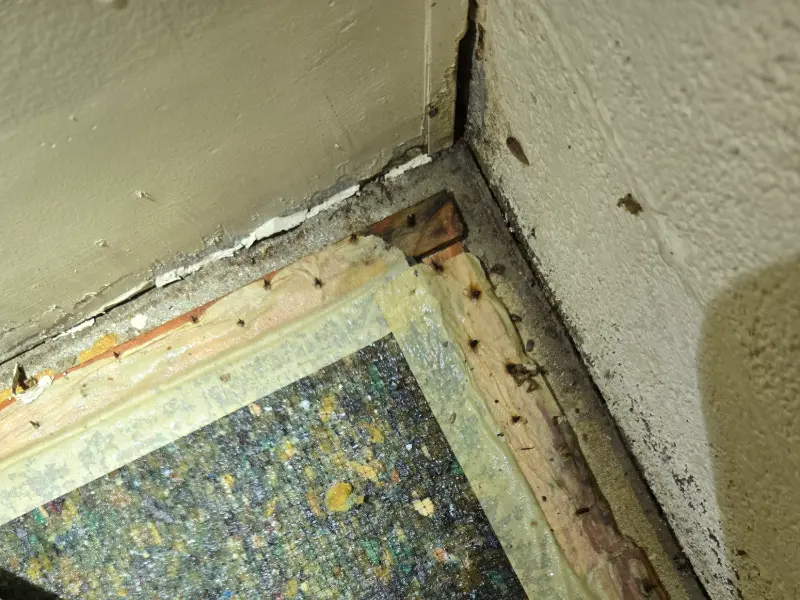
Mold doesn’t grow in open air—it grows where moisture is trapped. That means inside walls, under flooring, behind cabinets, and above ceilings.

If you’re not measuring those areas, you’re not inspecting.

Call (502) 200-6968

How to Read a Mold Inspection Report

An IICRC S520-compliant inspection report should not be a one-page checkbox form. Bear Restoration‘s reports run 8 to 20 pages, depending on property size and findings, and they contain six required sections. The property description documents the address, age, construction type, foundation type, and HVAC configuration. The moisture findings section logs all meter readings against baseline values, with a moisture map showing affected areas. The fungal contamination assessment classifies each affected area as Condition 1, 2, or 3 per S520. The moisture source diagnosis identifies the underlying water intrusion path (foundation seepage, plumbing leak, condensation, flood, etc.) because remediation without source correction will fail.

The scope of work spells out exactly what materials will be removed, what containment will be erected, what engineering controls (HEPA air scrubbers, negative pressure machines) will be deployed, and what the success criteria are. The cost estimate and contract include the disclosures required by 40 KAR 2:330 along with Forms MRC-1 and MRC-2.

If a Louisville inspection report you have received does not contain these elements, especially the moisture source diagnosis and the S520 condition classification, the document is not adequate to base remediation work on, and you should not sign a remediation contract that references it.

Schedule a Mold Inspection With Louisville’s IICRC-Certified Team

At Bear Restoration, we don’t treat mold inspections like a quick walkthrough. We follow IICRC S520 standards, which means your inspection is done the right way—with both a careful visual check and the right tools to actually find hidden moisture. We don’t guess. We measure, document, and explain everything in a way you can understand.

We serve all of Louisville and Jefferson County, including nearby areas like Jeffersonville, St. Matthews, Middletown, and Jeffersontown. Every inspection is handled by trained professionals with certifications in water damage, structural drying, and mold remediation.

And most importantly, Emery Bear personally reviews your report before you get it. Because this isn’t just paperwork—it’s the information you’ll use to make decisions about your home and your health.

Call Bear Restoration today to schedule your mold inspection, ask questions, or get a straightforward quote. We answer the phone, we show up when we say we will, and we give you real answers—not pressure.

Catch it early. Fix it right. Move forward with confidence.

Frequently Asked Questions About Mold Inspections

If the affected area is small (less than 10 square feet per EPA guidance) and you can identify the moisture source, an inspection may not be required. For anything larger, anything involving HVAC contamination, or anything where the moisture source is unclear, an inspection prevents recurrence and produces the documentation Kentucky law requires for any remediation contract.

An inspection itself is not legally mandated, but Kentucky regulation 40 KAR 2:330 requires any remediation company to perform a written assessment, identify the moisture source, classify contamination per IICRC S520, and produce specific contract disclosures before performing remediation work. In practice this means a compliant inspection is required before legitimate remediation can occur.

Plan on 90 minutes to three hours on site for a typical Louisville single-family home, plus 24 to 72 hours for the written report. Larger homes, commercial properties, and inspections involving lab samples take longer.

Do not clean, paint, or disturb the affected area. Document the timeline of when you first noticed the problem and any moisture events that preceded it. Pull together any related documentation (insurance claim numbers, plumbing repair invoices, prior inspection reports). Make sure the inspector has access to the basement, crawlspace, attic, HVAC system, and any rooms where symptoms have been reported.

Standard scheduling is within 24 to 72 hours for the Louisville metro. Emergency inspections related to active water intrusion or insurance-claim deadlines can usually be scheduled same-day or next-day depending on technician availability.

A qualified mold inspector uses non-invasive moisture meters (to scan walls and floors without cutting), pin-type penetrating meters (to confirm readings at depth), thermal imaging cameras (to find temperature differentials that indicate hidden moisture), and hygrometers (to measure ambient humidity). Some inspections also include air sampling cassettes or surface swabs sent to an accredited lab.

The goal is to build a moisture map of the property that identifies where conditions support mold growth—even in areas where mold is not yet visible.

Yes, and that is one of the most common reasons people request an inspection. Musty odors are produced by microbial volatile organic compounds (MVOCs)—gases released by active mold colonies. The smell can travel through wall cavities and HVAC systems, making the source difficult to locate without professional equipment.

Thermal imaging and moisture mapping allow us to trace the odor back to the moisture source, which is almost always the root cause. Treating the moisture eliminates the mold, which eliminates the odor.