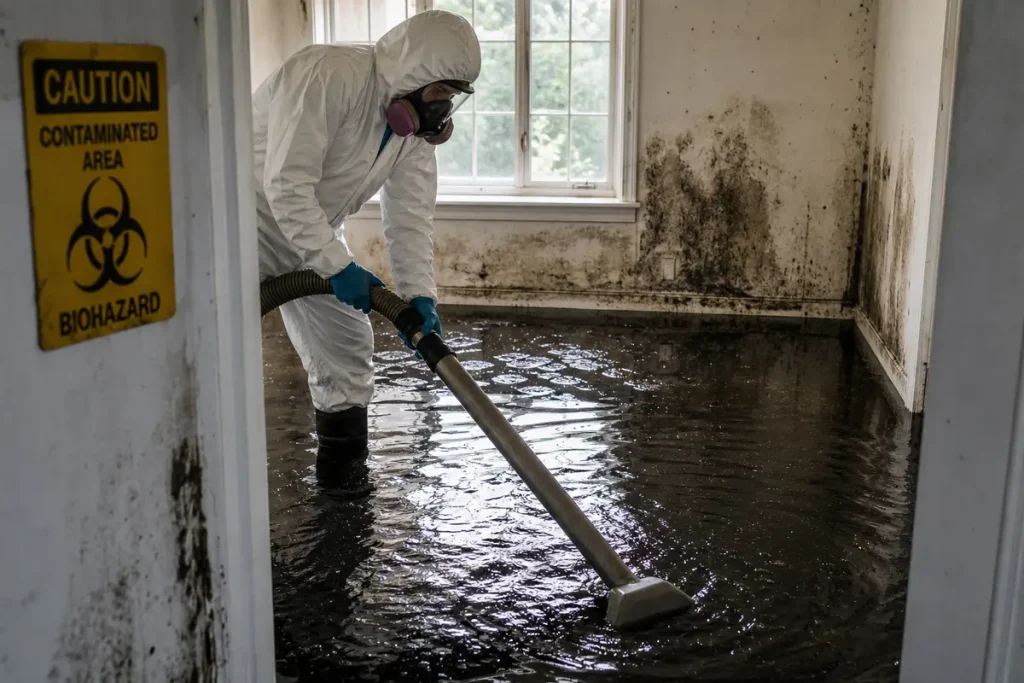
Category 3 water damage is the highest contamination level in water restoration, and it means your property has a biohazard problem, not just a water problem. If sewage backs up into a basement, floodwater enters from outside, or standing water degrades into black water, the main risk is exposure to harmful contaminants, followed immediately by damage to materials and habitability.
What Category 3 Water Damage Means
The ANSI/IICRC S500 standard defines Category 3 water as grossly contaminated water containing pathogenic, toxigenic, or other harmful agents. In plain language, this is black water: water unsafe to touch, breathe around, or clean up without proper controls. Sources such as BELFOR’s Category 3 guide use the same baseline definition and place raw sewage, stormwater runoff, and toilet waste in this category.
That distinction matters because people often confuse water category with water-damage class. Category describes contamination. Class describes how much water was absorbed and how difficult drying will be. A small sewage backup in one bathroom can still be Category 3 even if the drying scope is limited. A large clean-water loss can be Category 1 and still be harder to dry.
Finding: Category 3 water damage is a biohazard event, not a standard water cleanup.
How Category 3 Differs From Category 1 and Category 2
Category 1 starts as sanitary water from a clean source, such as a supply line. Category 2 carries significant contamination and is often called gray water. Category 3 is grossly contaminated black water.
CategoryContamination levelTypical examplesResponse
| 1 | Sanitary | Fresh supply line leak | Drying and cleanup |
| 2 | Significant contamination | Appliance discharge, some drain overflows | Controlled cleanup |
| 3 | Gross contamination | Sewage, floodwater, fecal overflow | Biohazard remediation |
If you want the full framework, it helps to understand how clean, gray, and black water are classified before a loss gets mislabeled. Misclassification leads to the wrong scope, the wrong safety measures, and insurance friction.
Finding: The defining issue is contamination, and Category 3 requires the highest level of control and remediation.
Why Floodwater and Sewage Backups Are Automatically Treated as Category 3
Outside floodwater, rising river water, toilet overflows with fecal matter, and sewage backups are treated as Category 3 because contamination is either known or cannot be ruled out. Floodwater travels through soil, streets, drains, crawl spaces, and building materials. Sewage carries human waste and sewer-line contaminants. Even if the water looks clear, the hazard remains.
That point is repeated across restoration guidance for a reason: appearance is a poor indicator of risk. Clear floodwater is still floodwater. A small backflow from beyond a drain trap is still contaminated. Unknown contamination is handled as dangerous contamination.
Finding: Unknown contamination is treated as dangerous contamination.
Why Category 3 Water Is a Health Hazard
Category 3 water is dangerous because it can contain bacteria, viruses, parasites, toxins, and chemical residues. Sources across public health and restoration guidance describe exposure through three main routes: skin contact, inhalation of aerosolized particles, and accidental ingestion. In an occupied house, rental, or small commercial space, those routes open fast. Foot traffic spreads residue. HVAC systems move particles. Cleanup without protection turns exposure into the next problem.
The contaminant mix varies by source. Sewage backup is not identical to river floodwater, and stagnant basement water is not identical to storm surge. But the response standard does not wait for lab results before treating the water as hazardous, because the exposure risk is immediate.
Finding: Category 3 water is dangerous because exposure can occur fast and through multiple pathways.
Contaminants Commonly Found in Black Water
Sewage-related Category 3 losses often contain organisms associated with fecal waste, including E. coli, norovirus, hepatitis A, and parasites. Floodwater adds dirt, organic debris, fuel residues, pesticides, heavy metals, and whatever else the water picks up outside. Stagnant water adds another problem: time. As water sits, microbial growth increases and the contamination profile worsens.
That is why time changes the category. Water that starts less contaminated can degrade. If you need that distinction spelled out, when lower-risk water becomes dangerous over time is not a technicality. It changes the entire remediation plan.
Finding: The risk rises as water picks up waste, environmental debris, and microbial growth.
Who Faces the Highest Exposure Risk
Children, older adults, immunocompromised occupants, maintenance staff, and anyone entering a confined or poorly ventilated area face the highest exposure risk. In Louisville properties, that often means basements, crawl spaces, utility rooms, and lower-level bathrooms. Older housing stock adds another layer because aging sewer lines, foundation cracks, and drainage weaknesses increase the chance of contaminated intrusion in hard-to-ventilate areas.
Building conditions matter as much as occupant vulnerability. A finished basement with carpet and drywall traps contamination differently than an unfinished concrete area. A rental with shared HVAC creates different exposure pathways than a detached garage office.
Finding: Occupant vulnerability and building conditions both increase exposure risk.
The Most Common Causes of Category 3 Water Damage
The most common Category 3 events start with sewage, flooding, or neglected standing water. EPA-referenced estimates place sanitary sewer overflows in the U.S. at 23,000 to 75,000 annually, which shows how routine this problem is at a national level. In Louisville, the local version often looks familiar: older sewer laterals in historic neighborhoods, basement intrusion after heavy rain, and drainage failures around slab and foundation walls.
The pattern matters because affects both cleanup and coverage. Source identification is not paperwork trivia. It determines contamination level, scope of demolition, and what your insurance carrier treats as a covered loss.
Finding: Category 3 events usually start with sewage, flooding, or neglected standing water.
Sewage Backups and Drain Failures
Blocked laterals, municipal backups, overloaded systems, and drain failures push contaminated water into the lowest points of a structure. That usually means basements, floor drains, laundry areas, and lower-level bathrooms. A backup does not need to cover an entire floor to qualify as Category 3. A narrow strip of sewage across a basement perimeter is still a biohazard.
That point is easy to underestimate. Small footprint does not mean low risk. Contamination level and drying scope are separate measurements.
Finding: A limited footprint does not reduce the contamination level.
Flooding, Stormwater, and Groundwater Intrusion
Floodwater is automatically handled as Category 3 because it collects contaminants along the way. RubyHome reports that 99% of U.S. counties experienced a flood event from 1996 to 2019, which puts flood exposure into national context. Once outside water enters a structure, it brings unknown biological and chemical contamination with it.
That is especially relevant for basements and low-lying entries. One inch of floodwater can cause significant damage, but the bigger issue is that the water enters as a health hazard from the first minute.
Finding: Outdoor water intrusion carries unknown contaminants and enters the structure as a health hazard.
Stagnant Water That Has Degraded Over Time
Standing water gets worse with delay. Multiple sources place mold risk in the 24 to 48 hour range, while broader microbial growth is often described in the 48 to 72 hour range depending on temperature, materials, and ventilation. That is not a contradiction. It is a timeline of escalating conditions.
A slow leak in an unoccupied unit, a sump failure in a basement, or pooled water under finished flooring can cross from manageable to hazardous quickly. For a related explanation, why gray water becomes more dangerous than it looks comes down to exactly this kind of escalation.
Finding: Delay changes the cleanup scope and increases contamination.
What You Should Do Immediately After Category 3 Water Damage
Your first response is simple: stay out, isolate the area, document the loss when safe, and call certified restoration professionals. Public health guidance and restoration standards align on this sequence because containment prevents more exposure than rushed cleanup ever will. Photos matter for insurance, but life safety comes first.
For landlords and property managers, this also affects habitability. Contaminated units, shared mechanical rooms, or sewage-affected common spaces should be treated as restricted areas until the loss is professionally assessed.
Finding: The correct first move is containment and professional response, not DIY cleanup.
Prioritize Safety and Stop Exposure
Keep occupants, tenants, employees, and pets out of affected rooms. Restrict foot traffic so contamination does not spread to clean flooring. If standing water is near outlets, appliances, or panels, power should be shut off only from a safe location. BELFOR advises evacuation and safe power shutoff as the first response when electrical hazards are present.
HVAC is another exposure route. If contamination is near returns or ducts, air movement can spread particles beyond the original loss area. That is why casual drying with household fans is the wrong move.
Finding: Exposure control comes before water removal….
Document the Damage for Insurance
Photograph the source, the water line, the affected rooms, damaged contents, and any visible contamination. Take both wide shots and close-ups. Save receipts for emergency mitigation, temporary lodging, and protective purchases. RubyHome’s insurance summary reports that water and freezing damage account for 29.4 percent of home insurance claims, with 1 in 60 insured homes filing such a claim annually and an average payout of $13,954.
Good documentation supports scope, timing, and source. But it never outranks safety. If the room is unsafe, the room waits.
Finding: Early documentation supports the claim file and the scope of remediation.
Call an IICRC-Certified Restoration Company
Category 3 cleanup requires trained crews, protective equipment, containment barriers, controlled demolition, moisture mapping, and disposal protocols for contaminated materials. Guidance from IICRC-certified cleanup recommendations is direct on this point: black water should be handled by certified technicians, not as a household cleanup project.
DIY fails because surface cleaning does not remove absorbed contamination from carpet pad, drywall, insulation, and upholstered contents. If the loss involves sewage or floodwater, professional response from water damage restoration company in Louisville, KY is the only acceptable response.
Finding: Certification and controlled remediation are required for safe restoration.
How Professional Cleanup Works and Why DIY Fails
Professional remediation follows a sequence: inspection, containment, extraction, removal of unsalvageable materials, cleaning and disinfection, structural drying, and verification. That process aligns with IICRC S500 principles because Category 3 losses involve both contamination control and moisture control. Cleaning without drying leaves a mold problem. Drying without decontamination leaves a health problem.
Porous materials usually do not survive Category 3 exposure. The limitation is that some non-porous and limited semi-porous materials can be restored if contamination is contained quickly and handled under proper protocol. But that exception is narrow, not broad.
Finding: Effective remediation depends on controlled removal, decontamination, and verified drying, not surface cleaning.
Materials That Usually Must Be Removed
Drywall, insulation, carpet pad, ceiling tiles, porous furniture, mattresses, paper goods, and other absorbent contents usually need disposal after black water exposure. Once contamination soaks into those materials, disinfection becomes unreliable because the hazard is not just on the surface.
That is why bleach-and-fan cleanup fails. You cannot sanitize what you cannot fully reach.
Finding: Porous materials exposed to Category 3 water are typically disposal items, not cleaning items.
Drying, Decontamination, and Mold Prevention
Cleanup is not finished when visible water is gone. Structural cavities, subfloors, framing, and trapped moisture behind walls still need drying and verification with moisture meters. Massachusetts public health guidance warns that 24 to 48 hours is the key mold window for wet porous materials, after which removal is often necessary.
Fast drying reduces the chance that a sewage event becomes a larger mold loss with a longer restoration timeline. In practical terms, speed protects both health and salvageability.
Finding: Drying speed directly affects whether a sewage loss becomes a larger mold loss.
Insurance, Cost, and Prevention Steps That Matter
BELFOR states that water damage is the second most common insurance claim in the United States and costs homeowners more than $20 billion each year. That gives the issue scale, but coverage still comes down to source and policy language. Category 3 classification supports proper remediation, yet it does not automatically create coverage.
Financial outcome depends on three things: correct classification, prompt mitigation, and endorsements already in place before the loss.
Finding: Financial recovery depends on correct classification, prompt mitigation, and the right endorsements before the loss.
What Insurance Typically Covers, and What It Does Not
A sudden internal event, such as a covered plumbing failure, is handled differently from sewer backup or overland flood. Standard homeowners coverage often excludes flood and may exclude sewage backup unless you added an endorsement. A landlord policy or commercial property policy follows the same basic logic: source matters.
That is the catch. Two basements can look identical after a loss and still produce very different coverage outcomes because one was caused by a burst line and the other by groundwater or sewer backup.
Finding: Source of water determines coverage as much as the damage itself.
Typical Cleanup Costs and Why Delay Increases Them
Black water restoration often runs about $7 to $7.50 per square foot, while general water restoration is often cited in the $1,381 to $6,350 range before severe demolition, mold, or reconstruction pushes the total higher. Delay drives cost up because contamination spreads, more materials become unsalvageable, drying takes longer, and tenant or business disruption expands.
In other words, waiting is expensive in two directions at once: health exposure rises while the claim total grows.
Finding: Delay expands both the health risk and the claim total.
How to Reduce the Odds of Another Category 3 Loss
Prevention is practical, not glamorous. Install backwater valves where appropriate. Maintain sump pumps and battery backup. Keep gutters and downspouts moving water away from the foundation. Inspect plumbing and sewer lines. Seal entry points around the basement. Use leak detection where early warning matters. Review flood and sewer-backup coverage every year.
For older Louisville homes, that combination matters more than any single product. Drainage maintenance, plumbing controls, and policy review work together.
Finding: Prevention combines drainage maintenance, plumbing controls, and policy review.
Once you understand Category 3 water damage correctly, the decision rule gets simple: if the source is sewage, floodwater, fecal backflow, or degraded standing water, treat it as a health hazard immediately. That changes everything, from who enters the space to what gets removed, what gets documented, and how fast restoration has to start.

Read Our Reviews