
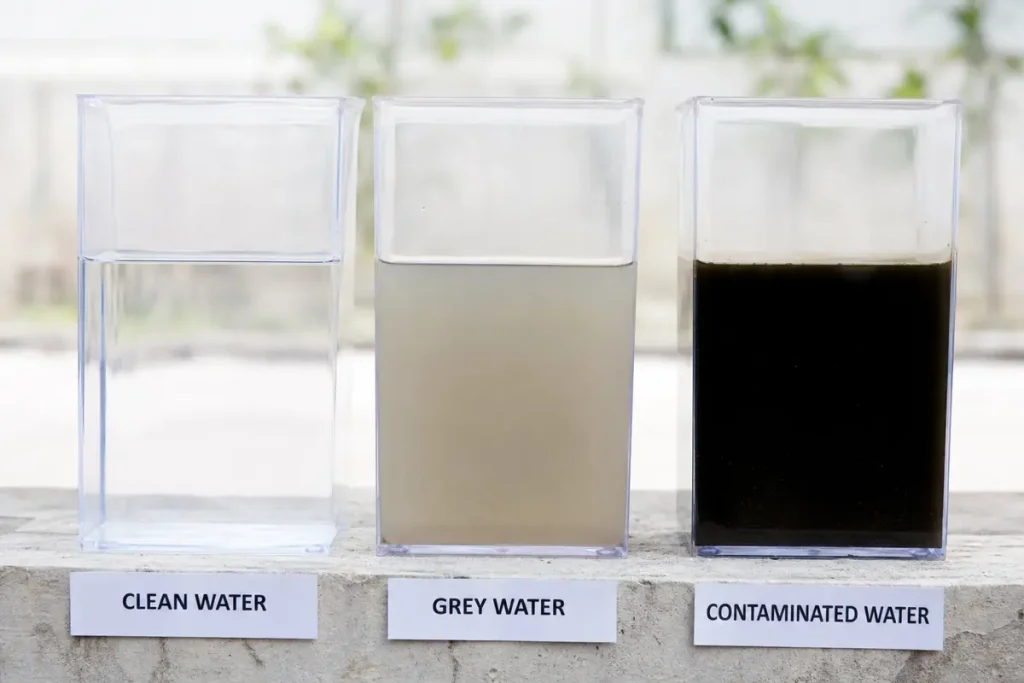
Water damage categories tell you how dangerous the water is, not how much water is in the building. That distinction matters fast, because the right label, clean, gray, or black, shapes your safety decisions, cleanup scope, and insurance documentation from the first hour.
What Water Damage Categories Mean
The contamination scale is straightforward: Category 1 is clean water, Category 2 is gray water, and Category 3 is black water. Under the ANSI/IICRC S500 framework, the category reflects health risk based on source and contamination level, not square footage or drying difficulty. A small sewage spill ranks higher than a large supply-line leak because contamination drives the category.
That matters because water losses are common and expensive. The Insurance Information Institute and Verisk data indicate that water damage and freezing account for about 29.4% of homeowners insurance claims, roughly 1 in 60 insured homes files this type of claim each year, and the average payout sits around $13,954. SERVPRO’s restoration guidance also notes that categorization happens before the mitigation plan because the category affects handling and can affect claim evaluation. The Insurance Information Institute and Verisk data indicate that water damage and freezing account for about 29.
In practice, fast identification changes three things immediately. First, it determines whether you should stay out of the area. Second, it determines how much material removal and disinfection the job requires. Third, it affects how clearly you describe the loss to your insurer and restoration contractor.
Finding: Water damage categories measure contamination risk, and getting the category right early affects safety, cleanup, and claim handling.
Category 1: Clean Water
Category 1 means sanitary water from a source that does not pose substantial harm to human health at the start. Sources recognized in IICRC-aligned and public health guidance include broken supply lines, appliance supply-line leaks, overflowing sinks or tubs with clean water, water heater leaks, toilet tank failures, and rainwater before it contacts contaminated surfaces. The water begins clean.
But clean water does not stay clean for long. Once it moves across drywall, subfloor, carpet backing, dust, adhesives, or insulation, the contamination level rises. Public health guidance from the Massachusetts Department of Public Health, citing EPA and related standards, points to a 24 to 48 hour drying window for wet porous materials before mold growth and material loss become far more likely. That is why even a simple supply-line leak becomes a restoration problem if it sits.
The catch is visual appearance tells you almost nothing here. Clear water on a hardwood floor still demands urgency because the category describes source sanitation, not future conditions after hours of contact and absorption. If you want a deeper breakdown of that shift, this explanation of how fast sanitary water degrades covers the timeline in more detail.
Finding: Category 1 starts as sanitary water, but speed determines whether it stays that way.
Common Louisville-Area Examples of Clean Water Losses
Louisville properties see Category 1 losses in very ordinary ways. Winter cold snaps split supply lines in exterior walls and crawlspaces. Older multi-story homes in Old Louisville get upstairs bathroom line failures that soak plaster, trim, and ceilings below. East End and South End homes see water heater leaks in basements, garages, and utility rooms, often with wide spread before discovery.
The scale of the loss does not change the starting category. A burst pipe that floods three rooms can still be Category 1 if the source is a clean domestic line. The contamination risk comes from the source and contact path, not from how dramatic the scene looks when you open the door.
Finding: In Louisville-area properties, a large clean-water loss is still Category 1 at the source, but it degrades quickly once it spreads.
Category 2: Gray Water
Category 2 is water with significant contamination that can cause illness through contact or ingestion. Sources repeatedly cited in restoration and public health guidance include washing machine discharge, dishwasher leaks or overflow, sump-pit overflows, toilet overflow with urine only, and certain seepage or condensate-related situations. This is not sanitary water.
Gray water often fools property owners because it may not look dirty. Detergents, microbes, organic residue, and contaminated contact surfaces push it beyond the “clean water” label even when the water appears clear or only slightly cloudy. That is why a laundry-room overflow needs a different response than a fresh broken supply line.
Cost data reflects that higher handling burden. RubyHome’s 2024 cost summary places clean-water restoration at about $3 to $4 per square foot, while gray water restoration runs around $4 to $6.50 per square foot because cleaning, protective handling, and material loss increase. For a focused look at the health and material risks, this page on why contaminated discharge is more serious than it looks adds detail.
Finding: Category 2 water is contaminated enough to cause illness, even when it does not look visibly dirty.
How Clean Water Turns Into Gray Water
Time and exposure drive the change. Sanitary water that sits on flooring, seeps under baseboards, contacts dust and adhesives, or wicks into insulation starts picking up contaminants. Microbial growth adds another layer of risk. That is why a delayed response changes the category even if the original source was a clean pipe.
There is one limitation worth stating plainly: no single clock tells you the exact moment Category 1 becomes Category 2. Environment, temperature, affected materials, and the water’s contact history all matter. The timing matters, but the source and exposure path matter just as much.
Finding: Delayed cleanup can raise the category, and source history matters alongside time.
Category 3: Black Water
Category 3 is grossly contaminated water that presents a serious health hazard. IICRC-aligned guidance and Massachusetts public health guidance define it as black water or grossly unsanitary water, and BELFOR describes it as grossly contaminated because it may contain sewage, pathogens, chemicals, and floodborne pollutants. Recognized biological risks include E. coli, Hepatitis A, Norovirus, and Rotavirus.
One rule is absolute: floodwater is treated as Category 3, even when it appears clear. External water travels through soil, streets, drainage systems, fuel residue, animal waste, and sewer-contaminated runoff before it reaches your building. Appearance does not lower the hazard.
Finding: Category 3 water is a biohazard, and all floodwater belongs in this category.
Common Sources of Black Water
Common sources include sewage backups, toilet backflow from beyond the trap, river or creek flooding, storm surge, groundwater mixed with runoff, and rainwater mixed with sewage or street contamination. In Louisville, that matters for basement units, low-lying lots, drainage-prone properties after heavy storms, and any structure near overflow-prone water paths.
A basement with only a thin layer of dark water after a storm is still a Category 3 event if the water entered from outside or from sewer backup. The contamination path controls the category.
Finding: Louisville-area black water losses usually come from sewage, storm runoff, and exterior flood intrusion, especially in basements and low spots.
Why Category 3 Requires Professional Cleanup
Professional black-water cleanup follows a controlled sequence: isolate the area, use PPE, establish containment and negative air pressure, extract contaminated water, remove non-restorable porous materials, disinfect, dry, monitor, and rebuild. BELFOR’s process description includes hazard evaluation, moisture mapping, barriers, HEPA filtration, disposal of unsalvageable porous materials, and EPA-registered disinfectants. Massachusetts public health guidance states that black-water and larger flood events should be handled by a professional cleanup contractor as soon as possible.
Here is the counter-finding that many owners miss: a small sewage intrusion is not a small problem. Category reflects contamination, not size. A five-square-foot sewage backup in a bathroom is higher risk than a much larger clean-water loss in a basement. More on that risk sits in this guide to what makes sewage-contaminated water so dangerous….
Finding: Category 3 requires professional remediation because contamination level, not square footage, determines the health risk.
Water Damage Categories Vs. Water Damage Classes
Category and class describe different parts of the same loss. Category tells you how contaminated the water is. Class tells you how much water was absorbed and how difficult drying will be.
MeasureWhat it meansExample
| Category 1 | Sanitary clean water | Burst supply line |
| Category 2 | Significantly contaminated water | Washing machine discharge |
| Category 3 | Grossly contaminated water | Sewage backup or floodwater |
| Class 1 | Low evaporation load, limited absorption | Small isolated wet area |
| Class 2 | Moderate spread and absorption | Wet carpet with wall wicking |
| Class 3 | Heavy saturation, high evaporation load | Multiple soaked rooms from overhead leak |
| Class 4 | Deeply bound moisture, specialty drying | Hardwood, plaster, brick |
A small sewage backup can be Category 3, Class 1. A clean-water line break soaking several rooms can be Category 1, Class 3. Class-based cost ranges help explain why claim totals vary so much: Class 1 jobs may run $150 to $400, Class 2 about $500 to $1,000, Class 3 about $1,000 to $3,000, and Class 4 specialty drying can jump to $20,000 to $100,000.
Finding: Category measures contamination, while class measures drying severity, and every loss has both.
A Simple Way to Identify Both on the Same Loss
Start with the source. Ask where the water came from and what it contacted before you found it. That gives you the category. Then ask how far it spread, how many materials absorbed it, and how deeply the moisture traveled. That gives you the class.
That order helps you describe the loss clearly when you call a restoration company or insurer. “A clean supply-line break that soaked two floors” tells a very different story than “a sewage backup limited to one bathroom,” even if the total wet area looks similar.
Finding: Identify contamination first, then drying scope, and your loss description becomes far more accurate.
What You Should Do First After Any Category of Water Damage
Immediate response follows a simple sequence. Stop the source if safe. Shut off electricity in affected areas if safe. Avoid contact with contaminated water. Photograph damage before moving or discarding materials. Move unaffected items out of the wet area. Then call a certified restoration company.
Speed matters because porous materials lose salvageability as saturation time increases. Massachusetts guidance says wet porous materials should be dried within 24 to 48 hours, and if wallboard is not sufficiently dried within 48 hours, removal is often required. The same time pressure applies to mold risk.
Finding: Your first job is to stop ongoing damage, stay safe, document everything, and get drying started immediately.
When You Can Handle It Yourself and When You Should Not
A minor Category 1 incident from a clean source can be handled without professional remediation only when you stop the source immediately and dry the area fully and fast. That means no hidden moisture, no soaked drywall cavities, no wet insulation, and no delayed discovery.
Category 2 and all Category 3 losses require professional assessment. Category 3 is a biohazard. Even when surface water looks minor, hidden moisture behind walls, under flooring, or inside insulation changes the decision.
Finding: DIY is limited to small, immediately dried Category 1 events, while Category 2 and Category 3 demand professional assessment.
What to Document for Insurance
Document the source of loss, when you discovered it, which rooms were affected, what materials were damaged, what emergency mitigation was performed, and whether sewer backup or external flooding was involved. Keep photos before disposal, invoices for extraction and drying, and notes from every call. That record matters because claim costs are high and coverage disputes usually turn on cause of loss, not on your description after the fact.
Coverage is not determined by category alone. Sudden internal plumbing failures are often covered. Flood damage generally requires separate flood insurance, and sewer backup often requires an endorsement. FEMA’s rule is clear: flood damage is not covered under standard homeowners policies.
Finding: Good claim documentation focuses on source, timeline, affected materials, and policy-triggering details such as flood or sewer involvement.
The Biggest Misconceptions About Water Damage Categories
The most common mistake is assuming clear water is always safe. It is not. Visual appearance is unreliable because contamination depends on source and contact path, not color. Another mistake is dismissing small sewage backups as minor. A limited black-water loss still carries a high health risk. A third mistake is confusing category with class, which leads to bad assumptions about cleanup scope and claim value. A fourth mistake is assuming insurance covers every water event, when policy language and cause of loss control the outcome.
There is also a limitation in many online explanations: simplified examples help, but real losses often involve mixed conditions. A sanitary leak discovered late, after hours of spread through dust, drywall, and flooring systems, no longer behaves like fresh Category 1 water.
Finding: Most mistakes come from judging water by appearance, size, or assumptions about coverage instead of source and exposure history.
Does Water Stay in the Same Category?
No. Water category worsens as water sits, spreads, and picks up contaminants. Delayed mitigation increases health risk, material loss, and claim cost.
Finding: Water damage categories can escalate over time, which is why delay gets expensive fast.
Is Floodwater Ever Category 1 or 2?
No. External floodwater is treated as Category 3 because the contamination path is unknown and routinely includes soil, fuel, sewage, and runoff.
Finding: Floodwater is always handled as black water, regardless of appearance.
Does Homeowners Insurance Cover Clean, Gray, and Black Water?
Insurance decisions depend on cause of loss and policy language, not just category. Sudden internal plumbing failures are often covered, while flood damage usually requires separate flood coverage and sewer backup often requires an endorsement.
Finding: Coverage follows the cause of loss, not the contamination label by itself.
How to Reduce Your Risk Before the Next Loss
Prevention is less glamorous than cleanup, but it is cheaper. Annual plumbing inspections catch weak supply lines and aging valves. Sump pump testing with battery backup protects basements during storms and outages. Backwater valves reduce sewage backflow risk. Gutter cleaning, downspout extensions, grading correction, and basement sealing lower exterior intrusion risk. Smart leak detectors catch the small clean-water losses that become gray or black problems after hours of unnoticed spread.
The data supports that focus. EPA figures cited in industry reporting estimate that the United States wastes 1 trillion gallons of water yearly through leaks and related issues, while flood-event data shows nearly every U.S. county has seen flood impact over time. Prevention is not overkill. It is basic property management.
Finding: The best defense is hiring water damage contractor in Louisville, KY and catching clean-water problems early and blocking the pathways that turn ordinary leaks into contaminated losses.

Read Our Reviews