
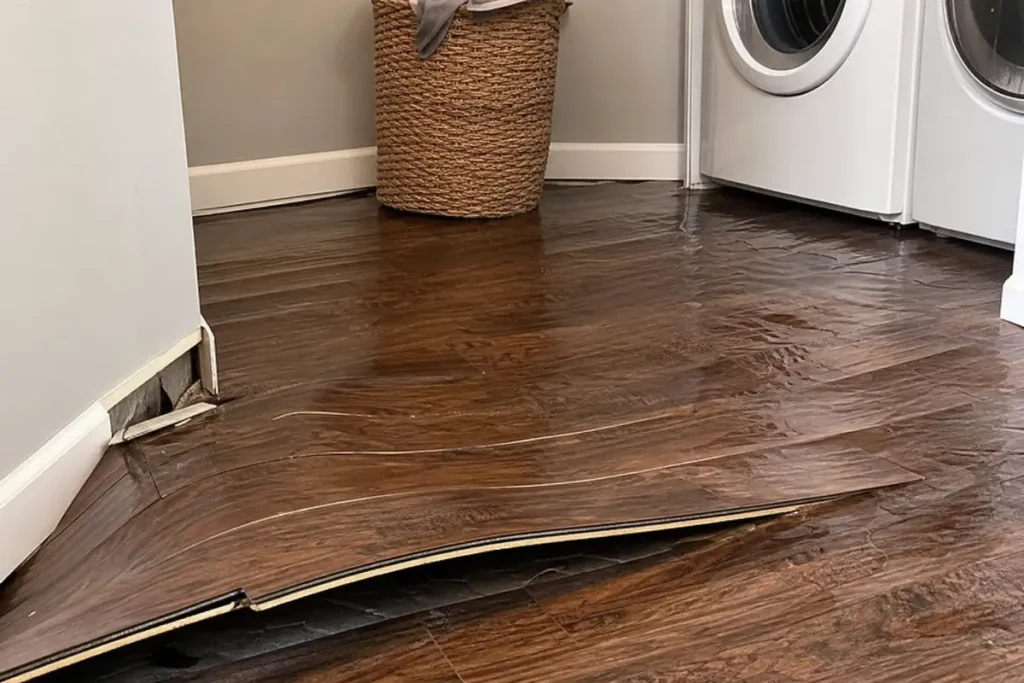
Washing machine overflow damage is water loss from a washer that escapes the appliance area and starts soaking nearby building materials, contents, and finishes almost immediately. The business stake is simple: fast response protects property value, rental uptime, tenant retention, and claim outcomes, while delay turns a contained laundry-room event into a wider demolition and rebuild loss. Based on field practice and IICRC restoration standards, the first 24 to 48 hours decide what stays in service and what gets torn out. Bear Restoration’s water damage restoration team is available 24/7 for emergencies.
What Washing Machine Overflow Damage Means and Why the First 48 Hours Decide the Loss
In plain English, washing machine overflow damage starts when wash water leaves the machine or its drain path and travels across the floor, under finishes, and into walls or lower levels. In Louisville housing stock, that spread looks different in an East End slab home than in an Old Louisville property with older trim, layered flooring, and more pathways for hidden migration. The pattern changes, but the rule does not: the loss gets worse by the hour.
What the field data shows is that visible water is only the surface event. The larger issue is absorption. Carpet pad, drywall, insulation, MDF trim, particleboard cabinetry, and boxed contents begin taking on water right away. Once that moisture sits beyond the drying window, salvage value drops fast and the repair scope expands from mitigation into reconstruction.
That timing also affects insurance position. A sudden washer malfunction generally fits the accidental-water-loss standard many policies recognize, but secondary damage grows harder to defend when the scene sits wet for days. That is why same-day documentation and drying are not just technical recommendations. They are claim-strength recommendations.
The First-Damage Sequence: What Gets Ruined First After a Washer Overflow
Based on analysis of restoration practice, washing machine overflow damage follows a predictable sequence. Water spreads low and wide first, then wicks upward and inward. Hard surfaces often show the incident first, but porous materials become the first true losses.
1. Flooring Surface, Carpet Pad, and Baseboards
The first contact point is usually the laundry room floor. Water runs to the lowest edge, crosses thresholds, follows grout lines and trim gaps, and reaches adjacent rooms in minutes. A supply or drain failure can flood in minutes, which is why a small-looking overflow routinely turns into a bigger flooring claim.
The first materials to get wet are often tile, vinyl, laminate edges, and any carpet at the room transition. But the first materials commonly ruined are usually the carpet pad and the baseboards. Pad acts like a sponge. Once gray water saturates it, the recommendation is removal, not surface drying. Fiberboard baseboards and lower trim swell, split, and lose profile quickly. Laminate seams also fail early because water gets under the wear layer and causes edge lift and core swelling.
That difference matters. A tile floor can be wet first and still be saved. The pad beneath the carpet a few feet away often cannot. The same goes for inexpensive trim. It looks minor, but it is often the first item that moves from wet to unsalvageable.
2. Drywall Bottom Edges, Insulation, and Wall Cavities
After water reaches the wall line, capillary action takes over. Drywall wicks moisture upward from the bottom edge, often well above the visible water line. Industry guidance shows that even shallow water can travel up drywall significantly, and if wallboard does not dry within the accepted window, removal becomes the recommendation.
Baseboards hide the next problem. Water moves behind them into wall cavities, wets the back side of drywall, and soaks insulation that no one can see from the room. Within 24 to 48 hours, wet porous materials enter the mold-risk zone. Massachusetts public health guidance is direct on this point: wallboard that has not dried sufficiently within 48 hours should be cut out and discarded, and wet insulation should also be removed.
This is where many owners underestimate the loss. The wall still looks mostly normal from eye level, but the bottom section is already failing from the inside.
3. Subflooring, Cabinet Toe Kicks, and Stored Contents
Once water gets below the finished floor, the subfloor becomes a major cost driver. Plywood can sometimes be dried if response is fast and moisture readings trend down. Particleboard and oriented fiber products do not perform the same way. They swell, soften, and lose structural stability early. The same pattern applies to cabinet toe kicks, vanity side panels, and laundry-room storage made from MDF or particleboard.
Stored contents on the floor also fail fast. Cardboard boxes, detergent cartons, pet supplies, paper goods, shoes, and fabric baskets absorb gray water immediately. Salvage decisions there are usually straightforward: porous contents with direct gray-water exposure lose value fast and are commonly discarded.
In multi-story properties, the spread does not stop at the room boundary. If the washer sits on an upper floor, the next loss often shows up below, where ceiling sagging and lower-level damage turn a laundry event into a two-floor restoration job.
What Gets Wet First Vs. What Gets Permanently Ruined First
This distinction is where claim scoping usually gets sharper. What gets wet first is not always what gets replaced first.
A porcelain tile floor often gets wet immediately and survives. Sealed concrete usually survives. Some sheet vinyl can survive if water has not migrated under seams and the drying starts quickly. But the materials around and under those surfaces tell the real story. Carpet pad, lower drywall, insulation, MDF trim, cabinet toe kicks, and particleboard shelving often become the first permanent losses because they absorb contaminated water and do not return to pre-loss condition.
Based on field inspections, underestimation starts when someone looks only at the visible puddle. The better question is this: which porous materials sat in contact with gray water, and for how long? That is the sequence that determines demolition scope, not the shininess of the floor after the puddle is wiped up.
The Three Drivers That Decide Severity
Three drivers control severity in a washer overflow: water category, exposure time, and material type. Those three factors shape cost, sanitation requirements, tenant disruption, and insurance documentation.
Water Category: Why Washer Overflow Is Usually Gray Water
Washing machine overflow is generally treated as Category 2 gray water, not clean water. That classification is based on the contents of the discharge: detergent, soil from clothing, lint, body oils, and general wash contaminants. Public health guidance explicitly classifies washer overflow as Category 2 water, and restoration pricing reflects that difference.
The cost impact is real. Gray-water mitigation typically runs higher per square foot than clean-water drying because sanitation, handling, and disposal requirements are stricter. That is why a washer overflow should not be treated like a harmless spill from a supply line.
Exposure Time: Why 24, 48 Hours Changes the Job
The first few hours are extraction time. After that, the job becomes a moisture-control problem. Standing water disappears into pad, underlayment, wall bottoms, and subfloor. Then swelling starts, adhesives fail, odor develops, and microbial growth risk rises.
The turning point is 24 to 48 hours. Mold can begin growing on damp porous materials inside that window. Once that happens, the loss moves from drying and cleaning into remediation and rebuild. From a business standpoint, that means higher reserve expectations, longer downtime, and more tenant disruption.
Material Type: Why Porous Materials Fail Before Hard Surfaces
Porous materials fail first because they store water, not just contact it. Carpet pad, drywall, insulation, particleboard, engineered wood, and upholstered goods absorb deeply and dry slowly. Hard surfaces like tile and sealed concrete do the opposite. They get wet, but they do not hold moisture in the same way.
That is why hard-surface rooms still produce major losses. The visible floor survives while the hidden materials underneath and beside it fail. In many incidents, the tile is not the problem. Everything touching the tile edge is.
The Materials Most Likely to Be Saved Vs. the Materials Commonly Removed
Restoration practice is not guesswork. Material response follows known patterns. The recommendation is to sort materials by contamination, absorbency, and response speed, not by appearance alone.
Often Salvageable If Mitigation Starts Fast
Tile, sealed concrete, some solid wood components, and limited hard-surface finishes are often salvageable when extraction begins the same day and moisture verification confirms drying progress. Non-porous metal and plastic items usually return to service after cleaning and sanitation. Some solid-wood trim can also be saved if it has not swelled, split, or stayed wet beyond the drying window.
Even then, salvage is tied to measurement, not optimism. Moisture mapping, material readings, and verification after equipment runs decide the outcome. Surface dryness does not count.
Frequently Removed After Gray-Water Overflow
Carpet pad is one of the earliest removals. Laminate flooring follows closely because swollen cores and edge delamination do not reverse. Swollen baseboards, lower drywall sections, wet insulation, particleboard cabinetry, MDF side panels, and porous stored items are also common removals after gray-water overflow.
Field data is consistent here. Particleboard distorts within hours, and porous finishes lose dimensional stability quickly. Once that happens, repair labor rises and replacement becomes the cleaner, faster path.
A related cause matters too. Some overflows begin with a hidden mechanical issue rather than an obvious hose burst. Early signs of pump-related leakage and appliance discharge trouble often show up before the full overflow event.
Hidden Damage That Drives up Cost After the Visible Water Is Gone
The visible puddle disappears first. The hidden loss stays.
Water moves under baseboards, beneath underlayment, through floor penetrations, around plumbing chases, and into adjacent rooms that still look dry at a glance. In older Louisville properties, gaps around trim and settled floor assemblies create even more migration routes. On upper floors, water tracks to joist bays and shows up later as stained ceilings or insulation saturation below.
This hidden spread is what drives cost. Drying chambers, selective demolition, insulation removal, cavity drying, odor treatment, and rebuild coordination all come from moisture that outran the visible scene. That also explains why a claim estimate rises after the initial visit. Mitigation defines the wet footprint. Build-back defines the final cost.
For landlords and small commercial owners, the business effect is broader than repair invoices. Delayed drying extends unit downtime, increases complaint volume, and weakens tenant retention. One flood-impact study found that a single day of interruption cost firms an average of 0.5% of annual revenue. A laundry-room overflow is smaller than a regional flood, but the principle holds: downtime compounds the loss.
What Insurance Usually Looks at After Washing Machine Overflow Damage
Insurance review usually centers on cause, timing, and mitigation. The adjuster is trying to separate sudden accidental discharge from long-term neglect and then measure what damage came directly from that event.
That is why the origin story matters. A sudden hose rupture, drain backup at the machine, or appliance malfunction reads very differently than a months-long seep at a connection. The resulting damage may look similar by the time the room is saturated, but policy treatment often does not.
Damage Often Covered: Sudden and Accidental Overflow
A sudden and accidental overflow generally fits standard water-damage coverage language. Sources reviewing current policy norms state that standard homeowners insurance often covers sudden and accidental water damage from appliance failure, including washer overflow events. The damage to floors, drywall, trim, and contents is evaluated, then mitigation, demolition, and repairs may be scoped as separate cost buckets.
One point catches many owners off guard: the resulting property damage is often covered, while the machine repair itself often is not. The appliance remains an out-of-pocket maintenance or equipment expense even when the surrounding damage is a covered loss.
Damage Often Denied or Limited: Gradual Leaks, Maintenance Failures, and Delay
Claims get weaker when the evidence shows a long-running leak, failed maintenance, unsecured drain lines, old hoses beyond service life, or delayed reporting. Policies commonly limit or exclude gradual seepage, repeated leakage, and neglect-related damage. Delay also creates a causation problem. Once the scene sits wet for days, the insurer has more room to argue that swelling, mold, and secondary damage came from failure to mitigate, not only from the original overflow.
That is one reason routine hose replacement matters. National claim reporting repeatedly points to washer hoses as a top failure source, and some guidance recommends replacement every 5 years. Preventive maintenance strengthens both risk control and claim defensibility.
The First Response Plan That Limits Structural Loss and Supports the Claim
The highest-value response follows four phases: stop the source, document conditions, extract and dry, then inspect hidden moisture. That sequence protects ROI because it limits spread, supports causation, and shortens rebuild scope.
Phase 1: Shut Off Water and Electricity to the Affected Area
Source control comes first. Water feeding the machine or the room must be shut off immediately. If outlets, cords, or the appliance area are wet, power to the affected area should also be shut off before anyone handles the machine. Wet floors around energized equipment create a direct safety hazard and a larger property-loss hazard if response is delayed.
Phase 2: Document the Cause, Water Path, and Damaged Materials
Photos, video, timestamps, and itemized notes should capture the source, the water path, and every affected material before disturbance changes the scene. The claim file needs to show suddenness, not just wetness. That includes the failed hose, drain issue, appliance malfunction, overflow line, stained walls, wet contents, and spread into adjacent rooms.
For the immediate sequence after a washer spill, the field approach aligns closely with the first six actions after a laundry-room flood: control the source, secure the area, record the evidence, and move quickly into extraction.
Phase 3: Begin Extraction, Air Movement, and Moisture Verification
Surface cleanup is not mitigation. Extraction, dehumidification, air movement, antimicrobial treatment when indicated, and moisture verification are what reduce actual loss. Gray-water incidents especially require more than towels and a box fan. Rental units and occupied properties also need documented drying because habitability, odor complaints, and turnover timing are all tied to whether the structure actually dried.
Professional mitigation outperforms cosmetic cleanup because the team measures the hidden moisture, not just the visible water. That is the difference between a room that looks dry and a building assembly that is dry.
Prevention Steps That Reduce Repeat Losses
Prevention pays back through lower claim frequency, lower vacancy risk, and fewer emergency rebuilds. Washer overflows are common enough to justify a standing prevention program in any managed property.
Replace Hoses, Secure Drains, and Check Connections on a Schedule
Supply hoses, drain lines, shutoff valves, and machine connections need scheduled inspection and replacement, not casual observation once a year. Rubber hoses age out fast. Braided lines generally hold up better under pressure and vibration. For owners comparing options, the practical difference between standard rubber lines and braided upgrades is directly tied to failure rate and loss prevention.
Drain hoses also need secure placement and correct standpipe fit. A loose drain line can send a full discharge onto the floor without any plumbing break at all. Washer leveling matters too, because vibration works fittings loose over time.
Add Drain Pans, Leak Detectors, and Shutoff Devices
Drain pans, leak alarms, and automatic shutoff devices limit spread and cut response time. Basic leak detectors are inexpensive relative to even a modest flooring claim. Smart shutoff devices cost more up front, but in rental portfolios and second-floor laundry setups they materially reduce loss severity.
These controls do not replace maintenance. They shorten the time between failure and response, which is what protects the building.
The Recommendation: Treat Any Washer Overflow as a Time-Sensitive Gray-Water Loss
The recommendation is direct: every washing machine overflow should be treated as a time-sensitive gray-water loss until testing and inspection prove otherwise. Porous materials at floor level are the first likely losses, hidden moisture spreads faster than the surface suggests, and the 24 to 48 hour threshold is the line between a controlled mitigation job and a larger remediation-and-rebuild project. Fast same-day action protects property value, keeps units in service, and puts the claim on stronger footing.

Read Our Reviews