
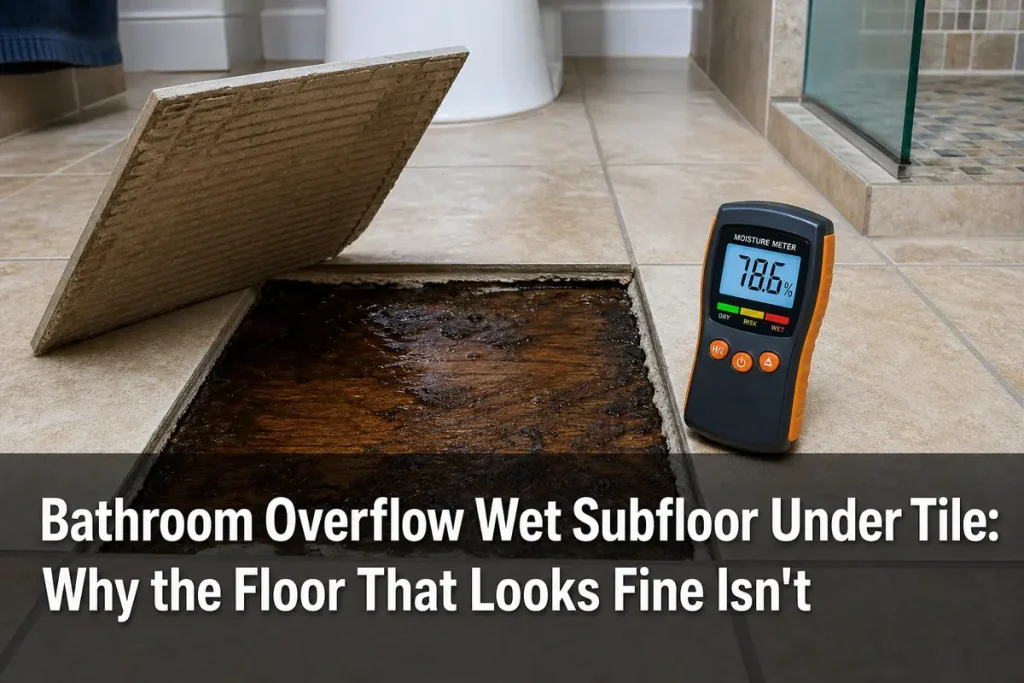
A bathroom overflow leaving a wet subfloor under tile is the most deceptive outcome in residential water damage, because the evidence dries first and the problem dries last. Tile and stone shed surface water within hours. Meanwhile the grout lines have already wicked water into the mortar bed and cement board below, and those cementitious layers hold moisture against the wood subfloor for weeks.
The deception works on everyone, including experienced homeowners. A St. Matthews mid-century bath overflows on a Saturday, the tile is squeegeed dry by Sunday, and the floor passes every visual and touch inspection for a month. Then the vanity toe kick smells musty, or a floor register downstairs exhales something earthy, and the investigation that follows finds a subfloor that never stopped being wet. Understanding the sandwich under the tile explains the whole timeline.
How Does Water Get Through a Tiled Floor in the First Place?
Water passes a tiled floor through its joints, not its tiles. Cement grout is porous and absorbs water readily, especially where sealer has worn thin, and caulk lines at the tub, toilet, and wall perimeter crack with normal building movement. Every fixture penetration, the toilet flange above all, is a direct channel to the layers below.
The flange deserves special attention because it is a designed hole in the floor. The wax ring seals the drain path, but the annular gap around the flange is open construction, and overflow water pooling around a toilet base pours through it into the subfloor and joist bay. Additionally, older Louisville baths often carry decades of remodel history: hairline cracks in original mud-set mortar beds, gaps where cement board seams were never taped, and grout that last saw sealer during a previous administration. Consequently, an overflow does not need to defeat the tile. It walks through the doors the assembly already left open.
Why Does the Mortar Bed Hold Water for Weeks?
The mortar bed holds water because cementitious materials absorb moisture readily but release it only as slow vapor, and a glazed tile surface above blocks the primary escape route. The result is a saturated mineral layer pressed directly against a wood subfloor, drying at a rate measured in weeks while wood decay organisms work on a schedule measured in days.
The moisture meter readings tell the story with numbers. On these investigations we routinely find surface tile reading dry while deep readings at the subfloor sit at saturation, a spread that would be impossible if the assembly could breathe. Trapped between tile above and, in many baths, a vinyl crawl space vapor barrier or finished ceiling below, the wet layer becomes the stable damp environment that the EPA's moisture guidance identifies as ideal for fungal growth, and that sustained wood moisture above roughly 28 percent invites actual structural decay fungi, the organisms behind soft, spongy subfloors. The mold arrives first, in the dead-air cavities at the vanity toe kick and behind the tub skirt where humidity from the wet bed accumulates. The rot follows if the moisture persists.
How Do Professionals Confirm and Fix a Wet Subfloor Under Tile?
Professionals confirm the condition without demolition first: deep-reading moisture meters, thermal imaging to map the wet footprint, and inspection from below through the ceiling or crawl space when access exists. If the subfloor reads wet, the fix is targeted: dry from below where access allows, or remove flooring along the wet path and dry the structure to documented standard per the ANSI/IICRC S500 Standard.
The from-below option is the homeowner's best friend when it applies. On a recent St. Matthews job, an overflow had soaked the mortar bed and subfloor, but an accessible basement ceiling below let our crew open the joist bay from underneath, remove the wet insulation, and drive drying air against the subfloor's bottom face while the tile stayed intact. Daily readings walked the assembly down to dry standard in nine days, and the bathroom never lost a tile. When there is no access from below, the honest scope removes the flooring, because entombing a wet subfloor under an intact tile field trades a repair bill now for a structural one later.
Who Investigates Hidden Bathroom Water Damage in Louisville?
Bear Restoration, an IICRC Certified Firm (#70216409) founded by Emery and licensed in Kentucky (LIC-GBCL-24-00148), performs post-overflow investigations with metering and thermal imaging across Louisville, St. Matthews, Middletown, Jeffersontown, Shively, and Prospect, and dries or remediates exactly what the readings justify.
If your bathroom overflowed recently, even weeks ago, and something smells different, the tile may be telling you a comfortable lie. Call 502-200-6968, or start with our Louisville water damage restoration page. Overflows involving bowl contents route through our sewage cleanup protocol, and cavities that fed growth for a month are exactly what our mold remediation team clears to the S520 standard. The surface dried in hours. We check the layers that did not.
Frequently Asked Questions
Can thermal imaging really see moisture under tile?
It sees temperature differences that wet materials create through evaporative cooling, which maps the likely wet footprint. Readings are then confirmed with moisture meters, since imaging suggests and meters verify.
Will the wet mortar bed dry on its own eventually?
Eventually is the problem. Cementitious layers under glazed tile dry at a pace measured in weeks to months, while wood decay and mold operate on a schedule of days. Waiting is choosing the slower horse.
Do I have to remove the tile to fix a wet subfloor?
Not always. When a basement or crawl space gives access from below, the assembly can often be opened and dried from underneath with the tile intact, which is the first option we evaluate on every job.

Read Our Reviews