
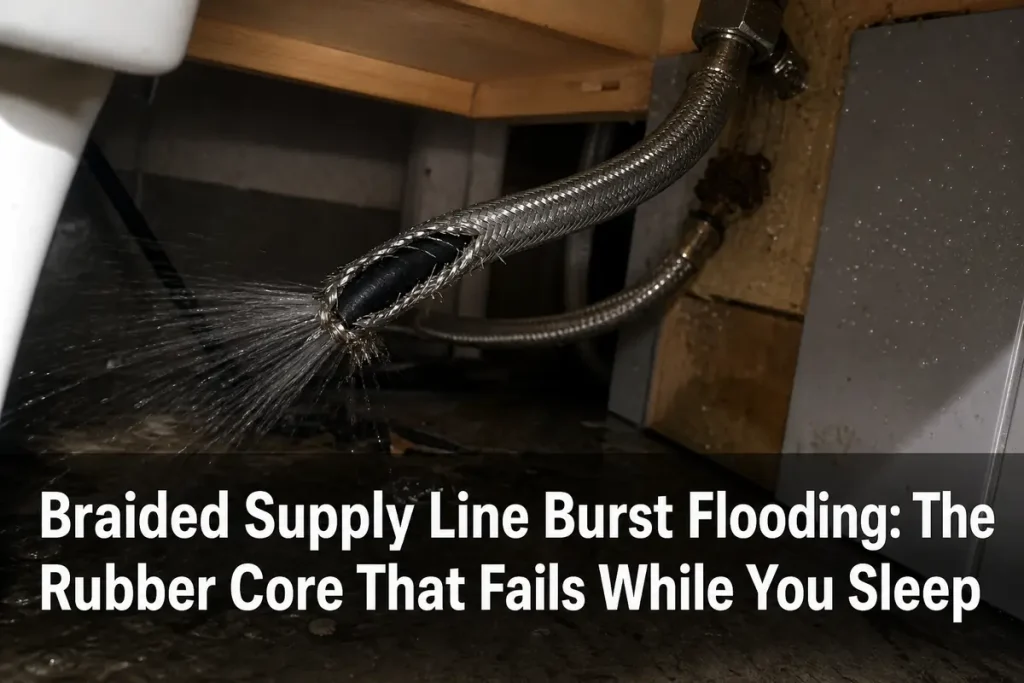
Braided supply line burst flooding is one of the most common and most preventable water losses in American homes, and the failure hides in plain sight. The shiny stainless braid on those flexible connectors is not the pipe. It is reinforcement around a polymer core, and when that inner core ages, cracks, or bulges through a gap in the braid, the line fails at full house pressure, often between 40 and 80 PSI, with nobody standing there to see it.
Insurance industry loss studies have ranked plumbing supply line failures among the leading causes of residential water damage for years, with the Insurance Institute for Business and Home Safety, IBHS, documenting that a large share of supply line claims involve exactly these flexible connectors. In Louisville homes from Jeffersontown to Shively, we find them in the same six places every time: both sides of every sink, every toilet, the washing machine, the dishwasher, the ice maker, and the water heater.
Why Do Braided Lines Fail More After Year Five?
Braided lines fail more after year five because the polymer core degrades on a chemical clock. Chlorine and chloramine in municipal water attack the rubber from inside, heat accelerates the reaction, and constant pressure works every microscopic flaw. IBHS research found the majority of failed washing machine hoses in claims data were older than five years, and the failure curve steepens with each year after.
The mechanics of the final failure come in two speeds. The catastrophic version is a core rupture that turns the connector into an open 4 to 8 gallon per minute line, capable of releasing thousands of gallons overnight. The insidious version is a pinhole weep at the crimped ferrule, releasing ounces per day into a vanity cabinet or behind a toilet for months, feeding a slow rot and mold colony that surfaces as smell before it surfaces as water. Additionally, overtightening at installation, kinked routing, and cheap fittings all shorten the clock. In our experience, the pinhole version causes more total damage in Louisville homes than the blowout, because the blowout at least announces itself.
What Does an Overnight Supply Line Burst Actually Cost a Home?
An overnight burst at 5 gallons per minute releases roughly 2,400 gallons in eight hours, close to 10 tons of water. In a Jeffersontown two-story, that volume saturates the bathroom, drops through the floor assembly, fills the ceiling below, wicks up first-floor walls, and finishes in the basement, converting one failed 15-dollar part into a three-level loss.
The scenario is not hypothetical. We worked a loss where a toilet connector let go in a Jeffersontown home while the family traveled for a weekend. Water ran for the better part of two days. The result touched every level of the house, and the drying plan under the ANSI/IICRC S500 Standard involved controlled removal of ceilings, flooring, and lower wall sections across multiple rooms, followed by nearly two weeks of documented structural drying. Consequently, the most valuable sentence in this entire article is the boring one: replace flexible supply lines on a schedule, roughly every five to seven years or per the manufacturer's stamp, and close the house's main valve before any trip longer than a weekend. Automatic leak shutoff valves, which several insurers now discount premiums for, close the loop for the trips you forget.
What Should You Do the Moment You Find a Burst Line?
The moment you find a burst line, close the fixture's stop valve, and if it will not turn or the failure is behind an appliance, close the main house shutoff. Then kill electricity to affected areas at the breaker, move what is dry to higher ground, and start photographing before cleanup begins, because the claim will want the story in pictures.
Speed after shutoff determines the recovery curve. Water extracted within hours keeps materials in the salvageable range. Water that stands for a day pushes drywall, insulation, and flooring past the point of drying in place, and by 48 hours the EPA's mold growth window is fully open on every damp surface. Professional extraction, moisture mapping, and sized dehumidification compress that timeline aggressively, which is precisely the work our crews are built for.
Who Responds to Supply Line Floods in Louisville?
Bear Restoration, an IICRC Certified Firm (#70216409) founded by Emery and licensed in Kentucky (LIC-GBCL-24-00148), responds to supply line floods across Louisville, Jeffersontown, Middletown, St. Matthews, Shively, and Prospect, from emergency extraction through documented dry standard and rebuild coordination.
If a braided line has failed in your home, the volume math is already written and the drying clock is running. Call 502-200-6968, or review our Louisville water damage restoration process. Multi-level losses that reached the lowest floor go through our flooded basement cleanup team, and slow pinhole leaks discovered late almost always involve our mold remediation specialists. Fifteen dollars of preventive hose beats ten tons of water every single time.
Frequently Asked Questions
How do I know how old my supply lines are?
Many lines carry a date stamp on the crimp collar or hose body. No stamp and no memory of replacing them is itself an answer. In a home you bought more than five years ago, assume they are due.
Are all braided lines equally risky?
No. Lines with brass fittings and quality cores outlast bargain versions, and some manufacturers warranty their premium lines for longer service. Whatever the brand, routing without kinks and hand-tight-plus installation extend life.
Do automatic water shutoff valves really prevent these losses?
The good ones do. Flow-sensing valves close the main when they detect continuous unusual flow, turning an overnight 2,400-gallon loss into a few gallons. Several insurers discount premiums for installing them.

Read Our Reviews