
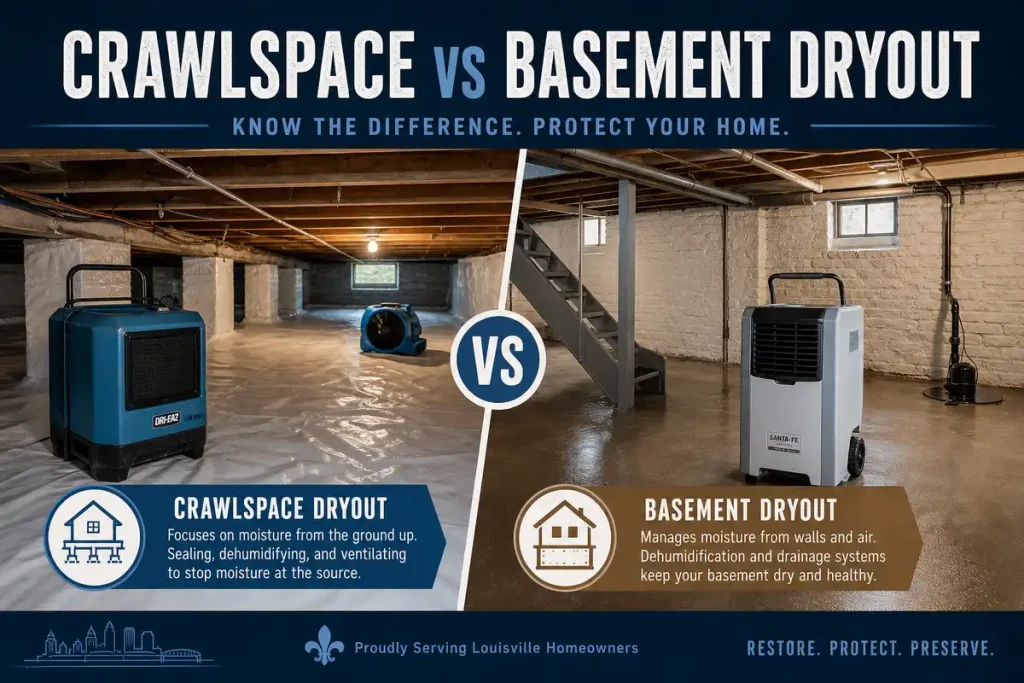
If a Louisville water loss is handled with the wrong drying strategy, the invoice climbs, the claim gets harder to defend, and hidden moisture keeps working against property value. Crawlspace Versus Basement Dryout Divergence in Louisville’s East End and South End Housing Stock is not a technical side issue, it is the factor that determines speed, contamination control, and long-term stability. For most East End properties, basement dryout wins on access and turnaround, but for older South End housing, crawlspace dryout demands faster priority because the hidden structural and air-quality risk is higher. For professional help, contact Bear Restoration’s water damage restoration team.
Quick Overview of Crawlspace Dryout vs Basement Dryout in Louisville Homes
Crawlspace dryout means removing water, mud, humidity, and contamination from the shallow area below the floor system. Basement dryout means extracting water and drying a larger below-grade room or finished lower level with easier access and wider equipment placement.
That sounds simple. The operational difference is not.
Based on analysis of Louisville housing stock, East End and South End properties create two very different restoration tracks. Basement losses usually stabilize faster, produce cleaner moisture maps, and allow stronger day-by-day monitoring. Crawlspace losses usually demand tighter controls, more sanitation work, more documentation, and a longer path to dry standards, even when the footprint is smaller.
The recommendation is direct: if the loss is in a basement, the focus is usually speed and finish preservation. If the loss is in a crawlspace, the focus is usually structural protection, contamination control, and indoor air quality. That distinction drives lower mold risk, stronger insurance files, and better long-term property performance.
Louisville Housing Stock: Why East End and South End Homes Dry Differently
Louisville does not behave like a single housing market during a water loss. Foundation type, build era, grading, utility routing, and remodel history all shape the dryout plan.
In the East End, newer subdivisions and larger finished lower levels create losses that are easier to reach but more expensive to rebuild. In the South End, older homes with lower-clearance crawlspaces, mixed foundation transitions, and aging drainage systems create losses that are harder to inspect and slower to correct. What the field data shows is that neighborhood housing patterns are not background detail. They set the drying method from day one.
East End Housing Patterns and Typical Water Intrusion Paths
East End homes often include full basements, partial below-grade walls, sump systems, and finished family-room layouts. Water commonly enters through sump failure, window wells, perimeter seepage, or appliance and plumbing leaks. During high-volume storms, battery backup limits and discharge issues become decisive, especially during events like those described in local sump failure analysis during 6-inch rain events.
These conditions change equipment choice immediately. Open floor plans, stair access, and utility clearances support faster extraction and broader airflow. But finished walls, luxury vinyl planks, insulation behind lower-level drywall, and built-in cabinetry create hidden wet zones that expand the rebuild.
South End Housing Patterns and Typical Water Intrusion Paths
South End properties more often present vented crawlspaces, pier-and-beam sections, older additions, low-clearance access points, and drains with decades of wear. Water intrusion paths include ground saturation, storm runoff, failed grading, plumbing breaks below the floor, and repeated moisture cycling after heavy rainfall.
That mix raises the labor intensity fast. Mud, standing water under insulation, rodent contamination, and damp framing shift the job from simple drying to controlled remediation. Smaller square footage does not reduce the scope. It usually increases the difficulty.
Access and Inspection Complexity
Access determines labor hours, safety exposure, and the accuracy of the initial scope. That makes it one of the biggest divergences between crawlspace and basement dryout.
Basements are visible. Crawlspaces are not. That difference affects every decision that follows.
Crawlspace Access Constraints
Low clearance slows every phase: entry, extraction, moisture readings, sanitation, and daily monitoring. Sagging insulation, ductwork, electrical runs, debris, and confined movement zones reduce setup speed and limit line-of-sight documentation.
The business outcome is slower time-to-value on mitigation. More labor hours are spent just making the workspace usable. That delay matters because moisture in subflooring and joists keeps migrating upward while the setup is still underway.
Basement Access Advantages and Hidden Obstacles
Basements usually provide stair access, standing room, better lighting, and easier equipment placement. Moisture mapping is more complete, photo documentation is easier to produce, and progress is easier to show to a carrier.
But there is a catch. Finished basements hide water inside wall cavities, behind base trim, under floating floors, and inside lower cabinets. The apparent simplicity of a basement loss often masks a larger reconstruction bill. Drying is easier. Rebuilding is often not.
Water Source and Contamination Risk
The source of water changes the recommendation immediately. Clean supply-line water, gray water from appliance discharge, and black water from sewage or outside runoff do not belong in the same category.
In crawlspaces, water more often arrives with soil contact and contamination. In basements, interior system failures are more common. That difference shapes demolition decisions, PPE requirements, and claim documentation.
Crawlspaces and Groundwater-Driven Contamination
Crawlspaces collect groundwater intrusion, mud, organic debris, vapor rise, and animal waste. Standing water under insulation or on exposed soil usually pushes the job into a more controlled remediation track, especially after stormwater entry or combined sewer influence. If sewage or heavily contaminated floodwater is involved, the sanitation standard lines up with the conditions described in Louisville Category 3 backup guidance.
Insurance files need more support here. Photo-heavy condition records, category notes, and moisture progression logs are not optional. Without that, contamination severity gets challenged and payout position weakens.
Basements and Interior System Failures
Basement losses often start with sump failure, water heater rupture, washing machine overflow, foundation seepage, or sewer backup. If the source is clean and addressed quickly, drying and selective material removal are often enough. If the source is black water, drywall cut-out, content disposal, and deep sanitation become mandatory.
The source category is the decision point. A clean sump overflow in an unfinished basement is a dryout job first. A sewer backup into a finished lower level is a demolition and controlled remediation job first.
Drying Speed and Moisture Control
Based on field data, crawlspaces dry slower than most basements. Enclosed soil surfaces, low airflow, cooler temperatures, and harder equipment service all work against drying efficiency.
Basements still lose time, just in different ways. The moisture leaves faster, but hidden finish assemblies often keep part of the loss active after the open areas look dry.
Airflow, Evaporation, and Structural Materials
Material mix matters more than square footage alone. Crawlspaces combine soil, masonry, joists, beams, insulation, and subflooring. Those materials hold moisture differently and release it unevenly. Exposed earth keeps feeding humidity back into the space unless vapor control is handled correctly.
Basements are usually concrete, masonry, drywall, and floor finishes. Air movement is easier to establish, and evaporation is easier to control, especially when standing water is extracted early. But dense finish assemblies can trap moisture in ways that delay clearance.
Vapor Pressure and Secondary Moisture Migration
When drying starts late, moisture does not stay where the water entered. It pushes upward into wall cavities, flooring systems, and occupied rooms. Louisville summer humidity makes that worse, especially during periods outlined in local drying limits during July and August dew points.
That is why stalled crawlspace drying often turns into odor complaints and flooring damage upstairs. Basement losses more often spread laterally into finishes and stored contents. Both are expensive. Crawlspaces just hide the damage longer.
Equipment and Setup Requirements
Crawlspaces often require more specialized setup than basements, despite the smaller footprint. That surprises owners and frustrates adjusters, but the field data is clear.
Equipment density, monitoring frequency, and containment planning all trend higher below a crawlspace floor.
Crawlspace Equipment Profile
Crawlspace jobs often require low-profile air movers, LGR or desiccant dehumidification, vapor barrier sections, remote sensors, and negative air setups when contamination is present. Tight access means more hand-carry labor, slower repositioning, and more setup time per square foot.
That drives rental cost and labor cost upward. The ROI comes from avoided structural deterioration, reduced odor carry-through, and lower risk of a repeat moisture event under the living space.
Basement Equipment Profile
Basement jobs usually support faster extraction with standard units, broader air mover coverage, conventional dehumidifier placement, and easier daily adjustments. When lower walls are wet but not fully removed, injectidry systems help target concealed cavities without opening every assembly.
Basement jobs scale faster because the space is serviceable. More equipment can be placed in less time, and daily readings are easier to collect. That operational advantage is why basement dryout usually wins on speed.
Mold Risk and Indoor Air Quality Impact
Crawlspace moisture has a stronger whole-home air impact. Basement moisture usually damages finishes and contents first. That is the key divergence.
If the concern is indoor air quality, crawlspace losses demand a higher level of urgency.
Crawlspace Mold Amplification Through Stack Effect
Air rises through the structure. Damp crawlspace conditions, microbial growth, and odor compounds move upward into occupied rooms through the stack effect. That means a wet crawlspace is not isolated. It becomes a whole-property air problem.
In rental housing and small commercial occupancy, that drives complaints, lowers retention, and increases callback exposure. Delayed drying below the floor system damages more than lumber. It damages confidence in the property.
Basement Mold Risk in Finished Lower Levels
Finished basements carry a different mold profile. Carpet pad, drywall, base trim, cabinetry, and stored contents trap moisture and support quick microbial growth after even a short wetting period. The dryout may be straightforward, but the restoration scope grows fast once finishes are involved.
That is why a basement loss often presents the larger visible invoice. The mold risk concentrates in finishes, not hidden framing.
Structural and Finish Damage Exposure
Crawlspace and basement losses threaten different asset classes. One hits structure first. The other hits finishes first.
That difference should shape the response plan and the claim strategy.
Crawlspace Damage Profile
Crawlspace water events put joists, beams, sill plates, insulation, subflooring, and suspended mechanical lines at risk. Prolonged wetting reduces material stability, raises fastener corrosion exposure, and creates recurring humidity under the home.
If the loss is ignored or under-scoped, the long-term performance of the floor system declines. Odors persist. Floor coverings above begin to show the consequences later, when the direct cause is harder to prove.
Basement Damage Profile
Basement losses typically damage drywall, trim, outlets, flooring, cabinets, doors, stored contents, and furniture. The structural shell often survives better than the finishes, but the rebuild invoice climbs quickly because materials are visible, finished, and labor-intensive to replace.
That makes basement losses feel more severe to owners. The visible damage is higher. The hidden structural risk is usually lower than in a neglected crawlspace.
Insurance Documentation and Claim Position
Stronger documentation drives faster approvals and fewer disputes. That is especially true in Louisville losses involving stormwater, seepage arguments, sewage, and older foundation conditions.
Based on analysis of restoration claims, crawlspace files need more defense than basement files.
Crawlspace Claims: What Carriers Scrutinize
Carriers scrutinize contamination category, pre-existing moisture allegations, access limitations, and the distinction between sudden loss and long-term dampness. Incomplete notes and weak photo records create avoidable friction. Daily readings matter, especially when the drying path is slow and less visible, which is why disciplined moisture tracking and defensible drying logs strengthen payout position.
Crawlspace claims fail when the file does not prove what changed, how wet the materials were, and what sanitation steps were required. Hidden work needs visible records.
Basement Claims: Common Approval and Denial Triggers
Basement claims usually turn on sump exclusions, sewer backup endorsements, content inventory quality, and the separation between mitigation and remodel upgrades. Finished-space damage is easier to prove, but coverage disputes still appear when water entered from repeated seepage, exterior hydrostatic pressure, or excluded backup routes. Foundation-driven losses tied to prolonged rainfall often need context like how older Louisville foundations fail after sustained rain.
The strongest basement claim files show source, timeline, affected materials, and daily mitigation progress without gaps.
Cost Comparison: Crawlspace vs Basement Dryout
Smaller does not mean cheaper. That is the most common cost mistake in this comparison.
Crawlspaces often cost more per square foot to dry. Basements often cost more in total once finishes and contents are included.
What Drives Crawlspace Dryout Costs
Crawlspace cost drivers include confined-space labor, debris removal, underfloor sanitation, wet insulation removal, vapor barrier work, antimicrobial treatment, longer equipment runs, and repeated low-clearance monitoring visits. If contamination is present, setup controls and PPE requirements raise the invoice again.
That spend protects structural value. The ROI is prevention of joist decay, subfloor damage, recurring odor, and repeat moisture losses that turn one event into a chronic condition.
What Drives Basement Dryout Costs
Basement cost drivers include larger extraction volume, broad equipment deployment, finished-material demolition, content handling, base trim and drywall removal, and more expensive rebuild overlap. Access is easier, but material count is higher.
A clean unfinished basement can dry quickly at a moderate cost. A finished lower level with cabinetry, flooring, and contents often becomes the more expensive total loss despite the easier mitigation path.
Timeline Comparison: Which Dryout Returns the Property Faster
Basement dryout usually returns the property faster from a mitigation standpoint. Crawlspace dryout usually takes longer to stabilize and longer to validate.
That difference matters for occupancy, rent continuity, and business interruption.
Crawlspace Timeline Expectations
Crawlspace jobs often spend the early phase on access, extraction, mud handling, sanitation, and vapor management before meaningful drying gains appear. True progress starts after the space is safe, clean enough to service, and properly equipped.
Schedule control depends on three checkpoints: source stop, contamination classification, and measurable reduction in wood and ambient moisture. If any one of those lags, the timeline slips immediately.
Basement Timeline Expectations
Basement extraction starts faster, equipment setup is quicker, and daily progress is easier to read. Moisture targets are often reached sooner in open areas, especially in unfinished spaces.
The delay usually starts after dry standards are met. Rebuild sequencing, flooring replacement, cabinet lead times, and content decisions can extend the total return-to-service date. Mitigation moves fast. Reconstruction often does not.
Best Use Cases: When Crawlspace Dryout Is the Better Recommendation
Crawlspace-focused mitigation is the better recommendation in older South End homes, vented crawlspaces, properties with subfloor wetting, repeated ground moisture intrusion, and buildings with odor-driven indoor air complaints. It is also the better choice when the visible water seems minor but the hidden structural and contamination exposure is not.
If the loss sits below the floor system and the air in the occupied rooms already smells damp, the crawlspace deserves first priority. That is where the business risk sits.
Best Use Cases: When Basement Dryout Is the Better Recommendation
Basement-focused mitigation wins in East End finished basements, sump failures, appliance leaks, utility-room floods, and properties where faster return to service protects rent continuity or daily use. It also wins when the affected materials are visible, reachable, and still salvageable.
If speed, direct access, and finish preservation are the main objectives, basement dryout is the stronger operational choice. That is why it usually produces better time-to-value.
Verdict: Which Dryout Strategy Wins for Louisville Homes?
Basement dryout wins on speed, serviceability, and easier claim support. If the property is in the East End with a finished lower level, the practical recommendation is to treat the basement loss aggressively and early to protect finishes, contents, and occupancy.
Crawlspace dryout demands the more specialized response and becomes the higher-priority recommendation in South End and older housing stock. Hidden structural wetting, contamination exposure, and whole-home air impact make it the more serious loss even when the water volume looks smaller.
The decision rule is simple: choose the strategy that protects the most exposed asset. In East End basements, that asset is usually finished space and faster return to use. In South End crawlspaces, that asset is the structure itself and the air moving through the home.
Per square foot, yes. Low clearance, contamination control, vapor management, and slower equipment service raise crawlspace costs. In total dollars, a finished basement can still exceed the crawlspace invoice because demolition and rebuild scope are larger.
A basement dries faster in most Louisville losses. Access is better, extraction starts sooner, and equipment placement is easier. Crawlspaces lose time on entry, sanitation, and airflow limitations.
Yes. Crawlspace claims face more scrutiny around contamination category, pre-existing dampness, and access-related documentation gaps. Basement claims more often turn on sump exclusions, sewer backup endorsements, and finished-material inventories.
Air movement pulls damp air, odors, and spores upward from below the floor system. That stack effect makes crawlspace moisture an indoor air quality problem, not just a hidden structural problem.
Demolition is required when contaminated water affects porous materials, when finished assemblies trap moisture beyond recovery, or when source category makes sanitation impossible without removal. Sewer backups and storm-driven contamination are the most common triggers.
Older South End homes, vented crawlspaces, low-clearance additions, and properties with recurring stormwater intrusion need the fastest response. Those conditions create the highest hidden risk to framing, subflooring, and indoor air quality.

Read Our Reviews