
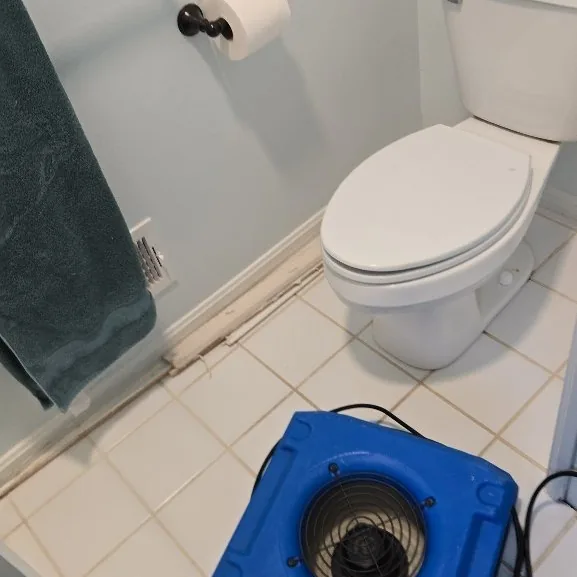
How Much Toilet Paper Does It Take to Flood a Bathroom? We Ran the Numbers
Roughly one standard roll. About 90 grams of wadded, waterlogged paper is enough to bridge the weir of a modern toilet trap, and once that bridge holds, the next flush puts water on your floor. The paper is not the flood, though. The paper is the cork. The flood is the 1.28 gallons behind it, arriving again and again until somebody notices.
That distinction is the whole point of this article, and it is the thing most Louisville homeowners get backwards when they call us. They think the question is how much toilet paper it takes to flood a bathroom. The real question is how long the paper holds and how much water shows up while it does.
The Short Version: One Roll to Clog, 25 Gallons to Flood
Start with the bathroom itself. A typical Louisville full bath, the kind you find in a Germantown shotgun or a St. Matthews ranch, runs about 5 feet by 8 feet, or 40 square feet of floor. Covering that floor in one inch of standing water takes 3.33 cubic feet, which works out to roughly 25 gallons.
Now bring in the toilet. A post-2010 high-efficiency fixture uses 1.28 gallons per flush, and the EPA notes that toilets account for nearly 30 percent of a home’s indoor water use. When a clogged bowl overflows, you do not lose the full 1.28 gallons to the floor. Call it a gallon. So somewhere around 25 panicked flushes gets you that first inch.
Nobody flushes 25 times, of course. That is not how these calls come in. What actually happens is the fill valve keeps running against a bowl that will not drain, or a flapper hangs open, or the homeowner leaves for work. The EPA estimates a running toilet wastes about 200 gallons every day. Spread 200 gallons across that same 40 square foot bathroom and you are looking at roughly eight inches of water. That is not a mopping situation. That is a subfloor.
So How Much Paper Actually Clogs It?
Here is where the physics gets specific. A modern toilet trapway measures about 2 to 2 1/8 inches across, and the S-bend path through it runs somewhere between 12 and 14 inches. That gives you a trap volume of roughly 46 cubic inches, or about 750 cubic centimeters.
Dry toilet paper is mostly air. A standard 2-ply roll holds around 150 sheets and weighs about 120 grams, and a mega roll runs closer to 260 grams. Soak it, compress it, and that fluff collapses to a pulp density around 0.8 grams per cubic centimeter. Do the arithmetic and fully packing a toilet trap solid takes roughly 600 grams of pulp, which is five to six standard rolls or a little over two mega rolls.
But you almost never need that. Consequently, the number that matters is much smaller. A clog does not fill a trap, it bridges one. Two inches of packed paper across the narrowest point is about 116 cubic centimeters, or 93 grams. Three quarters of a standard roll. One decent wad.
| What you are blocking | Wet pulp needed | Rough roll count | What happens next |
|---|---|---|---|
| Bridge the trap weir | About 90 g | Under 1 standard roll | Bowl backs up, the next flush hits the floor |
| Pack the S-trap solid | About 600 g | 5 to 6 standard rolls | Nothing moves, a plunger will not reach it |
| Block a 3-inch branch line | 1,500 g or more | 12 to 15 standard rolls | Auger job, tub and sink back up too |
| Choke a scaled 1890s cast iron lateral | Accumulates over weeks | No single number | Whole-house backup, Category 3 water |
Why Old Louisville Houses Clog on Less Paper
That last row is the one we see most, and it is the reason this stops being a bar-trivia question and starts being a restoration invoice.
A lot of the housing stock here predates the plumbing that serves it. Old Louisville Victorians from the 1880s and 1890s were built with 4-inch cast iron laterals. After 120 years, tuberculation and scale build up along the pipe wall, and that nominal 4 inches is functionally closer to 3. The interior surface is no longer smooth, either. It is rough, and rough pipe catches fiber.
Now stack a modern fixture on top of an antique drain. Toilets built before 1994 moved 3.5 gallons per flush, and plenty moved 5 or more. Those old drain lines were sized and sloped for that volume. Swap in a 1.28 gallon high-efficiency toilet, which is exactly what most owners of these homes have done, and you have cut the carry water by more than two thirds while the run to the main is still 40 or 50 feet of scaled iron at minimum slope. The paper does not make it out. It stalls halfway, snags on the scale, and builds. By contrast, the same toilet in a 1990s Fern Creek build with PVC and a short run will clear paper for decades without complaint.
As a result, the Old Louisville clog is rarely a single event. It is six weeks of accumulation and then one ordinary Tuesday.
Bear Restoration, owned by Emery, holds IICRC WRT and ASD certifications and has handled water losses across Louisville from the Highlands to Crescent Hill to Butchertown. In our experience, the second-floor bathroom in an Old Louisville mansion is the worst version of this problem, because the water does not stay in the bathroom. It finds the gap at the toilet flange, runs the joist bay, and lands on 130-year-old plaster ceilings that were never coming back.
The Part That Costs Money Is Not the Paper
Once water is on the floor, the clock that matters is a contamination clock, not a volume clock. Under the ANSI/IICRC S500 standard, water is graded by category. Clean supply water from the tank side is Category 1. Water that has overflowed the bowl carrying urine is Category 2. Anything backing up from beyond the trap, meaning the sewer side, is Category 3, and Category 3 means porous materials come out. Drywall, carpet pad, and particleboard vanity bases are not dried in place. They are removed.
More importantly, category is not static. Category 1 water degrades to Category 2 within 24 to 48 hours as it sits, picks up soils, and feeds bacteria. In practice this means the homeowner who mops up 20 gallons on Saturday and figures the tile looks fine has not solved anything. Tile is not the issue. The issue is what wicked under it.
Here is the number we would put in front of anyone who thinks a toilet overflow is a paper towel problem: drywall wicks water 12 to 18 inches above the visible waterline within the first day. You can have a dry floor and a wet wall cavity at the same time, and the wall cavity is where the mold grows. If you want the full sequence, our breakdown of what the water damage restoration process actually involves walks through extraction, psychrometrics, and clearance.
What To Do In the First Ten Minutes
The single highest-value move is also the least intuitive. Do not flush again. The second flush is what turns a clog into a claim, and it is the most common mistake we hear about on intake calls.
After that, reach behind the toilet and close the supply stop, the small oval or football-shaped valve on the wall. If it is seized, which is common on the original chrome stops in older Louisville homes, lift the tank lid and push the flapper down by hand to seal the tank. Then get towels down at the door threshold before water leaves the room, because containing 20 gallons in a bathroom is a fundamentally different job than chasing it across a hall floor.
If the water came from the sewer side, stop there and call. Emergency water extraction in Louisville is a 24-hour service for exactly this reason, and Category 3 work is not a shop vac and a box fan.
The Honest Answer
So, how much toilet paper does it take to flood a bathroom? Under a roll to start it. Zero additional rolls to finish it, because after the plug forms, the paper has done its entire job and the water takes over unsupervised.
That said, the funnier answer is that in a lot of Louisville houses, the paper does not even need to arrive all at once. It just needs six weeks and a pipe that was old when your grandmother was born.
If you are already past the trivia stage and there is water on your floor, call Bear Restoration at [PHONE]. We are on site the same day, and we can tell you in about fifteen minutes whether you have a mop job or a demo job. If it has been sitting more than a couple of days, start with mold remediation for Louisville homes instead.
Yes, if the bowl was already draining slowly. About 90 grams of paper, less than a standard roll, can bridge the trap. The flush that follows the clog is what overflows. In older Louisville homes with scaled cast iron laterals, the trap may not even be the blockage point.
Toilet paper disperses, it does not dissolve. The fibers break apart with agitation and carry water, which is why it clears a healthy line. In a rough, low-slope drain, the fibers snag instead of breaking apart, and that is where accumulation starts.
More than people expect. Twenty five gallons puts an inch across a typical 5 by 8 bathroom, and a toilet left running overnight can push 200 gallons. On a second floor, most of that never stays in the bathroom. It goes into the joist bay and lands on the ceiling below.
Frequently, yes, though the toilet is not the defect. A 1.28 gallon fixture on a long, scaled, minimum-slope cast iron lateral does not carry solids the way the 3.5 gallon fixture it replaced did. The pairing is the problem, not the fixture.
Sudden and accidental overflows are typically covered, while gradual seepage and long-term neglect usually are not. Sewer backup is often a separate endorsement rather than part of the base policy. Document everything with photos before cleanup, and let your restoration contractor coordinate with the adjuster directly.
Category 2 water carries significant contamination and can cause illness, such as bowl water containing urine. Category 3 is grossly contaminated, including sewage backing up from past the trap. Category 3 requires removal of affected porous materials rather than drying them in place.

Read Our Reviews