Middletown Ky

Mold remediation in Jeffersontown depends on one thing above all: controlling the spores before they spread to clean parts of the building. Bear Restoration, owned by Emery, runs every Jeffersontown project to the ANSI/IICRC S520 standard, the document that governs professional mold remediation across the United States. Call (502) 200-6968 for a same-day assessment anywhere in the 40299 and 40220 zip codes. Our crews hold IICRC certifications, which means the people setting up containment in your home actually understand the biology of what they are removing.

Jeffersontown sits east of the Watterson Expressway with a building stock heavy on 1960s through 1990s slab and crawlspace ranch homes, plus a dense band of commercial and warehouse space along Bluegrass Parkway. That mix matters. Slab-on-grade ranches off Taylorsville Road tend to hide mold behind baseboards where capillary moisture wicks up through the slab, while the crawlspace homes near Charlie Vettiner Park grow it on floor joists fed by ground humidity. The remediation approach is not the same for both, and a generic franchise crew often treats them identically.

Call (502) 200-6968

Why Jeffersontown Properties Grow Mold

Mold needs three things: a food source (drywall paper, wood, dust), moisture, and temperatures between roughly 40 and 100 degrees Fahrenheit. Louisville’s Ohio Valley climate supplies the moisture almost year round. Summer dew points in Jefferson County routinely sit in the low 70s, and the CDC notes that indoor relative humidity above 60 percent is enough to sustain active mold colonization. In a Jeffersontown crawlspace with no vapor barrier, ground evaporation alone can push the wood moisture content of floor joists past the 16 percent threshold where common molds like Aspergillus and Penicillium begin to colonize.

The other driver is the building stock itself. Many J-town subdivisions, including the Hurstbourne-adjacent developments built during the 1970s expansion, used unvented or poorly vented crawlspaces. As a result, we frequently find Stachybotrys chartarum, the slow-growing greenish-black mold that requires sustained saturation, on the underside of subfloors above those crawlspaces. More often, though, the culprit is a slow supply-line leak under a kitchen sink or a failed wax ring on a toilet, both of which feed a hidden colony for weeks before a homeowner smells the musty, earthy odor that microbial volatile organic compounds (MVOCs) produce.

Containment: The First and Most Important Step

Before a single moldy surface is touched, we build containment. The S520 standard requires it because disturbing a colony without it can raise airborne spore counts in adjacent rooms by orders of magnitude. For a contained bathroom or closet in a J-town ranch, we frame 6-mil polyethylene sheeting into a sealed enclosure and establish a decontamination chamber at the entry. For larger jobs, such as a finished basement off Six Mile Lane that flooded and sat for a week, we use a full critical barrier with a double-layer airlock.

Inside that containment, we run negative air pressure. A HEPA-filtered air scrubber pulls air out of the work zone and exhausts it outside, so the enclosure stays at lower pressure than the rest of the house. Consequently, any air that moves does so into the containment, never out of it. We verify the pressure differential with a manometer and target the negative 5 pascals that keeps spores from migrating into the living space your family still occupies.

Nearby Areas in Jeffersontown We Provide Mold Removal & Remediation

As you know, we also provide mold remediation & removal services throughout the Louisville Metro Area.

View All Areas

HEPA Filtration and Air Scrubbing

A true HEPA filter captures 99.97 percent of particles at 0.3 microns, the most penetrating particle size. That specification matters because most mold spores range from 2 to 10 microns, well within HEPA’s capture range, while the fragments and hyphae that break off during removal can be smaller. We size air scrubbers to achieve a minimum of four air changes per hour inside containment, and on heavier Stachybotrys jobs we push toward six. After removal, every surface inside the containment gets HEPA vacuumed and damp-wiped, because S520 treats spore-laden settled dust as part of the contamination, not an afterthought.

The Remediation Process for J-town Homes

When we respond to mold in a Jeffersontown slab ranch, we start by mapping the moisture with a pinless meter and a thermal camera to find the actual source, not just the visible growth. Visible mold on a baseboard usually means a larger reservoir is hidden inside the wall cavity. Next, we set containment and negative air, then physically remove the non-salvageable porous materials: moldy drywall cut 12 to 18 inches above the visible line, saturated insulation, and any carpet pad that wicked water. Mold does not “clean off” porous materials reliably, and S520 is explicit that heavily colonized porous building materials are removed rather than treated.

Semi-porous structural wood, by contrast, is often salvageable. We HEPA vacuum it, then use abrasive methods such as soda or media blasting on heavily colonized joists, followed by an antimicrobial applied per label. We do not “paint over” mold with a fogger and call it done, a shortcut that fails post-remediation verification. After cleaning, we dry the structure to a documented target and only then break containment. A third-party industrial hygienist clearance test, which we recommend on any job involving health complaints, confirms airborne spore counts inside match or beat the outdoor baseline.

Indoor Air Quality and Health Risks

The reason any of this matters is health. The EPA and CDC both link indoor mold exposure to upper respiratory symptoms, coughing, wheezing, and asthma aggravation, with stronger effects in children, the elderly, and immunocompromised people. A 2004 Institute of Medicine review found sufficient evidence connecting indoor dampness and mold to respiratory illness. For Jeffersontown families with kids in the Jefferson County schools nearby, or seniors in the area’s many single-story ranches, restoring indoor air quality is not cosmetic. We document spore counts before and after so the improvement is measurable, not assumed.

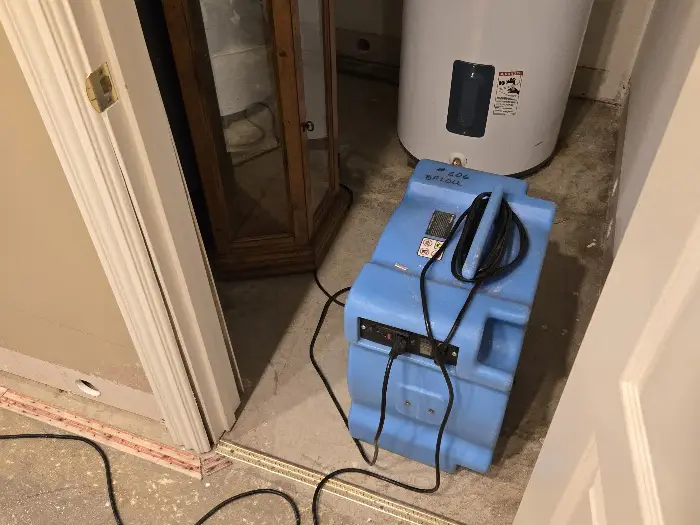
Water damage restoration equipment Bear Restoration Louisville KY
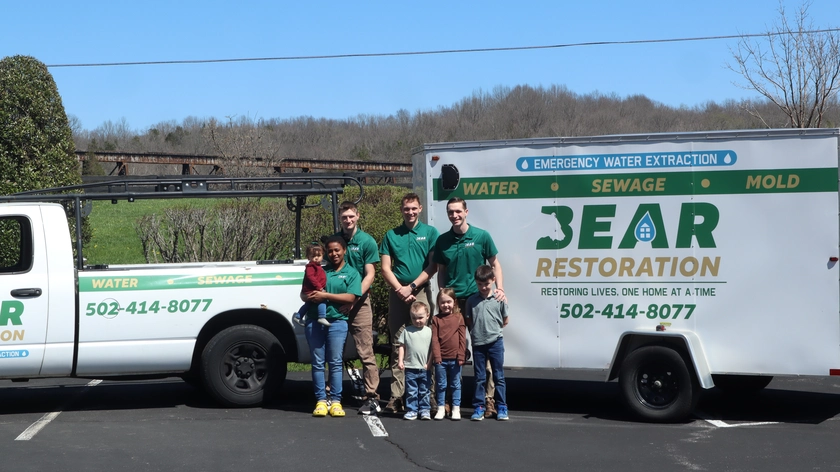
Bear Restoration team photo with service truck Louisville KY
emergency water extraction from utility room

Real Jeffersontown Mold Damage Situations

A common J-town call: a homeowner near Blankenbaker Parkway notices buckling laminate in a hallway and a musty smell near the HVAC return. The cause turns out to be a condensate line that backed up inside the air handler closet, feeding mold into the return plenum, which then distributed spores through the whole duct system. In a case like that, remediation has to include the HVAC system, because cleaning the closet while leaving a colonized evaporator coil simply re-seeds the house.

Another frequent scenario involves the area’s finished basements. After a heavy Ohio Valley thunderstorm, a below-grade rec room off Watterson Trail takes on an inch of water through a foundation crack. The homeowner shop-vacs it and runs a box fan, but the drywall and the back of the paneling stay damp. Three weeks later the entire lower wall is colonized. Caught early as a Category 2 water loss and dried properly, that job is a drying project. Caught at three weeks, it is a full S520 remediation with containment, demolition, and clearance testing.

For homes built before 1978, common in the older sections near downtown J-town, we factor in EPA RRP lead-safe practices during any demolition, since disturbing old painted surfaces during mold removal can release lead dust. Bear Restoration coordinates directly with your insurance carrier and documents the loss to support the claim. To understand how water intrusion turns into mold, see our work on water damage restoration in Louisville, and if your situation started with a burst pipe or appliance failure, our Middletown restoration team handles the adjacent eastern suburbs.

Jeffersontown Mold Remediation & Removal FAQ

We offer same-day assessments throughout Jeffersontown, including the 40299 and 40220 zip codes. Because mold spreads with sustained moisture, fast inspection limits how much porous material has to be removed. Call (502) 200-6968 to schedule.

Not always. Visible growth larger than about 10 square feet usually warrants remediation regardless of testing. We recommend third-party clearance testing after the work, especially when someone in the home has respiratory symptoms, so the result is verified independently rather than self-graded.

Removing mold without containment disturbs the colony and sends spores throughout the home through normal air movement. S520 requires containment and negative air pressure precisely to keep a one-room problem from becoming a whole-house problem. It protects the parts of your J-town home that are still clean.

Coverage depends on the source. Mold from a sudden, accidental event like a burst pipe is frequently covered, while mold from long-term neglected leaks often is not. We document the moisture source and loss timeline to give your carrier what they need, and we coordinate directly with adjusters.

Yes. Crawlspace mold on floor joists is common in J-town’s vented-crawl housing stock. We HEPA vacuum and treat salvageable wood, remove unsalvageable material, and often recommend a vapor barrier and dehumidification to stop the ground moisture that caused it in the first place.

OTHER SERVICES WE OFFER IN JEFFERSONTOWN, KY

Start now
Start now
Start now