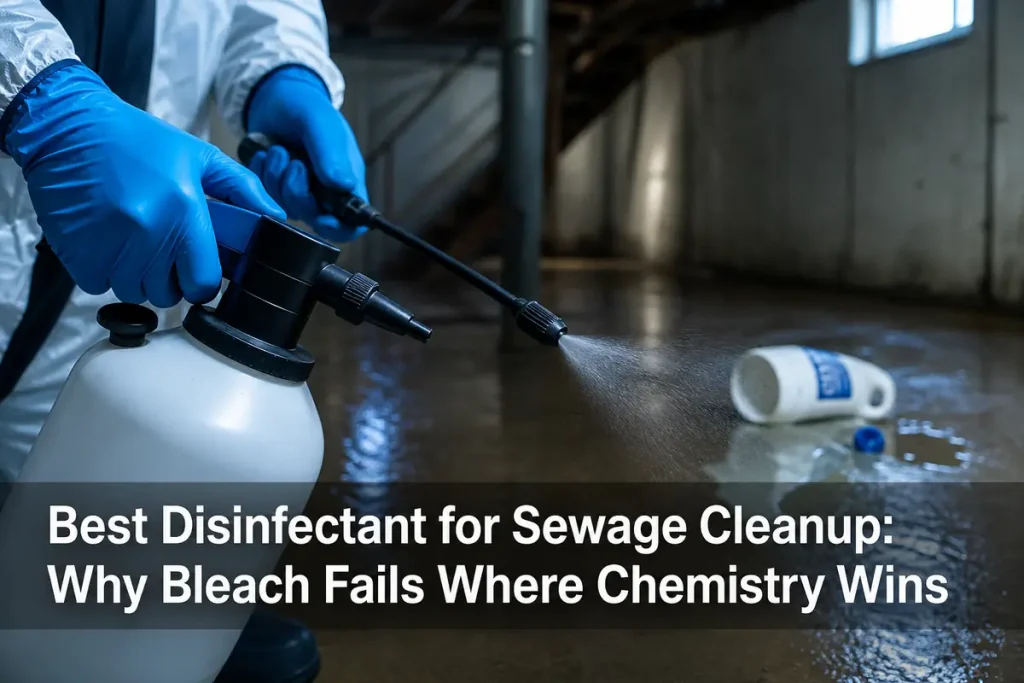
The best disinfectant for sewage cleanup is not a single product. It is the right chemistry applied in the right order, and the order starts with removing solids before any disinfectant touches the surface. Here is the fact most Louisville homeowners never hear: household bleach is chemically neutralized by the very sewage it is supposed to disinfect.
Picture a real scenario from our service area. A homeowner in a 1950s Shively cape cod gets a main line backup into the basement, watches a video, and pours a gallon of bleach across the floor. The smell of chlorine fills the room, so it feels like progress. In reality, most of that chlorine was consumed within minutes, and the bacterial population under the surface barely noticed. Understanding why requires a short trip into oxidation chemistry, and it is genuinely worth the trip.
Why Does Bleach Stop Working on Raw Sewage?
Bleach fails on raw sewage because sodium hypochlorite is a reactive oxidizer that binds to any organic matter it touches. Fecal solids, food waste, and biofilm consume the available chlorine before it ever reaches living bacteria, a phenomenon water treatment engineers call chlorine demand. Dirty surfaces can neutralize the majority of applied chlorine almost immediately.
This is not a fringe claim. Municipal water plants measure chlorine demand daily, because they must dose enough chlorine to satisfy the organic load first and still leave a free residual to kill pathogens. The EPA's disinfectant registration program reflects the same reality: label kill claims are validated on pre-cleaned surfaces, with a required contact time, often 5 to 10 minutes of continuous wet dwell. Consequently, splashing bleach on visible sewage skips both conditions the product needs to work.
What About Quaternary Ammonium and Hydrogen Peroxide?
Quaternary ammonium compounds, called quats, and accelerated hydrogen peroxide each solve part of the problem bleach cannot. Quats bond to surfaces and keep working over a longer dwell, though they too lose strength against heavy organic soil. Accelerated hydrogen peroxide tolerates organic load better and breaks down into water and oxygen, leaving no toxic residue.
In practice, professional restorers match the chemistry to the phase of the job. However, no chemical on the EPA's registered lists is engineered to disinfect through a layer of solids. That is why the ANSI/IICRC S500 Standard puts gross contamination removal ahead of antimicrobial application in the Category 3 workflow. The sequence, not the jug, is the secret.
What Is the Correct Order of Operations for Sewage Disinfection?
The correct order is removal, cleaning, disinfection, then drying. Solids and contaminated porous materials come out first. Hard surfaces get detergent cleaned to strip the organic film. Only then does an EPA-registered disinfectant go down, at label dilution, with full wet contact time. Drying equipment runs last, never before disinfection.
Reversing that order causes real harm. Running air movers over undisinfected sewage aerosolizes bacteria into the air your family breathes, and disinfecting before cleaning wastes the chemical on chlorine demand. On a recent Jeffersontown job, our moisture mapping found Category 3 wicking eight inches up the wall behind baseboards that looked clean. The drywall came out, the framing got cleaned and treated with proper dwell time, and post-remediation readings confirmed dry standard. That sequence, straight out of S500, is what a passing result looks like.
When Should a Louisville Homeowner Call a Professional Instead?
Call a professional whenever sewage has contacted porous materials, traveled under flooring, entered wall cavities, or covered more than a few square feet. At that point the job is demolition and verification, not surface disinfection, and Kentucky homes with finished basements almost always cross that line.
Bear Restoration, an IICRC Certified Firm (#70216409) founded by Emery and holding Kentucky license LIC-GBCL-24-00148, handles Category 3 losses across Louisville, Shively, St. Matthews, Middletown, Jeffersontown, and Prospect. We bring the containment, the chemistry, and the moisture instrumentation to prove the space is actually clean, and we coordinate directly with your insurance carrier. Furthermore, our sewage backup cleanup team can walk you through what your water backup endorsement covers before the work begins. If the loss began as a burst pipe rather than a backup, our Louisville water damage restoration crew responds to those around the clock as well. Call 502-200-6968 and skip the bleach aisle entirely.
Frequently Asked Questions
Can I just use extra bleach to make up for the organic load?
More bleach helps less than you would think, because each application is still consumed by solids before reaching bacteria, and heavy chlorine use indoors creates its own respiratory hazard. Removal first, then disinfection, beats any amount of extra product.
How long does a disinfectant need to stay wet on the surface?
Most EPA-registered products require 5 to 10 minutes of continuous wet contact to achieve their label kill claims. A spray that dries in two minutes on a warm Louisville afternoon never finished the job.
Do I need to disinfect areas the sewage did not visibly touch?
Often yes. Splash, tracking on shoes, and aerosol drift extend the contaminated zone beyond the visible edge, which is why professional scopes treat a buffer area around the obvious loss.

Read Our Reviews