
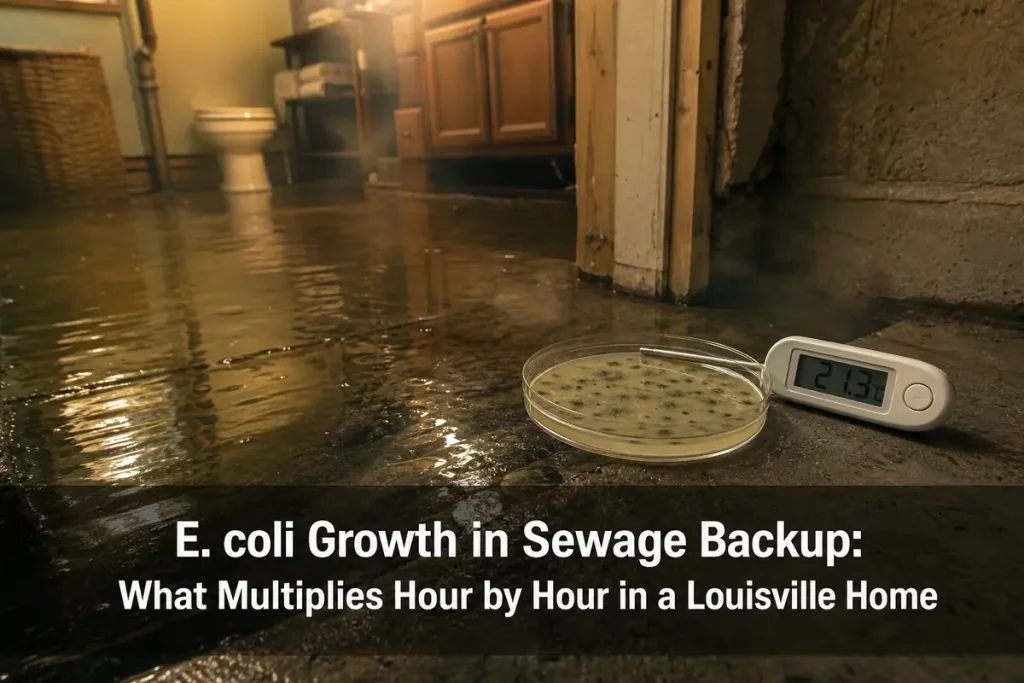
E. coli growth in sewage backup follows a predictable and fast curve. Under the warm, wet conditions of a flooded basement or bathroom, coliform bacteria can double roughly every 20 minutes. That means a contamination load can multiply more than a thousandfold in a single afternoon. The water sitting on your floor at hour eight is biologically a different event than the water that arrived at hour zero.
We see this play out constantly across Jefferson County. Louisville's older neighborhoods sit on combined sewer lines managed by the Louisville MSD, which carry both stormwater and sanitary sewage in the same pipe. When a summer thunderstorm dumps two inches of rain in an hour over Jeffersontown or St. Matthews, those combined lines can surcharge, and the lowest drain in the house, usually a basement floor drain, becomes the exit point. What comes up is Category 3 water as defined by the ANSI/IICRC S500 Standard, and the clock starts immediately.
How Fast Does Bacteria Grow in Sewage Water Inside a House?
Bacteria in sewage water grow fastest between 70 and 100 degrees Fahrenheit, which is exactly the range of a Louisville basement in July. At those temperatures, E. coli and other fecal coliforms can double every 20 to 30 minutes. Starting from even a modest population, that doubling rate produces exponential contamination within two to eight hours of the backup.
Here is why that matters in practice. A homeowner in a 1970s Jeffersontown ranch calls us at 7 a.m. about a backup that happened overnight. By the time the sun is up, the bacterial load in that water has been amplifying for eight or more hours. The carpet pad, the bottom two feet of drywall, and the wood base plates have been soaking in an actively growing culture, not just dirty water. Consequently, the S500 standard treats time as a contamination multiplier, and so do we.
What Is the Hour-by-Hour Timeline After a Sewage Backup?
A sewage backup moves through four rough phases: initial contact, bacterial amplification, absorption into porous materials, and finally aerosolization as surfaces begin to dry. Each phase expands the contaminated zone beyond the visible waterline, which is why fast professional response protects both your home and your health.
At hour zero, contamination is mostly where you can see it. From hours two through eight, bacteria multiply and wick sideways and upward into drywall, insulation, and cabinet toe kicks. After roughly 24 hours, something counterintuitive happens: as the surface water evaporates, bacterial cells and their fragments become light enough to go airborne. Air currents, and especially a running HVAC blower, can then carry that bioaerosol into supply ducts and upstairs living spaces. More importantly, dead gram-negative bacteria release endotoxins, cell wall fragments that remain irritating to lungs even after the organism dies. The CDC's guidance on sewage exposure is blunt about the illness risk from this class of contact.
Why Does the Smell Get Worse After You Clean the Surface?
The smell intensifies after a surface-only cleanup because the living contamination is inside the materials, not on top of them. Mopping with household cleaner removes the visible layer while bacteria continue metabolizing inside carpet pad, drywall cores, and sill plates, producing hydrogen sulfide and other odor gases as byproducts.
In our experience, a sewage-affected room that only gets mopped will smell worse on day four than it did on day one. That said, the odor is actually useful information. It is telling you that porous materials are still hosting an active bacterial population and need removal, not deodorizing. The S500 standard is clear that porous materials contacted by Category 3 water, including carpet pad and gypsum drywall, should be removed and discarded rather than cleaned in place.
What Does Bear Restoration Actually Do Differently on a Sewage Job?
Professional sewage remediation reverses the amplification curve in a specific order: containment first, gross removal second, controlled demolition of porous materials third, disinfection fourth, and structural drying last. Running fans before disinfection would aerosolize live bacteria, so the sequence matters as much as the products.
Bear Restoration, an IICRC Certified Firm (#70216409) founded by Emery and licensed in Kentucky (LIC-GBCL-24-00148), runs Category 3 losses to the S500 protocol on every job from Shively to Prospect. Our crews set containment and negative air pressure with HEPA filtration before demolition begins, then verify results with moisture readings down to dry standard. Additionally, we document every step for your insurance carrier, because sewer backup claims in Louisville frequently hinge on whether a water backup endorsement applies.
If sewage has backed up in your home, do not wait out the amplification curve. Keep children and pets away from the affected area, shut down your HVAC system, and call Bear Restoration at 502-200-6968. We respond across Louisville, Middletown, Jeffersontown, St. Matthews, Shively, and Prospect around the clock, and our team on our Louisville sewage cleanup page explains exactly what to expect when the truck arrives. For water losses that started clean, our water damage restoration team handles those too, and if the backup sat long enough to trigger growth, our mold remediation crew closes the loop.
Frequently Asked Questions
Is sewage backup water dangerous even if it looks mostly clear?
Yes. Clarity says nothing about bacterial load, and backup water from a Louisville MSD surcharge is Category 3 regardless of appearance. E. coli, Salmonella, and viruses are invisible at any concentration, so treat every backup as contaminated until proven otherwise.
How long does it take for a sewage backup to become a mold problem?
Mold growth can begin on damp porous materials within 24 to 48 hours, and sewage adds bacteria that multiply far faster. In a warm Jeffersontown basement, the biological damage compounds hour by hour, which is why same-day response matters.
Should I run fans on a sewage backup while I wait for help?
No. Airflow across undisinfected sewage aerosolizes bacteria into the rest of the house. Shut off the HVAC, close the room, and wait for a crew with containment and HEPA filtration.

Read Our Reviews