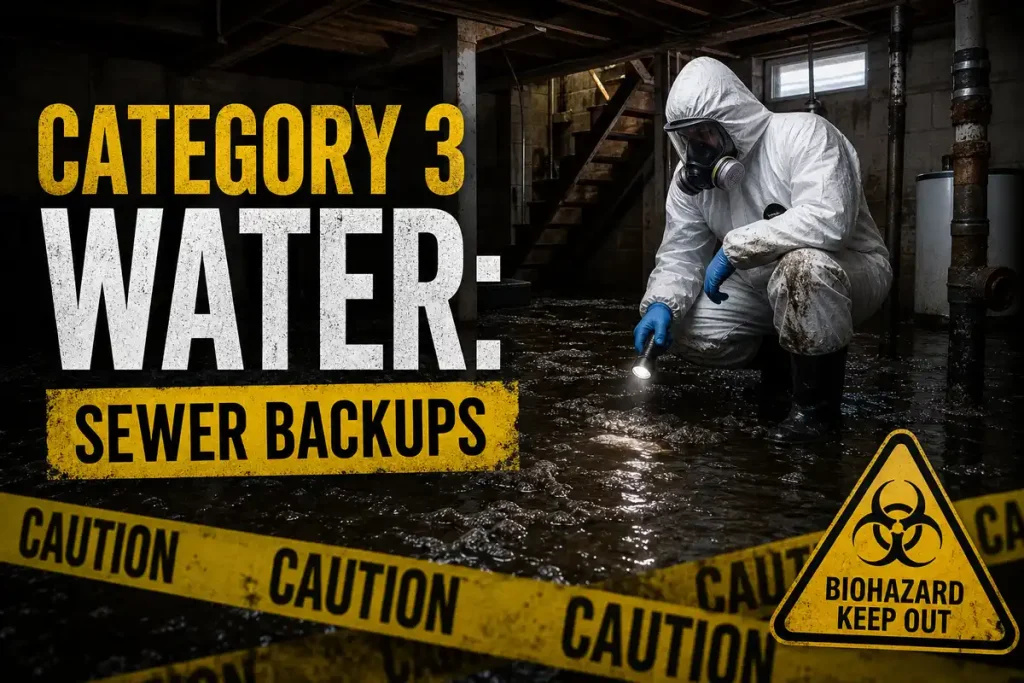
Category 3 Water Classification for Louisville Combined Sewer Backups means one thing: sewage-contaminated water has entered your property, and your loss is a biohazard event from the start. If backup water rises through a basement drain, toilet, or other low fixture during a Louisville sewer event, speed matters because faster action protects property value, rental income, occupancy, and insurance claim outcomes.
What Category 3 Water Means in a Louisville Combined Sewer Backup
Category 3 water is grossly contaminated water that contains disease-causing organisms, sewage, and harmful waste. In plain English, it is black water. Once that water enters your basement, lower level, utility area, or commercial space, the issue is no longer simple water removal. The issue is contamination control.
In a Louisville combined sewer backup, that definition applies directly. Stormwater and wastewater can overload the same system in older parts of the city, then force contaminated water back through the lowest available openings in a structure. If that discharge comes through a floor drain, toilet base, shower drain, or other lower-level fixture, your property has a Category 3 water loss.
That classification changes the business outcome immediately. Cleanup scope becomes larger, material disposal increases, occupancy disruption lasts longer, and claim documentation matters more. Based on analysis of comparable sewage losses, the recommendation is to treat the event as a hazardous contamination incident, not a routine flood cleanup job.
Why Louisville Combined Sewer Backups So Often Qualify as Category 3
Louisville combined sewer backups qualify as Category 3 so often because the source water is not just rainwater. It is a mixture of storm runoff and sanitary waste moving through shared infrastructure under pressure. Once sewage is part of the source, the classification is already at the highest contamination level.
This is why Louisville backup events feel different from a pipe leak or an overflowing washing machine. A supply line break starts as clean water. A combined sewer backup starts contaminated. That difference drives every decision that follows, from safety precautions to demolition scope to claim positioning.
How a Combined Sewer System Changes the Risk Profile
A combined sewer system carries stormwater and wastewater in the same network. During intense rain, capacity gets consumed fast. When flow exceeds what the system can carry, pressure builds and seeks the lowest release point. In many Louisville homes and small commercial properties, that point is the basement.
Water then enters through floor drains, basement showers, toilets, utility sinks, or other low fixtures. The source is not isolated groundwater or roof runoff. It is mixed flow that includes sewage. Once that mixture enters the structure, the loss is Category 3 by definition.
That risk profile is especially relevant in older housing stock, older commercial buildings, and finished basements. Lower-level spaces contain more absorbent materials, more stored contents, and more hidden cavities. In neighborhoods where long rain events create foundation and drainage stress, understanding how prolonged rainfall changes below-grade moisture pressure helps explain why water intrusion and sewer backup can become a combined problem instead of a single-source event.
Common Louisville Triggers
What the field data shows is that Louisville backups usually do not arrive with much warning. Heavy rain is the most obvious trigger, especially when storm intensity overwhelms local capacity. Blocked private laterals add another layer of failure because even moderate municipal stress can turn into an interior backup when the building drain line is already restricted.
Aging lines matter too. Older sewer pipes crack, settle, and lose flow capacity. Root intrusion compounds that problem by narrowing the interior pipe diameter and trapping debris. Once municipal flow is elevated, the restriction becomes the choke point and contaminated water reverses direction into the property.
Overwhelmed city flow is the final driver. In practical terms, your property does not need a plumbing defect inside the building for a backup to occur. The exterior system can surcharge and push contamination inward. That is why older neighborhoods and lower-level spaces see these events so often.
The Three Water Categories and Where Category 3 Fits
Water damage gets grouped into three categories based on contamination level and health risk. This classification system helps determine cleanup methods, required protective equipment, demolition scope, and restoration cost. Category 3 sits at the top because it presents the highest health hazard and the most invasive remediation requirements.
A useful analogy is a traffic-light system. Category 1 is green, relatively clean. Category 2 is yellow, contaminated enough to require caution. Category 3 is red, stop normal activity and control exposure.
Category 1 vs. Category 2 vs. Category 3
Category 1 water starts from a sanitary source and carries low contamination. Think of a fresh supply line leak or a sink overflow from clean water. The initial response focuses on drying and material preservation.
Category 2 water contains significant contamination. It can cause discomfort or illness through contact or consumption. Appliance discharges, some sump failures, and certain drain overflows can fall into this category depending on source and condition.
Category 3 water contains gross contamination and harmful agents. Sewage backups are the clearest example. If the source includes toilet waste, sewer discharge, or water from a combined sewer backup, the event begins at Category 3. It does not need to look dark, thick, or visibly filthy to qualify. Source determines classification.
Why Time Does Not Improve a Category 3 Loss
Time makes a Category 3 loss worse, not safer. Contaminated water spreads across more surface area, wicks into drywall and trim, and migrates below finished floors. Every extra hour increases contact time between sewage and porous materials.
That drives up demolition needs. Drywall that might have been cut lower now requires a taller flood cut. Cabinet toe-kicks, insulation, underlayment, and contents absorb contamination and move from questionable to unsalvageable. Odor compounds also settle deeper into assemblies.
The business effect is direct: delay increases remediation cost, extends downtime, slows re-occupancy, and weakens time-to-value on every recovery dollar spent. If structural drying is delayed during humid summer conditions, Louisville’s high dew points can materially slow proper dryout, which stretches the schedule even further.
What Makes Category 3 Water Dangerous
Category 3 water is dangerous because the problem is biological as much as physical. Visible standing water is only part of the loss. The real issue is pathogen spread, contaminated residue, aerosolized particles, and absorbed waste inside materials that no longer appear wet on the surface.
That is why casual cleanup fails so often. Mops, bleach, and box fans address what you can see. Category 3 response has to address what entered cavities, settled into seams, coated surfaces, and contaminated contents.
Health Risks From Sewage Exposure
Sewage exposure brings bacteria, viruses, parasites, and waste byproducts into occupied space. Contact can happen through skin, accidental ingestion, contaminated footwear, splashing, or breathing fine airborne particles disturbed during movement and cleanup.
The practical implication is simple. Children, tenants, staff, maintenance personnel, guests, and pets should stay out of the affected area. Soft goods, toys, pet items, and anything stored near the floor require special attention because exposure is not always obvious.
Protective equipment standards exist for a reason. Gloves and a dust mask are not a full sewage response plan. In contaminated residential work, proper protective measures for sewage handling determine whether cleanup contains the hazard or spreads it through the rest of the property.
Property Damage Beyond the Visible Waterline
Category 3 damage extends beyond the waterline because contamination travels into materials, not just onto them. Drywall absorbs. Insulation holds waste-laden moisture. Subfloors trap residue between layers. Baseboards, cabinetry, and door casings create protected pockets where contamination remains after surface drying.
HVAC-adjacent areas deserve attention too. If airflow moves across the loss area, particles and odor can travel into cleaner sections of the building. Even when mechanical components avoid direct contact, the surrounding environment can still require cleaning and verification.
This is why contamination level, not just moisture reading, determines what stays and what goes. A material can be dry and still be unfit to keep.
The Four Signs a Backup Should Be Treated as Category 3 Immediately
Fast identification protects both safety and claim outcomes. If you wait for lab results or visual certainty, the loss expands while the decision stalls. In Louisville sewer events, four indicators justify immediate Category 3 treatment: sewage odor, visible toilet waste, discharge from drains or lower fixtures, and storm-timed backup in a combined sewer area.
Those indicators matter because source classification drives response. Once the source points to sewage involvement, the safest and most defensible approach is immediate Category 3 handling.
Sewage Odor, Toilet Waste, or Drain Discharge
A strong foul odor is the first sign many property owners notice. That smell reflects contaminated organic waste, not simple dampness. If the water carries visible solids, toilet paper, dark residue, or toilet overflow tied to a drain line event, the classification is straightforward.
Water entering through a basement floor drain is another major indicator. Clean water lines do not discharge upward through basement drains. Sewer systems do. The same logic applies to water rising through a shower drain, utility sink, or lower toilet during a backup event.
Storm-Related Basement Backup in Combined Sewer Areas
Timing matters. If the backup begins during or right after heavy rainfall in a Louisville combined sewer zone, treat the event as Category 3 until proven otherwise. That timing links the source to overloaded shared infrastructure, which means sewage involvement is already part of the risk profile.
This is especially true when water appears in the basement without a visible pipe break. The source is then external to the interior supply system, and in a combined sewer area, that points directly toward contaminated reverse flow. Properties also face different flood mechanisms depending on neighborhood and storm conditions, so knowing the difference between river backwater pressure and flash-flood style basement loss helps narrow the source and support documentation.
What to Do First After a Louisville Sewer Backup
The first response phase sets the tone for the entire recovery. The right sequence reduces contamination spread, preserves evidence, and shortens restoration downtime. The wrong sequence turns a contained loss into a larger, more expensive one.
The recommendation is to think in three phases: secure, document, and assign the work correctly.
Phase 1: Secure the Area and Stop Contact
Shut off access to the affected area immediately. Keep children, tenants, employees, customers, and pets out. Do not allow traffic in and out of the space because contaminated footwear spreads residue to unaffected flooring.
Stop using plumbing fixtures that feed the same drainage system. Flushing toilets, running showers, or discharging sinks can worsen the backup. If electrical hazards are present and the panel is safely accessible without entering standing water, cut power to the affected area. If it is not safely accessible, leave it alone until qualified help arrives.
Phase 2: Document Conditions for the Claim File
Capture the scene before major disturbance. Take wide shots of each affected room, then close shots of floor drains, toilets, damaged finishes, visible residue, waterlines, and impacted contents. Video helps show flow path and depth across connected spaces.
Record timestamps, weather timing, when the backup was first noticed, and which fixtures were involved. Build an affected-room list and a damaged-item inventory while the layout is still intact. Include utility rooms, storage areas, closets, and adjacent spaces, not just the obvious wet zone.
Claims move faster when documentation is organized. Moisture records and restoration notes become even more valuable after extraction begins, which is why keeping drying and condition records that support an insurance file often improves scope accuracy and reduces later disputes.
Phase 3: Call Qualified Sewage Remediation, Not General Cleanup
Category 3 loss requires sewage remediation, not general cleaning. The distinction matters. Janitorial crews clean visible surfaces. Water mitigation teams remove water. Qualified sewage-remediation professionals handle contamination boundaries, material disposal, disinfection standards, protective equipment, and structural drying together.
The recommendation is IICRC-aligned biohazard response because the loss involves both water intrusion and hazardous contamination. That approach protects health, supports claim defensibility, and reduces the chance of partial cleanup that leaves odor, residue, or hidden contamination behind.
What Professional Category 3 Cleanup Usually Involves
Professional Category 3 cleanup is invasive because the contamination is invasive. If sewage touched, wicked into, or passed behind a material, the process has to reach that area. Based on analysis of standard sewage-loss protocols, proper remediation follows three operating phases: inspection and control, removal and disinfection, then drying and verification.
That process is what separates a real restoration effort from surface cleanup.
Inspection, Containment, and Safety Controls
The first step is defining the loss. Moisture mapping, contamination boundary checks, and room-by-room inspection establish how far water and residue traveled. That includes adjacent walls, trim lines, utility penetrations, and floor transitions.
Containment then keeps the problem from spreading. Affected areas are isolated from cleaner sections of the structure. Depending on layout and contamination extent, air control measures may be added to reduce particle movement during demolition and cleanup. Personal protective equipment is part of this phase, not an afterthought.
Extraction, Removal, and Disinfection
Next comes water extraction and gross contamination removal. Standing water leaves first, then unsalvageable porous materials come out. Carpet pad, wet insulation, low drywall sections, contaminated storage items, and other absorbent materials often require disposal because cleaning them back to a safe condition is not realistic.
Salvageable structural surfaces then get cleaned and disinfected according to contamination level. This is a controlled process, not a single spray-and-wipe pass. The objective is to remove residue, reduce microbial hazard, and prepare remaining assemblies for drying and verification.
Drying, Verification, and Clearance
Once contaminated materials are removed and surfaces are cleaned, structural drying begins. Air movement, dehumidification, and monitoring continue until moisture levels return to acceptable targets for the affected assemblies. In Louisville, drying conditions vary significantly by season and house type, and the difference between below-grade basement dryout and crawlspace recovery paths often changes equipment needs and timeline expectations.
Verification closes the loop. Odor control, follow-up inspection, moisture confirmation, and remediation reporting support safe re-occupancy decisions. In larger or more sensitive losses, additional clearance documentation can also strengthen claim settlement and reduce disputes about whether the job was truly completed.
What Usually Has to Be Removed After Category 3 Water Exposure
One of the most common questions after a sewer backup is what can stay. The answer depends on porosity, contamination depth, dwell time, and whether the item can be cleaned to a sanitary condition. In Category 3 losses, porous low-level materials are the first to fail the salvage test.
This is where many property owners lose time and money by trying to save everything. Saving the wrong material often means paying twice, once for attempted cleaning and again for eventual removal.
Materials Commonly Discarded
Carpet pad is almost always a removal item after sewage exposure. It holds contamination deep within the fibers and foam structure. Porous flooring, especially laminate and low-grade engineered products, also performs poorly because contaminated water enters seams and swells the assembly.
Drywall below the contamination line usually requires removal. Wet insulation behind it holds both moisture and waste residue. Upholstered furniture, cardboard boxes, paper records stored low, pressed-wood furniture, and low-value porous contents are also common disposal items. If sewage reached them, replacement is usually more defensible than restoration.
Materials Sometimes Salvaged
Concrete can often be cleaned and disinfected because it is structurally durable and not treated like a soft porous finish. Tile surfaces may also remain if the underlying assembly did not trap contamination and grout conditions support proper cleaning.
Some hardwood assemblies, metal items, and non-porous contents can be restored when contact was limited, dwell time was short, and condition remained stable. But salvage is never based on optimism. It is based on contamination reach, material behavior, and cleaning feasibility.
Insurance and Documentation: What Louisville Property Owners Need to Know
Insurance treatment for sewer backup is different from standard water damage. That catches many Louisville property owners off guard. A pipe leak and a sewer backup are both water losses, but they are often handled under different coverage terms, limits, and exclusions.
This matters because your financial outcome depends not only on the remediation scope but also on how well the source and damage path are documented.
Sewer Backup Coverage vs. Standard Water Damage Coverage
Standard water damage coverage often responds differently to internal pipe failures than to sewer backup events. Sewer backup coverage is commonly tied to a separate endorsement, and that endorsement can carry its own sublimit. If your cleanup cost, demolition, contents loss, and reconstruction exceed that cap, the uncovered balance becomes your problem.
Deductibles and depreciation also affect recovery. Actual cash value treatment on certain contents lowers reimbursement, and lower sublimits can compress what gets replaced versus what gets repaired. For rental property owners and small commercial operators, that gap affects vacancy time, rent continuity, and revenue recovery.
Records That Improve Claim Speed and Scope Accuracy
Good records produce better outcomes. Emergency invoices show immediate response cost. Remediation reports establish contamination class, materials removed, and procedures performed. Plumber findings help confirm source, blockage, or line failure.
Photos, videos, moisture records, discarded-item inventories, and proof of pre-loss condition all strengthen the file. Weather timing matters too, especially when the event lines up with heavy regional rain. If the backup followed a storm-driven infrastructure event, documenting that context helps anchor the claim narrative in the actual cause sequence.
Common Misconceptions About Category 3 Water
Category 3 losses get worse when property owners rely on the wrong assumptions. Most expensive mistakes come from underestimating contamination, overestimating what household cleaning can achieve, or assuming the job ends when standing water disappears.
Three misconceptions show up again and again.
“If It Looks Clear, It Is Safe”
Clear appearance does not mean clean source. Sewage-contaminated water can look relatively clear, especially early in a backup or when stormwater dilution is part of the event. Dissolved waste, pathogens, and fine residue do not need to be visible to create a Category 3 condition.
Source matters more than appearance. If the water came from a sewer-related backup path, treat it as contaminated.
“Bleach and Fans Are Enough”
Bleach on a floor surface does not decontaminate wall cavities, insulation, carpet backing, subfloor seams, or wet trim assemblies. Fans without controlled removal and drying can also spread contamination or drive moisture deeper into materials.
The result is predictable: lingering odor, hidden damage, and claim friction when later repairs reveal incomplete cleanup. Surface chemistry alone is not a sewage-remediation plan.
“Once the Water Is Gone, the Problem Is Over”
Extraction is only the opening move. After visible water is removed, the hard part begins: demolition of unsalvageable materials, cleaning of structural surfaces, disinfection, drying, and verification. If that sequence is skipped, the property remains contaminated even when the floor looks dry.
This is why post-loss frustration is so common. A space can look better within hours and still be unsafe for normal use.
Preventing Repeat Sewer Backups in Louisville Properties
Prevention planning matters because repeat losses are common in the same properties. Once a building proves vulnerable to sewer surcharge, blocked laterals, or below-grade water entry, waiting for the next storm is a poor operating strategy. The recommendation is to reduce both event frequency and event severity.
That means pairing infrastructure review with practical interior changes.
Property-Level Prevention Measures
Backwater valves are one of the most direct ways to reduce reverse-flow entry where installation conditions support them. Drain maintenance and routine line inspection also matter, especially in older properties with root pressure or known slow drainage. If your line has a history of intrusion or partial blockage, that history is an operating risk, not a minor maintenance note.
Sump system evaluation belongs on the list too, though a sump pump does not solve sewage backup by itself. Grading corrections, downspout management, root control, and smarter fixture-use habits during major storms all help reduce pressure on vulnerable systems. Basement storage changes also pay off. Keeping contents elevated and limiting low-level porous storage reduces severity when water still gets in.
Why Older Homes and Basements Need a Higher Prevention Standard
Older Louisville homes, especially in neighborhoods with aging underground infrastructure and finished basements, need a higher prevention standard because the exposure is structurally baked in. Low fixtures sit near the failure point. Older drain lines offer less margin. Deferred maintenance narrows that margin further.
Finished basements add more at-risk material value per square foot. Flooring, drywall, trim, furniture, stored contents, and mechanical areas all sit in the most exposed zone of the property. If storm patterns are shifting and intense rainfall events are becoming more disruptive, prevention planning has to reflect that reality, not the best-case version of the past.
Frequently Asked Questions About Category 3 Water in Louisville Sewer Backups
Is it safe to stay in the property after a sewer backup?
If the affected area contains Category 3 water, that area is not safe for normal occupancy until contamination is controlled and cleanup is complete. If the backup affects primary living areas, HVAC circulation, or large portions of the structure, temporary relocation becomes a serious practical consideration.
How fast should Category 3 water be cleaned up?
Category 3 water requires immediate response. Every hour of delay increases contamination spread, material loss, odor penetration, downtime, and claim complexity. Fast containment and professional remediation produce the best recovery outcome.
Does every basement backup count as Category 3?
No. Source determines classification. A clean supply line leak in a basement does not start as Category 3. But a Louisville combined sewer backup, drain discharge, toilet-related sewer event, or sewage-involved overflow should be treated as Category 3 from the start.
Can contents be saved after sewage exposure?
Some contents can be saved, but only when material type, contamination contact, dwell time, and cleaning feasibility support restoration. Non-porous items perform best. Upholstered, absorbent, low-value, and sewage-soaked porous contents are commonly discarded.
The Recommendation for Louisville Sewer Backup Response
Any Louisville combined sewer backup entering through drains, toilets, or lower-level fixtures should be treated as Category 3 immediately. That classification is not a technical detail. It determines safety controls, remediation scope, occupancy planning, cost, and insurance positioning.
Based on analysis of sewage-loss response patterns, the recommendation is direct: secure the area, stop contact, document the event thoroughly, and assign the work to qualified sewage-remediation professionals. That approach protects health, shortens downtime, preserves property value, and produces stronger claim outcomes than delayed or surface-level cleanup.

Read Our Reviews