
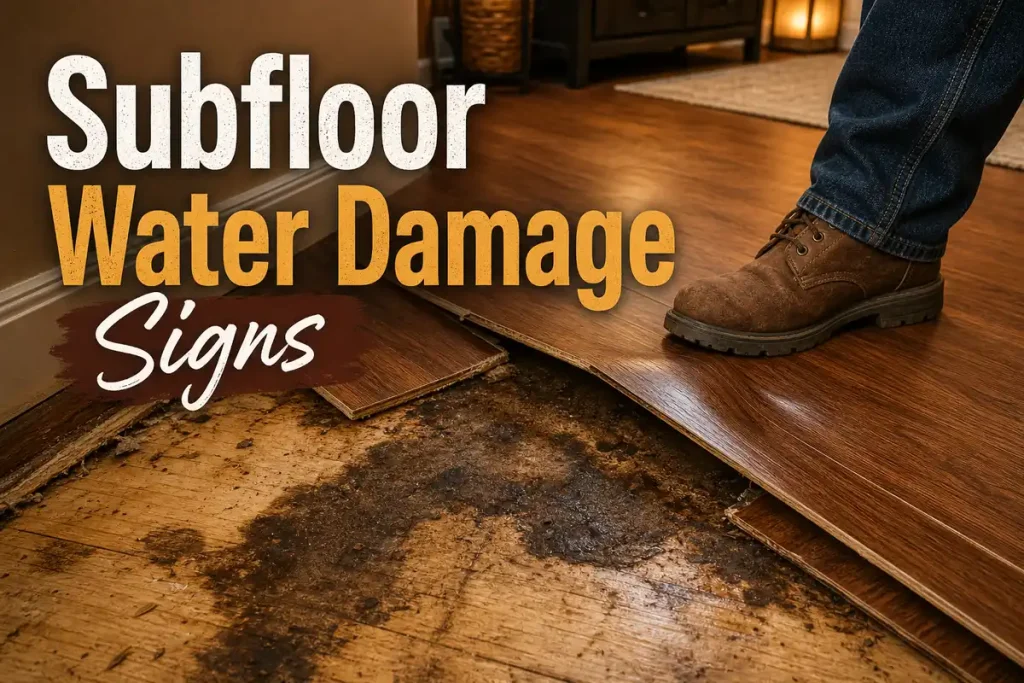
Subfloor water damage is moisture damage in the structural layer beneath your finished floor, and it starts causing trouble long before you see obvious surface failure. According to the EPA, moisture problems that stay hidden feed mold growth quickly, while building materials lose strength as saturation continues. If your floor feels different, smells off, or starts shifting out of line, you are already past the point of a cosmetic problem.
What Subfloor Water Damage Means and Why It Escalates Fast
Water intrusion changes building materials fast. The EPA states mold can begin growing within 24 to 48 hours, and the IICRC S500 standard treats prompt extraction, drying, and contamination control as the core of professional water damage restoration. That matters because your subfloor is not the visible layer you walk on. It is the structural panel or planking beneath tile, hardwood, vinyl, laminate, or carpet, and it helps carry live loads, keep floors flat, and hold fasteners in place.
Once water gets below the finish floor, the damage pattern changes. Tile and grout hide moisture. Luxury vinyl can trap it. Hardwood can cup or crown only after the subfloor has already absorbed a large amount of water. Carpet pads hold moisture against wood for hours or days. Visible surface damage often lags behind the real problem.
The result is a three-part risk. First, structural performance drops as OSB swells, plywood delaminates, or older plank boards soften. Second, microbial growth becomes more likely in dark, low-airflow cavities. Third, insurance gets more complicated because concealed damage needs proof, documentation, and source identification. Sudden pipe breaks are treated differently from ongoing seepage, especially when the moisture path stayed active for weeks.
Finding: Subfloor water damage starts below the finish floor, accelerates quickly once moisture is trapped, and often becomes serious before you can see it.
The Signs of Subfloor Water Damage You Shouldn’t Ignore
Damage usually shows up first through performance changes, not holes in the floor. The Forest Products Laboratory of the USDA has long documented that wood changes dimension and strength as moisture content rises, which is why the earliest signs are movement, softness, odor, and shifting finishes rather than dramatic collapse.
A sound floor feels firm, flat, and stable. A wet subfloor does the opposite. It starts subtle, then gets worse. In Louisville homes, especially older properties in Old Louisville or rental stock with deferred maintenance, that progression often follows repeated bathroom leaks, appliance drips, crawl space humidity, or stormwater entry.
Finding: If your floor feels different, moves differently, or smells different, hidden moisture under the surface is the leading explanation until inspection proves otherwise.
Soft, Spongy, or Bouncy Areas Underfoot
A soft or bouncy section is one of the clearest warning signs because it reflects loss of stiffness in the material below. When OSB or plywood takes on water repeatedly, the panel edges swell, fibers break down, and fasteners stop holding with the same strength. That change is easy to feel near toilets, tubs, showers, sinks, dishwashers, refrigerators, washing machines, and exterior doors.
This is not the same as ordinary wear on finished flooring. A worn vinyl surface still sits on a stable base. A water-damaged subfloor gives under weight because the support layer is deteriorating. If the spot expands over time or feels worse after rain, laundry use, or showers, the pattern points to active moisture, not age.
Finding: Soft or bouncy flooring signals loss of subfloor integrity, not a surface-only defect.
Musty Odors, Stains, and Surface Changes
Persistent odor often shows up before visible distortion. The CDC notes that damp indoor environments are associated with mold growth and musty smells, and those odors tend to collect in bathrooms, kitchens, finished basements, and first-floor rooms over crawl spaces. On the floor surface, you may notice staining, darkened seams, bubbling vinyl, hardwood cupping, lifted edges, or carpet tack strips that stay discolored.
The limitation is simple: odor alone does not prove subfloor rot. A wet cabinet toe-kick, damp insulation, or a crawl space issue can create the same smell. That is why smell is a warning sign, not a final diagnosis.
In homes with recurring crawl space moisture, especially older foundations with weak vapor control, the issue often starts below the room. A useful comparison is sorting out whether repeated moisture comes from ground water or a plumbing source, because the repair path changes completely once the source is identified.
Finding: Musty odor and surface staining indicate trapped moisture, but inspection is required to confirm whether the subfloor itself is damaged.
Cracks, Movement, and Alignment Problems Nearby
Cracked grout, loose tile, widening seams, shifting baseboards, and doors that start rubbing near a wet room all point to floor movement. Tile systems are rigid. Subfloors are not. When the base weakens, the rigid finish layer becomes the messenger. Grout cracks. Tile loosens. Trim separates. Cabinet lines stop looking square.
That movement is not just cosmetic. It indicates longer-term stress in the floor assembly. In an upstairs bathroom, for example, a failed toilet seal can saturate the panel around the flange, loosen fastener hold, and transfer movement into the tile field. By the time the grout cracks, the subfloor has already lost performance.
Finding: Cracks and alignment problems near wet areas usually reflect subfloor movement from hidden moisture damage.
Where Subfloor Water Damage Starts Most Often
Subfloor damage follows repeat exposure and poor drying, not random bad luck. FEMA guidance on flood recovery emphasizes that water reaches concealed assemblies easily and stays there when materials are layered or enclosed (FEMA). In Louisville, repeated exposure is the real driver, especially after heavy rain, sump failures, plumbing leaks in older homes, and seasonal humidity that lingers under floors.
Bathrooms, kitchens, laundry rooms, entryways, basement-adjacent rooms, and rooms over crawl spaces sit at the top of the risk list because each one combines water sources with hidden penetrations. Small commercial break areas have the same pattern, just with more frequent use and slower reporting.
Finding: The highest-risk areas are the rooms that get wet repeatedly and dry poorly.
Bathrooms, Kitchens, and Laundry Areas
These rooms create the classic concealed-wetness problem. Supply lines drip slowly. Drain fittings loosen. Toilet wax rings fail. Shower overspray reaches outside corners. Dishwasher and refrigerator lines leak under cabinets where you do not look every day. Washing machine hoses fail hard and fast.
Once water reaches seams, cutouts, and pipe penetrations, the subfloor absorbs it from the edges first. That matters because panel edges are often the weakest point. In practical terms, a bathroom floor in St. Matthews can look mostly fine on top while the toilet surround below is already soft enough to flex.
Finding: Wet rooms damage subfloors through repeated small leaks just as often as through dramatic failures.
Entryways, Crawl Spaces, and Basement-Adjacent Floors
Storm-driven moisture hits entry doors, mudrooms, and low thresholds first. Wet shoes alone do not rot a subfloor, but repeated saturation at door seams does. Basement-adjacent floors and rooms over crawl spaces face a second pathway: moisture rising from below. Louisville’s humidity swings, combined with older foundations and marginal drainage, make those assemblies harder to keep dry.
If your property has chronic dampness after storms, understanding why a crawl space stays wet after rain becomes directly relevant because the floor system above that space absorbs the consequences. Historic homes in Old Louisville are especially vulnerable where original framing meets outdated drainage and limited vapor control.
Finding: Entry zones and floors over damp lower spaces are high risk because moisture attacks from below as well as above.
The Main Causes Behind a Wet or Rotting Subfloor
The water source changes the restoration standard. The IICRC S500 separates losses into clean water, gray water, and black water because contamination affects salvage, demolition, cleaning, and documentation. Clean water comes from supply lines. Gray water includes discharge from appliances and some drains. Black water includes sewage and floodwater with substantial contamination.
The main causes are straightforward: burst pipes, slow plumbing leaks, appliance failures, storm flooding, roof or flashing leaks that travel down walls, sewage backups, and chronic humidity. In Louisville properties, old angle stops, aging galvanized or copper supply lines, failed toilet seals, and sump malfunctions show up again and again. Roof leaks are less obvious because the water path can travel far from the actual entry point before dropping into a floor cavity.
There is one useful counter-finding. A single spill that is dried immediately rarely destroys a subfloor. Repeated minor leaks do. That pattern aligns with what building science has shown for decades: duration and trapped moisture drive deterioration more than one brief event.
Finding: Source, contamination level, and duration determine how serious the subfloor damage becomes.
How to Tell Whether the Subfloor Can Be Dried or Must Be Replaced
Not every wet subfloor needs full tear-out. But any subfloor that has lost structural integrity, stayed saturated too long, or absorbed contaminated water needs removal. The decision relies on moisture readings, exposure duration, visible deformation, fungal growth, rot, and whether fasteners still hold.
Material type matters. Plywood handles short-term wetting better than OSB because it tends to swell less aggressively and often dries with less edge deformation. OSB commonly swells at the edges and loses profile stability. Older plank subfloors can sometimes be dried if the boards remain sound, but gaps, cupping, and embedded contamination change that calculation fast.
Finding: Salvage depends on measured moisture, structural condition, and contamination, not wishful thinking.
Conditions That Support Drying and Salvage
Drying is appropriate when the water source was clean, the response was fast, the panel remains flat and firm, and moisture reduction is verified with meters. Accessible inspection from below improves confidence because staining, sagging, and hidden mold become visible. Controlled drying under IICRC-aligned practice uses extraction, dehumidification, and air movement based on material and cavity conditions, not random fans pointed at the floor.
You also need proof that the source is fixed. Drying a panel while a dishwasher line still leaks is not restoration. It is delay.
Finding: A subfloor is a salvage candidate only when exposure was limited, structure remains sound, and drying is verified.
Conditions That Require Removal and Replacement
Replacement is required after black water exposure, persistent saturation, swelling, delamination, rot, soft spots, fungal growth, or joist damage. If a panel crumbles at the edges, will not hold screws, or remains elevated after drying attempts, the material has failed. The same applies when mold growth extends through porous layers or when insulation and framing below are affected.
Waterproof finished flooring does not change that. A waterproof plank surface protects against top-side spills for a time, but once water enters at seams, transitions, toilet cuts, tub edges, or from below, the subfloor still absorbs it.
Finding: If the subfloor is contaminated, deformed, soft, or structurally weakened, replacement is the correct standard.
How Professionals Confirm Hidden Subfloor Water Damage
You need measurements, not guesses. The Infrared Training Center and restoration industry guidance both emphasize that thermal imaging is a screening tool, while moisture meters and direct inspection confirm the condition of materials. Insurance-adjusted claims also depend on documentation that ties visible symptoms to measured wetness and a defined source.
A proper assessment maps the affected rooms, checks below from a crawl space or basement when accessible, compares moisture readings in wet and dry control areas, and opens a small test section when the evidence is mixed. In older Louisville housing stock, underfloor access often reveals staining or sagging that the top surface hides.
Finding: Proper confirmation relies on documented readings and direct inspection, not visual guessing from the finished floor alone.
Moisture Mapping and Underfloor Inspection
Moisture mapping identifies the actual footprint of damage. Inspectors look for darkening, sagging, rusted fasteners, microbial growth, wet insulation, and staining on subfloor panels and joists. Those signs often extend beyond the obvious room boundary because water follows framing, gravity, and low points.
In crawl-space homes, older properties that trap moisture below the floor system often show wider impact than the room above suggests. That is why underfloor access matters so much. The visible stain around a toilet can connect to a much larger damp zone beneath.
Finding: Underfloor inspection often expands the known damage area beyond what the surface reveals.
Test Openings, Material Readings, and Source Tracing
A small controlled opening answers the question fast. It exposes the finish layer underside, underlayment, subfloor panel, and sometimes the joist top edge. Moisture readings are then documented by location and material. For insurance, that record matters because adjusters want a measurable basis for demolition scope.
Source tracing comes before rebuild. If the leak path is not fixed first, any repair is temporary. That includes plumbing leaks, shower failures, foundation moisture, and damp crawl spaces that need better vapor control. In some homes, the real fix starts below with better moisture management under the house.
Finding: Test openings and source tracing convert suspicion into documented proof and prevent repeat failure.
What You Should Do Immediately After You Notice the Signs
Time matters. The EPA states mold growth can begin within 24 to 48 hours after water intrusion, and secondary damage expands from there. Once you notice the signs, your priorities are simple: stop the source, protect safety, document conditions, and start professional mitigation before hidden moisture spreads.
For homeowners, landlords, and property managers, claims also hinge on prompt action. Delays increase damage depth, raise mold arguments, and make it easier for a carrier to classify the problem as ongoing leakage instead of a sudden event.
Finding: Fast action reduces structural loss and strengthens your position if an insurance claim follows.
Steps to Take in the First 24 Hours
Shut off the water source if plumbing is involved. Shut off power to affected areas if water is near outlets, appliances, or floor-level wiring. Photograph everything with timestamps before materials are moved. Remove standing water if it is safe to do so. Move contents out of the wet area. Increase airflow only when electricity and contamination conditions allow it.
Do not keep walking across soft sections. An unstable bathroom floor around a toilet flange or tub can fail under concentrated weight. In rental or small commercial settings, close the affected room early. That simple step prevents injuries and limits liability.
Finding: The first 24 hours determine how much damage spreads and how well the loss is documented.
What Not to Do
Do not seal over wet materials. Do not blast heat into hidden cavities and assume the problem is solved. Do not reinstall flooring before moisture verification. Do not assume that fading odor means the subfloor is dry.
Those mistakes trap moisture deeper, distort materials, and create larger demolition later. They also weaken claims because the damage trail becomes harder to separate from poor post-loss handling.
Finding: Covering, heating, or ignoring hidden moisture turns a manageable water loss into a larger restoration job.
Insurance, Documentation, and Claim Issues for Subfloor Water Damage
Coverage usually depends more on cause and documentation than on whether the finish floor is hardwood, tile, or vinyl. The Insurance Information Institute explains that sudden and accidental discharge is often handled differently from long-term seepage, flood, wear and tear, or deferred maintenance. That distinction controls a large share of subfloor disputes.
Adjusters typically want source identification, moisture readings, photographs, emergency mitigation invoices, and a line-item scope showing demolition, drying, and rebuild. If your file only shows warped flooring on top, the carrier can argue that the subfloor was never proven wet. If your file shows the source, mapped moisture, and documented affected materials, the claim stands on firmer ground.
Policy language remains the limitation. Exclusions and endorsements control the final result.
Finding: Claim strength comes from proving cause, timing, and measured impact below the visible floor surface.
What Strengthens a Water Damage Claim
Strong claims are built on dated photos, plumber findings, mitigation reports, drying logs, moisture maps, room diagrams, and invoices that show prompt mitigation. If a dishwasher line failed on Tuesday and extraction began Tuesday, the timeline supports sudden loss. If records are sparse and the damage looks aged, the carrier gets room to argue ongoing leakage.
This matters even more in rental homes and small commercial properties where tenant reporting delays or maintenance gaps complicate the story.
Finding: Documentation wins subfloor claims because hidden damage must be proved, not assumed.
When Coverage Gets Disputed
Coverage disputes usually center on long-term leakage, mold exclusions, wear-and-tear arguments, and lack of evidence that water reached the subfloor rather than only the finish floor. Sewage backups create another layer because contamination changes demolition standards and may trigger separate endorsements.
Once those disputes start, vague descriptions hurt you. Measured readings, source reports, and clear photos help resolve the issue faster.
Finding: Most claim denials trace back to leakage duration, exclusions, or weak proof of concealed damage.
Safety Risks, Structural Concerns, and When the Problem Turns Urgent
Urgency rises sharply once the floor loses load-bearing strength or contaminated water is involved. The Occupational Safety and Health Administration identifies walking-surface hazards and electrical exposure as major risk categories in wet environments (OSHA). In a house or small commercial space, that translates into trip hazards, localized collapse risk, and shock risk near wet appliances or outlets.
Longer-term moisture also affects joists, fasteners, and insulation. In older Louisville homes, a failed bathroom floor often exposes a second issue below it: joist ends darkened by chronic moisture, rusted plumbing straps, or mold growth in the cavity. In rentals, delayed reporting adds liability because known soft spots become predictable injury points.
Finding: Once the floor feels unstable or contamination is present, the issue shifts from repair planning to immediate safety control.
How to Prevent Subfloor Water Damage From Returning
Source control outperforms repeat repair. Competitor patterns and restoration standards point in the same direction: replacing flooring without correcting the moisture pathway almost guarantees a second loss. Prevention starts with plumbing checks, hose replacement, caulk and grout maintenance, bathroom ventilation, gutter and grading correction, sump pump testing, and moisture monitoring after any prior event.
There is an important counter-finding here. Surface-level replacement alone does not prevent recurrence. New tile over a damp bathroom subfloor, or new LVP over an unresolved crawl space moisture problem, just resets the clock.
Finding: The only durable fix is stopping the water path, not just replacing what got wet.
Maintenance Priorities for Louisville-Area Properties
Local property type changes the checklist. Historic homes in Old Louisville need closer attention on aging supply lines, patched bathrooms, and moisture migration from older basements and crawl spaces. East End and Middletown homes with finished basements need reliable sump systems, discharge management, and post-storm checks. Jeffersontown rentals and small commercial spaces need quicker leak reporting, appliance line replacement, and room-by-room inspections between occupants.
In practice, the highest-value maintenance is the boring stuff: checking toilet seals, replacing old braided supply lines, servicing sump pumps, and controlling crawl space humidity before summer locks it in.
Finding: Louisville-area prevention works best when it matches the age, drainage profile, and floor system of the specific property.
Common Questions About Subfloor Water Damage
How Long Does It Take for Water to Damage a Subfloor?
Damage begins immediately. The EPA notes that mold growth can begin within 24 to 48 hours, while wood-based panels start absorbing water as soon as moisture reaches seams and cut edges. Visible deterioration often appears later, which is why waiting for obvious warping is a mistake.
Can a Wet Subfloor Dry Out on Its Own?
Passive drying is unreliable. Finished flooring, underlayment, insulation, and enclosed cavities trap moisture and slow evaporation. A subfloor should only be considered dry after inspection and acceptable moisture readings confirm it.
Does Waterproof Flooring Protect the Subfloor?
Only from limited top-side exposure. Waterproof surfaces resist spills on the face of the material, but they do not stop water entering through edges, penetrations, transitions, failed plumbing connections, or moisture rising from below.
Can You Live or Operate in the Property During Repairs?
That depends on structural stability, contamination category, and the scope of demolition. Clean-water drying in one contained room is very different from sewage exposure or an unstable bathroom floor. If the floor is soft, contaminated, or being opened for drying, the affected area should be closed.
Does Sewage or Floodwater Always Require Replacement?
Contaminated water changes the standard sharply. Under IICRC-based practice, porous materials exposed to black water often require removal because cleaning alone does not return them to a sanitary condition. That frequently includes affected subfloor sections, especially when saturation is prolonged.
The Decision Rule That Matters Most
If the floor feels soft, smells persistently musty, shows movement, or sits above a known water source, treat subfloor water damage as an active structural and moisture problem until inspection proves otherwise. That shift in mindset changes everything. You stop looking at warped flooring as a finish issue and start addressing the hidden layer that actually holds the room together.

Read Our Reviews