
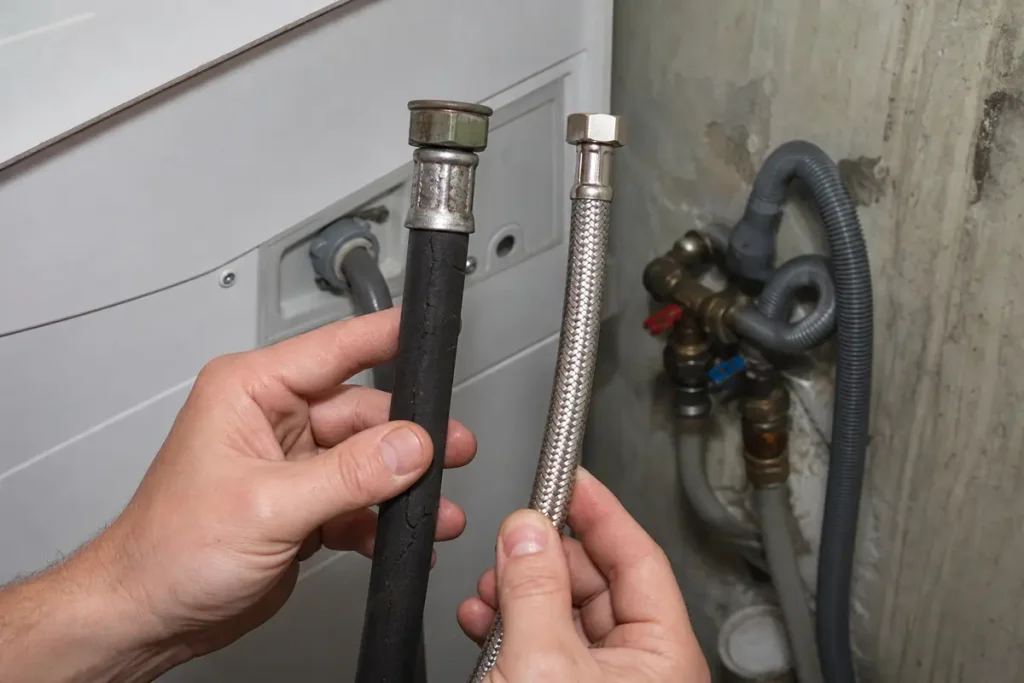
A burst washer hose turns a cheap maintenance item into a fast insurance problem. For anyone searching how often should washing machine hoses be replaced, the direct answer is simple: replace them every 3 to 5 years, with rubber hoses on the 3-year end and braided stainless steel hoses at 5 years. In water damage work across Louisville homes, rentals, and small commercial spaces, that schedule protects flooring, walls, occupancy, and claim readiness.
The Replacement Rule That Protects Property and Claims
The recommendation is firm: washing machine hoses should be replaced on a schedule, not after failure. Rubber hoses belong on a 3-year cycle. Braided stainless steel hoses belong on a 5-year cycle. That is the safest maintenance rule for protecting property value and avoiding preventable water loss.
This is not minor upkeep. A failed washer hose can dump water behind a machine, under sheet vinyl, into hardwood, through subflooring, and straight into drywall cavities before anyone notices. In occupied rentals, that means tenant disruption. In turns, that means delayed leasing. In insured losses, that means a larger claim file, more drying, and more scrutiny.
Why Washer Hose Timing Matters so Much
Based on analysis of field guidance, washer hose failure is a high-speed water event. One plumbing source notes that a broken hose can release
Based on analysis of field guidance, washer hose failure is a high-speed water event. One plumbing source notes that a broken hose can release over 5 gallons per minute. That rate overwhelms laundry rooms quickly, especially when the machine runs unattended.
What the field data shows in actual loss conditions is familiar: baseboards wick first, drywall softens fast, laminate flooring swells, cabinetry edges delaminate, and mold growth begins once wet materials stay trapped. In older Louisville housing stock, especially basements and tight rear utility rooms, moisture also hides longer. That raises drying time and reconstruction cost. For owners dealing with . That rate overwhelms laundry rooms quickly, especially when the machine runs unattended.
What the field data shows in actual loss conditions is familiar: baseboards wick first, drywall softens fast, laminate flooring swells, cabinetry edges delaminate, and mold growth begins once wet materials stay trapped. In older Louisville housing stock, especially basements and tight rear utility rooms, moisture also hides longer. That raises drying time and reconstruction cost. For owners dealing with overflow-related material damage, the pattern is consistent: the first ruined materials are rarely the cheapest ones to restore.
, the pattern is consistent: the first ruined materials are rarely the cheapest ones to restore.
The Cost Gap Between Prevention and Water Damage
The ROI on hose replacement is obvious. Angi estimates a basic hose swap at about 5 to 15 minutes, with low material cost. Compare that with extraction, equipment drying, demolition,
The ROI on hose replacement is obvious. Angi estimates a basic hose swap at about 5 to 15 minutes, with low material cost. Compare that with extraction, equipment drying, demolition, mold prevention, flooring replacement, paint, and lost use of space. The gap is not close.
For landlords and property managers, that cost gap hits revenue directly. A scheduled hose replacement protects occupancy, shortens turnover risk, and preserves time-to-value after a vacancy. A burst hose during a weekend vacancy does the opposite.
, flooring replacement, paint, and lost use of space. The gap is not close.
Why Insurance-Aware Owners Replace Hoses Before Failure
Insurance coverage does not turn neglect into a good business decision. Preventive maintenance records strengthen the property file. They show that the owner acted before a known wear item failed.
Aging hoses, visible cracking, rusted fittings, and delayed shutoff all create avoidable complications during claims handling. Water losses that look preventable receive closer review. Owners who track hose age, inspection dates, and replacement dates are in a better position when adjusters ask what maintenance was performed and when.
The 3 Drivers Behind Hose Replacement Timing
Three drivers control hose life: material, age, and operating conditions. Together, they explain why one blanket rule is not enough.
Driver 1: Hose Material
Standard rubber hoses degrade faster. Heat from hot-water cycles, pressure changes, and constant machine vibration break down the material over time. Cracking, softening, and bulging follow.
Braided stainless steel hoses perform better and are the preferred upgrade. The steel braid resists puncture and handles stress better than plain rubber. Still, no hose lasts forever. Owners comparing options benefit from a closer look at
Braided stainless steel hoses perform better and are the preferred upgrade. The steel braid resists puncture and handles stress better than plain rubber. Still, no hose lasts forever. Owners comparing options benefit from a closer look at which hose type fails less in practice.
.
.
.
Driver 2: Hose Age
Age is non-negotiable. Multiple sources recommend a 3 to 5 year replacement cycle even when hoses look fine. PNS Plumbing reports that 80% of hoses are broken by 10 years, and the average breaking point is 8 years.
Waiting for year 8 or 10 is poor risk management. By then, the hose has already spent years in the failure zone. Scheduled replacement at 3 or 5 years removes that exposure before it turns into a water job.
Driver 3: Use, Pressure, and Location
Heavy laundry volume shortens hose life. So do water pressure swings, cramped closets, and washers shoved too tightly against the wall. Every bend, rub point, and vibration point adds wear.
That matters in Louisville. Historic homes in Old Louisville often have older shutoff valves and tighter utility spaces. Basement laundry setups add humidity and concealment. Rental units see more appliance movement during turns. All of that raises stress on the hose assembly.
Washer Hose Lifespan by Type
The practical replacement schedule depends on what is installed behind the machine.
Rubber Hoses: Replace at About 3 Years
Rubber hoses are short-life parts. They break down faster, and they fail harder. The warning signs are familiar: cracking, soft spots, bulges, odd shaping, and surface brittleness. Once those signs appear, the replacement date has already passed.
The recommendation is proactive replacement at 3 years. Not at leak onset. Not at visible failure. At 3 years.
Braided Stainless Steel Hoses: Replace at About 5 Years
Braided stainless steel hoses are the stronger choice and the standard upgrade recommendation. Some guidance stretches them to 5 to 7 years, but the safer property-management policy is 5 years. That keeps scheduling predictable and risk lower.
A 5-year rule also aligns better with real-world maintenance cycles, appliance replacements, and inspection records.
Replace Both Hoses at the Same Time
Hot and cold hoses age together. Replacing one and leaving one old hose in service saves little and preserves risk.
The better practice is replacing both at the same visit, with one install date and one maintenance record. That approach lowers oversight risk and simplifies property files.
The Warning Signs That Demand Immediate Replacement
A leaking hose is replaced, not repaired. Any visible sign of material breakdown moves the timeline from scheduled replacement to immediate action.
Physical Damage to Watch For
Cracks, bulges, blisters, holes, kinks, discoloration, brittleness, and unusual shaping all indicate breakdown. These are not cosmetic defects. They are failure warnings.
Trouble at the Connections
Fittings often show trouble first. Rust, corrosion, mineral buildup, damp threads, and drips at the valve or hose end point to active deterioration. In hard-water areas, older hoses also seize at the threads, which makes delayed replacement more expensive and harder to manage.
Machine Movement and Installation Stress
An unlevel washer shakes harder. A machine pushed tight to the wall bends hoses too sharply. Over time, that mechanical stress shortens service life. When active leaking follows a cycle, the source is not always the supply hose. Some losses start elsewhere, including
An unlevel washer shakes harder. A machine pushed tight to the wall bends hoses too sharply. Over time, that mechanical stress shortens service life. When active leaking follows a cycle, the source is not always the supply hose. Some losses start elsewhere, including drain pump failures behind the front panel, which is why accurate source identification matters.
, which is why accurate source identification matters.
A Simple Inspection Schedule That Reduces Surprise Failures
Inspection should happen every 6 months and whenever the appliance is moved, replaced, or serviced. That schedule catches aging and installation stress before a burst occurs.
The 6-Month Inspection Checklist
Each inspection should confirm hose age, hose material, visible wear, fitting condition, machine position, and any moisture behind or under the washer. The install date and inspection date should be recorded in the property file. For multi-unit owners, that single habit reduces missed replacements across the portfolio.
When Inspections Should Happen Outside the Calendar
Extra inspections belong after move-ins, move-outs, washer replacement, plumbing pressure issues, freeze events, and pre-listing or pre-lease prep. These are the moments when hoses get bumped, stressed, or exposed to conditions that shorten life.
How to Replace Washing Machine Hoses the Right Way
The process is simple, but correct installation matters. Water should be shut off first. Old hoses should be removed carefully. Shutoff valves should be inspected before new hoses go on. Then the new hoses should be connected and tested slowly.
Key Installation Standards
Most washer hoses use standard 3/4-inch fittings on both ends. They should be tightened correctly, not forced. Overtightening damages fittings. Too little slack causes kinks. Too much twist strains the connection. Good installation protects the value of the new hose.
When Professional Service Is the Better Decision
Professional service is the better decision when valves are corroded, access is tight, plumbing is older, or prior leaking has affected walls or flooring. That applies often in historic Louisville homes, where aging valves and hidden moisture turn a simple hose swap into a broader risk inspection.
The Best Preventive Upgrade for Most Properties
The recommendation is direct: replace aging hoses with braided stainless steel hoses and document the install date. That upgrade lowers burst risk and improves maintenance planning.
Add a Date Label and Maintenance Record
A date written on the hose tag or nearby wall prevents guesswork later. In managed properties, that date should also go into the maintenance log. Better records reduce oversight failures and support stronger asset management.
Pair Hose Replacement With Shutoff Valve Checks
A strong hose paired with a failing valve still creates preventable loss exposure. Valve condition and operation should be checked every time hoses are replaced.
The Recommendation for Louisville-Area Properties
For Louisville-area properties, the policy should be simple and enforced: replace rubber washer hoses every 3 years, braided stainless steel hoses every 5 years, inspect every 6 months, replace both hoses together, and upgrade immediately when any warning sign appears. That recommendation lowers water-loss exposure, reduces emergency calls, supports cleaner claims handling, and protects property value where it counts most: in the floors, walls, occupancy schedule, and repair budget.

Read Our Reviews