
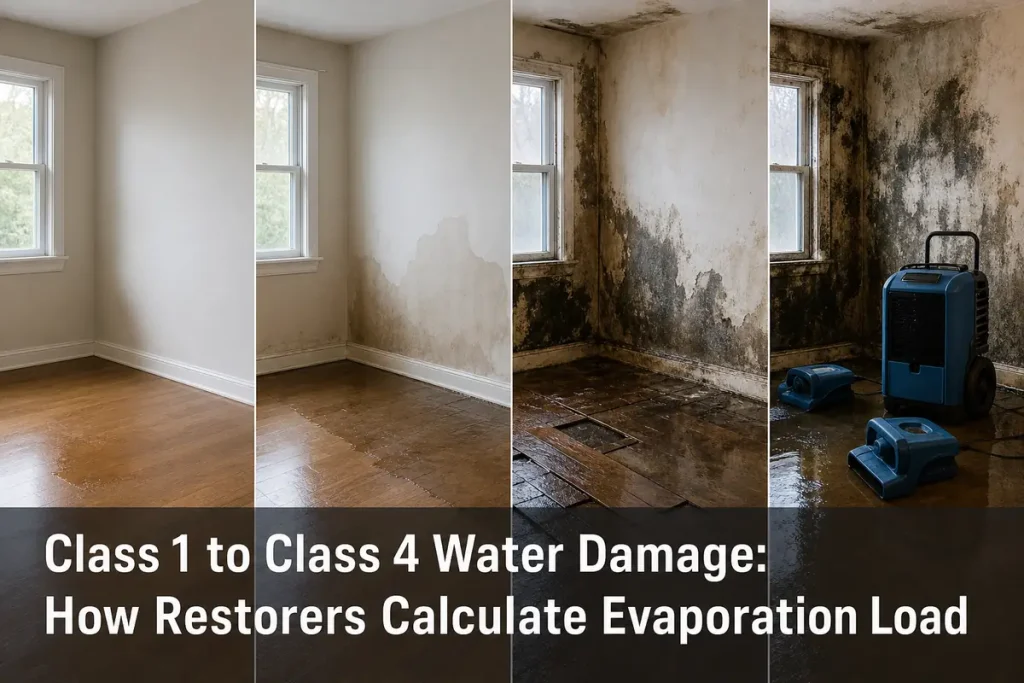
Class 1 to Class 4 water damage is the IICRC's system for rating how much water a space must evaporate, and it directly determines how many air movers and dehumidifiers a job needs. Class describes evaporation load. Category describes contamination. Getting the class wrong means under-equipping the job, and an under-equipped job leaves framing wet behind finished walls.
Homeowners rarely hear this vocabulary until an estimator uses it, so here is the plain version, along with the math that runs quietly behind every professional drying plan in Jefferson County. When our crew walks a flooded Jeffersonville-style split-level in Jeffersontown, the first questions are not about fans. They are about surface area, porosity, and how much bound water the materials are holding, because those answers set the class, and the class sets everything else.
What Do the Four Water Damage Classes Actually Mean?
The four classes rank losses by how much wet, porous surface area is involved and how deeply water has bound into materials. Class 1 involves minimal porous wetting. Class 2 wets an entire room's carpet and climbs walls under two feet. Class 3 saturates a space from overhead, wetting ceilings, walls, and floors together. Class 4 involves deeply bound water in dense materials like hardwood, plaster, and concrete that resist normal evaporation.
The class assignment is a judgment made with meters, not eyes. A room can look like a Class 2 and behave like a Class 4 once readings show water bound deep in dense plank flooring, which is a common surprise in Louisville's pre-war housing stock.
How Do Restorers Calculate How Many Dehumidifiers a Job Needs?
Restorers calculate dehumidification from the space's cubic footage divided by a class-based factor, converted into required pints-per-day of water removal capacity, following the formulas in the ANSI/IICRC S500 Standard. Air movers are then counted from wet surface area, roughly one unit per set span of wall and floor, so evaporation and moisture removal stay in balance.
Balance is the operative word. Air movers accelerate evaporation, which loads the air with vapor. Dehumidifiers unload that vapor. Too many air movers with too little dehumidification pushes humidity up until moisture condenses on cool surfaces elsewhere in the building, effectively spreading the loss. Too little airflow and the drying stalls at the surface while bound water sits deep in materials. In practice, our crews compute the pint load, deploy matched equipment, and then let daily psychrometric readings, not the calendar, decide when the job is done. Energy Star's dehumidifier capacity standards make one thing clear for homeowners: retail units are rated for maintaining ambient comfort, a different task by an order of magnitude than processing a structural water loss.
Why Does the Wrong Equipment Count Leave Framing Wet?
Undersized equipment dries surfaces first and abandons the depths, because evaporation slows dramatically as materials approach the air's moisture condition. Drywall faces and carpet can reach touch-dry while base plates, sill boxes, and framing behind vapor barriers still read far above dry standard, and those hidden reservoirs feed mold growth weeks later.
We re-mediate other people's fast jobs regularly. A Shively homeowner had a flooded basement dried by a fly-by-night crew in two days, no moisture logs, no dry standard, invoice paid. Months later our meters found bottom plates at nearly double the dry-standard reading behind fresh baseboard, with growth to match. The rework cost more than the original job would have. Consequently, the question to ask any restorer is simple and revealing: show me the daily moisture map. If the answer is a shrug, the equipment count was a guess.
Who Runs the Drying Math Correctly in Louisville?
Bear Restoration, an IICRC Certified Firm (#70216409) founded by Emery and licensed in Kentucky (LIC-GBCL-24-00148), classes every loss on arrival, computes the S500 equipment load, and documents daily readings to dry standard across Louisville, Jeffersontown, Middletown, St. Matthews, Shively, and Prospect.
If your home has taken on water, the class of the loss decides the plan, and the plan decides whether the problem is actually gone. Call 502-200-6968, or start with our Louisville water damage restoration overview. Basement losses run through our flooded basement cleanup team, and any loss that sat wet too long before the call gets our mold remediation crew as backup. The math is not glamorous, but it is the difference between dry and dry enough to fool you.
Frequently Asked Questions
What is the difference between water damage class and category?
Class measures how much evaporation the drying plan must accomplish. Category measures contamination, from clean Category 1 to sewage-level Category 3. Every loss gets one of each, and together they set the scope.
Why did my estimator call my hardwood floors a Class 4 problem?
Dense materials like hardwood, plaster, and concrete hold bound water that resists normal evaporation, which is the Class 4 definition. They need specialty dehumidification, sometimes heat or drying mats, and longer timelines.
Can a job change class partway through drying?
Yes. Daily readings sometimes reveal deeply bound water that initial metering missed, and the equipment plan adjusts. That is exactly why professional jobs are monitored daily instead of set and forgotten.

Read Our Reviews