
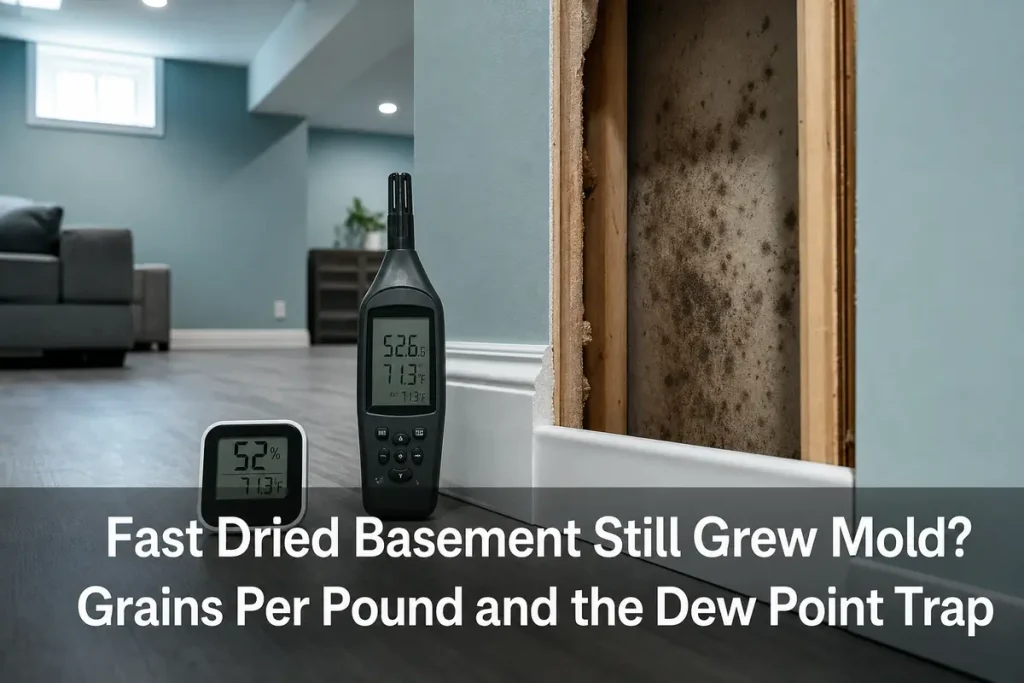
A fast dried basement that still grew mold is almost always a psychrometrics failure, not bad luck. Drying speed means nothing if the air's actual moisture content, measured in grains per pound, stays high enough to condense on cool foundation surfaces. Warm air blowing across a cold basement wall can cross the dew point and quietly re-wet the very surfaces the fans were supposedly drying.
This scenario walks into our office in the same form every time. A Middletown homeowner floods a finished basement, rents fans and a small dehumidifier, runs everything for four days, touches the carpet, declares victory. Six weeks later there is a musty smell and speckled growth behind the baseboards. The surfaces felt dry. The air science says they never fully were, and understanding two numbers explains the whole failure.
What Are Grains Per Pound and Why Does Relative Humidity Mislead You?
Grains per pound, or GPP, measures the actual weight of water vapor in each pound of air, with 7,000 grains equaling one pound of water. Relative humidity only tells you how full the air is at its current temperature. Because warm air holds more moisture, heating a room drops the relative humidity reading while the GPP, the real water load, has not changed at all.
This is the trap in one sentence: a homeowner sees 45 percent relative humidity on a cheap gauge and assumes the drying worked, while the air is still carrying 90-plus grains of water per pound through a cool basement. Professional restorers work in GPP precisely because it cannot be fooled by temperature. The ASHRAE psychrometric chart, the reference document for this entire field, maps the relationship between temperature, humidity, and moisture content, and every drying plan we build is a route across that chart, not a guess about fan placement.
How Does Dew Point Re-Wet a Basement During Drying?
Dew point is the temperature at which air becomes saturated and its moisture condenses into liquid. Louisville basement walls below grade often sit at 55 to 65 degrees year round. If the drying setup pushes warm, moisture-loaded air across those cool surfaces, and the surface temperature falls below the air's dew point, condensation forms exactly where you cannot see it: on masonry behind insulation, inside wall cavities, and on cool slab edges.
The physics get worse in a Kentucky summer. Outdoor air in July can carry a dew point near 70 degrees, so the popular move of opening basement windows to help the fans is actually importing water. Air movers then accelerate evaporation from wet materials into air that has nowhere to unload, GPP climbs, and the coolest surfaces in the room start collecting the difference. Consequently, a basement can pass the touch test on day four and still hold cavity conditions above the growth threshold that the EPA identifies as a 24 to 48 hour mold window on damp materials.
How Do Professionals Verify a Basement Is Actually Dry?
Professionals verify dryness by measuring, not touching. The ANSI/IICRC S500 Standard workflow establishes a dry standard from unaffected materials, then tracks daily moisture content readings in affected drywall, framing, and slab until they return to that baseline, while GPP readings confirm the dehumidifiers are actually removing water rather than relocating it.
In our experience, the difference shows up in the equipment math. A finished basement of moderate size can hold hundreds of pounds of absorbed water in its materials after a flood, and a rental-counter dehumidifier rated for a damp closet cannot process that load before biology outruns it. Our crews size low-grain refrigerant dehumidification to the cubic footage and the water load, position air movers to feed those units rather than the walls, and log psychrometric readings morning and night. On a recent Middletown job, drywall that felt dry to the homeowner on day two did not reach documented dry standard until day five. Those three days are exactly where the mold would have lived.
Who Should Dry Your Basement in Louisville?
Bear Restoration, an IICRC Certified Firm (#70216409) founded by Emery and licensed in Kentucky (LIC-GBCL-24-00148), dries basements to verified standard across Louisville, Middletown, Jeffersontown, St. Matthews, Shively, and Prospect, with the meters and daily documentation to prove the result to you and your insurance carrier.
If your basement flooded, or if a past flood left a smell that fans never fixed, call 502-200-6968. Our flooded basement cleanup team handles extraction and structural drying, our Louisville water damage restoration page walks through the full S500 process, and our mold remediation specialists resolve growth that an earlier fast-but-wrong drying job left behind. Dry is a number, not a feeling, and we bring the instruments that read it.
Frequently Asked Questions
Should I open basement windows to help dry a flooded basement?
In a Louisville summer, no. Outdoor dew points near 70 degrees mean open windows import moisture faster than fans remove it. Closed drying with sized dehumidification wins in humid climates.
Is a home dehumidifier from the hardware store enough after a flood?
Rarely. Retail units are rated to maintain ambient comfort, not to process the hundreds of pounds of water bound in flooded materials. Undersized capacity is the single most common reason self-dried basements grow mold.
How do I know when my basement is actually dry?
When affected materials meter at the same moisture content as identical unaffected materials elsewhere in the house, the dry standard. Touch, smell, and the calendar are all unreliable substitutes for that reading.

Read Our Reviews