
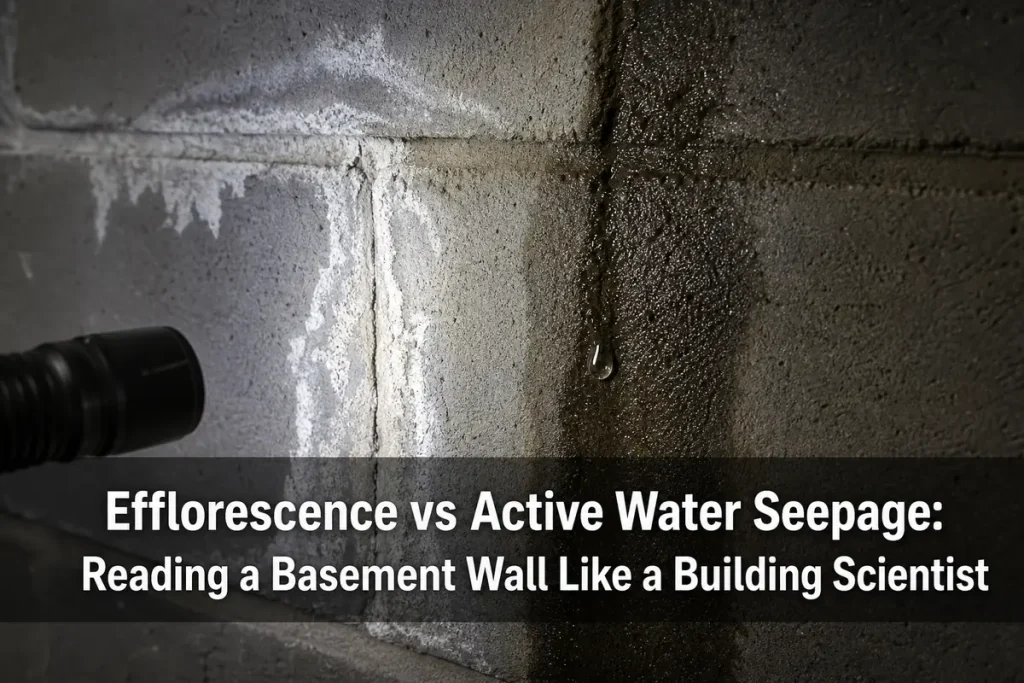
Efflorescence vs active water seepage is the difference between a moisture history and a moisture emergency. Efflorescence is the white, powdery mineral deposit left behind after water has moved through masonry and evaporated. Active seepage is water still arriving. One is the receipt, the other is the transaction, and a basement wall usually displays both if you know the reading order.
Louisville's foundation stock makes this diagnostic skill genuinely useful. Shively and the postwar South End run heavily to concrete block, Old Louisville to stone and brick, and the eastern suburbs like Middletown and Jeffersontown to poured concrete. Each material writes its moisture story differently, and a homeowner who can read the wall knows whether to schedule a project or make an emergency call. Here is how our estimators actually read one.
What Is Efflorescence and What Does It Tell You?
Efflorescence forms when water dissolves calcium hydroxide and mineral salts inside concrete, block, or mortar, carries them to the surface, and evaporates, leaving crystals behind. Its presence proves three things at once: water has a path through the wall, the path has carried enough volume to transport minerals, and evaporation is happening on the interior face.
The pattern is the informative part. A thin white band low on a Shively block wall points to capillary rise from damp soil at the footing, a chronic but slow condition. Deposits ringing a specific crack map a preferential water path worth sealing after the pressure outside is addressed. A broad, chest-high bloom across a wall suggests the exterior soil holds moisture against a large area, often a grading or downspout problem dumping roof water beside the foundation. Additionally, heavy crusty buildup with flaking or spalling concrete signals the process has run long enough to damage the wall surface itself, because salt crystallization inside pores generates real expansive pressure. The Portland Cement Association documents this whole mechanism, and it is worth knowing that efflorescence itself is not mold and not toxic. It is mineral, and it is information.
How Do You Confirm Whether Seepage Is Active Right Now?
Confirming active seepage takes a moisture meter, a flashlight held at a low angle, and patience around rain events. Active moisture darkens masonry, reads elevated on a meter, and often shows a sheen under raking light. A simple taped-plastic test, sealing a square of plastic to the wall for a day or two, separates seepage through the wall from condensation forming on it.
That last distinction matters more than any other, because the fixes point in opposite directions. Water beading behind the plastic means moisture is passing through the wall and the conversation is about exterior water management: grading, gutters, drain tile, sump capacity. Moisture only on the room side of the plastic means humid interior air is condensing on a cool wall, and the conversation is about dehumidification and ventilation. In our experience, Louisville's humid summers produce plenty of condensation cases that get misdiagnosed as leaks, and plenty of slow leaks dismissed as summer damp. Meter readings settle the argument, and the EPA's moisture control guidance backs the principle that identifying the water source correctly is the prerequisite to every lasting fix.
When Does Wall Moisture Become a Restoration Problem?
Wall moisture becomes a restoration problem the moment it reaches materials that can absorb it: framing, insulation, drywall, carpet, and stored belongings. A damp bare wall in an unfinished utility room is a maintenance item. The same wall behind a finished surface feeds a concealed wet cavity, and concealed wet cavities cross the mold threshold within days.
The finished basement is where we meet most of these cases. A Middletown homeowner noticed efflorescence at the base of one exposed wall and thought little of it, until remodeling revealed the neighboring finished wall had been quietly wicking for a year, with insulation damp to the touch and growth across the drywall back. The remediation, run to the ANSI/IICRC S520 mold standard, opened the cavity under containment, removed the affected materials, and dried the masonry to documented standard before rebuild. Consequently, the honest advice is this: treat efflorescence on an unfinished wall as your foundation filing a report, and treat any dampness behind finished surfaces as a call worth making this week.
Who Investigates Basement Wall Moisture in Louisville?
Bear Restoration, an IICRC Certified Firm (#70216409) founded by Emery and licensed in Kentucky (LIC-GBCL-24-00148), performs moisture investigations and remediation across Louisville, Shively, Old Louisville, Middletown, Jeffersontown, St. Matthews, and Prospect, with instrument readings that turn a wall's clues into a clear answer.
If your wall is showing white powder, damp patches, or both, call 502-200-6968 and we will tell you which story it is telling. Our Louisville water damage restoration team handles active intrusion, our flooded basement cleanup crew responds when seepage becomes standing water, and our mold remediation specialists resolve what long-term dampness left behind finished walls. The wall has been keeping records. We just bring the instruments that read them.
Frequently Asked Questions
Is efflorescence harmful to my family or my foundation?
It is not toxic, it is mineral salt. However, heavy recurring deposits signal sustained water movement, and salt crystallization inside pores can spall the wall surface over time, so treat it as a report worth acting on.
Can I just clean the white powder off the wall?
You can brush it off dry, and it will return if the water path stays active. Cleaning treats the symptom. Grading, gutters, and drainage treat the cause.
How can I tell condensation from seepage without special tools?
Tape a square of plastic to the wall, sealed on all edges, for 48 hours. Moisture behind the plastic means water is coming through the wall. Moisture on the room side means humid air is condensing on it.

Read Our Reviews