
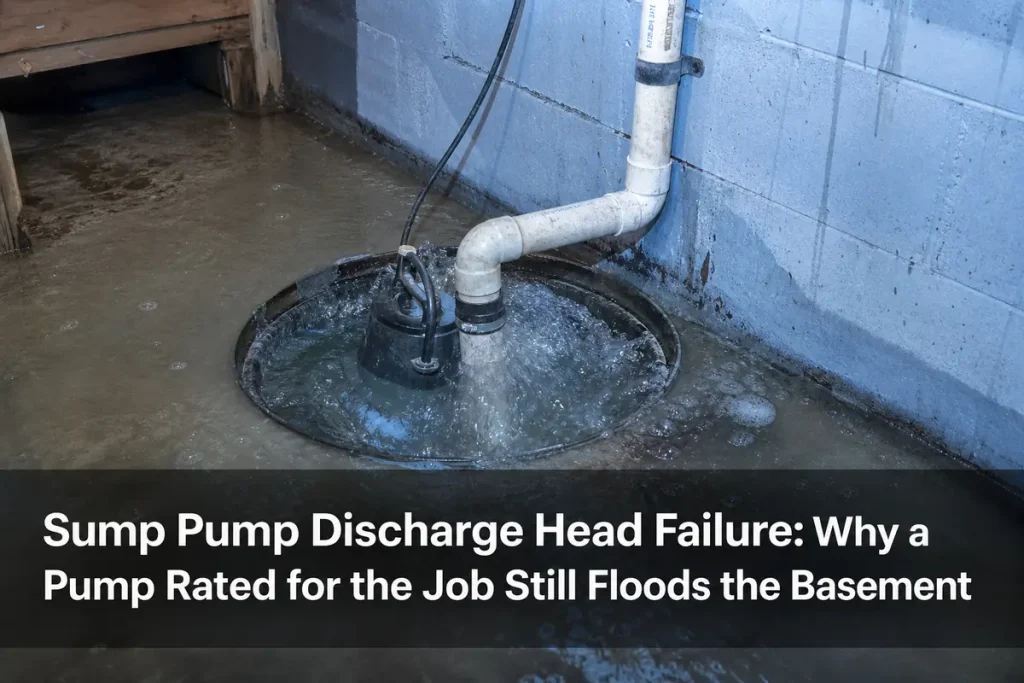
Sump pump discharge head failure is the gap between the number on the box and the number in your basement. A pump advertised at 3,000 gallons per hour delivers that rate at zero feet of lift. Push the water up eight vertical feet, through a check valve, and around two elbows, and real-world output can fall to half the rating or less. Basements flood inside that gap.
Louisville tests this math regularly. On August 4, 2009, a training thunderstorm dropped roughly six inches of rain on parts of the city in about an hour, and the National Weather Service in Louisville still references that event as a benchmark local flash flood. Sump pumps across St. Matthews and the Highlands ran continuously that morning, and many lost the race not because they died, but because inflow simply exceeded their real discharge rate. Understanding why requires three concepts: total dynamic head, check valves, and float switches.
What Is Total Dynamic Head and Why Does It Cut Pump Output?
Total dynamic head is the sum of every force the pump must overcome: the vertical lift from pit to discharge point, plus friction losses through pipe length, elbows, and the check valve. Pump output falls as head rises along a performance curve, so a typical basement installation with eight to ten feet of effective head may deliver only 40 to 60 percent of the advertised zero-head rating.
The arithmetic against inflow is sobering. Water weighs 8.34 pounds per gallon, so lifting it costs real energy, and every pipe fitting adds equivalent feet of friction head. Meanwhile, during a heavy Kentucky storm, drain tile around a typical foundation can feed a pit at rates that approach or exceed the pump's degraded output. When inflow wins by even a few gallons per minute, the pit rises, then the cove joint weeps, then the carpet pad starts drinking. In our experience, most homeowners have never seen their pump's performance curve, and consequently they own a pump sized for the sticker rather than the storm.
How Do Check Valves and Float Switches Cause Sudden Failures?
Check valves and float switches fail differently but with the same result: a working motor that moves no water. A failed check valve lets the discharge column drain back into the pit after each cycle, forcing the pump to re-lift the same water and cutting net output further. A float switch stuck against the pit wall or tangled in its cord simply never tells the motor to start.
The 30-second version of the failure sequence looks like this: the storm peaks, inflow spikes, a stuck float delays activation, the pit overtops, and water crosses the slab toward the finished side of the basement. From the first overtop to wet carpet is often under a minute. Battery backup systems buy insurance against the other common killer, power loss mid-storm, but backup runtime is its own math: amp-hours divided by draw, minus the derating of an aging battery. Additionally, FEMA's basement flood mitigation guidance pairs pumps with the unglamorous partners that reduce inflow in the first place: grading, downspout extensions, and clean drain tile.
What Should Happen in the First Hours After a Sump Failure Flood?
After a sump failure flood, the priorities are safety, extraction, and speed. Electricity and standing water share the space, so the circuit gets cut before anyone wades in. Then extraction and structural drying need to start within hours, because carpet pad, drywall, and base plates begin the same absorption clock as any other basement flood.
The insurance wrinkle matters here too. Standard homeowner policies commonly exclude groundwater flooding, while water backup and sump overflow coverage is a separate endorsement many Louisville homeowners discover they lack at the worst moment. Photograph everything, save the failed pump as evidence, and get moisture documentation started immediately, because a well-documented loss file supports whichever coverage applies. On a St. Matthews job after a spring downpour, our meter map and daily drying logs, built to the ANSI/IICRC S500 Standard, were exactly what the adjuster needed to move the claim without friction.
Who Responds to Sump Pump Floods in Louisville?
Bear Restoration, an IICRC Certified Firm (#70216409) founded by Emery and licensed in Kentucky (LIC-GBCL-24-00148), responds to sump failure floods across Louisville, St. Matthews, Middletown, Jeffersontown, Shively, and Prospect with truck-mounted extraction, sized dehumidification, and documented drying to standard.
If your pump lost the race this storm season, the water damage clock is already running. Call 502-200-6968, or start with our Louisville flooded basement cleanup page. Our emergency water extraction team handles everything from extraction through rebuild coordination, and when a flood sat unnoticed over a weekend away, our mold remediation crew addresses what grew in the meantime. Pumps have performance curves. So does bacteria. We make sure the right one wins.
Frequently Asked Questions
How do I find out my sump pump's real output at my head height?
Check the performance curve in the manual or on the manufacturer's site, then read output at your vertical lift plus friction losses. Many homeowners discover their real capacity is roughly half the box rating.
How often should I test my sump pump in Louisville?
Monthly during storm season. Pour a bucket of water into the pit and confirm the float triggers, the pump evacuates quickly, and the check valve holds. Five minutes of testing beats a flooded rec room.
Is a water-powered backup pump better than a battery backup?
Each has tradeoffs. Water-powered units run indefinitely during outages but need municipal pressure and waste water. Batteries need maintenance and have finite runtime. Homes with finished basements often justify both.

Read Our Reviews