
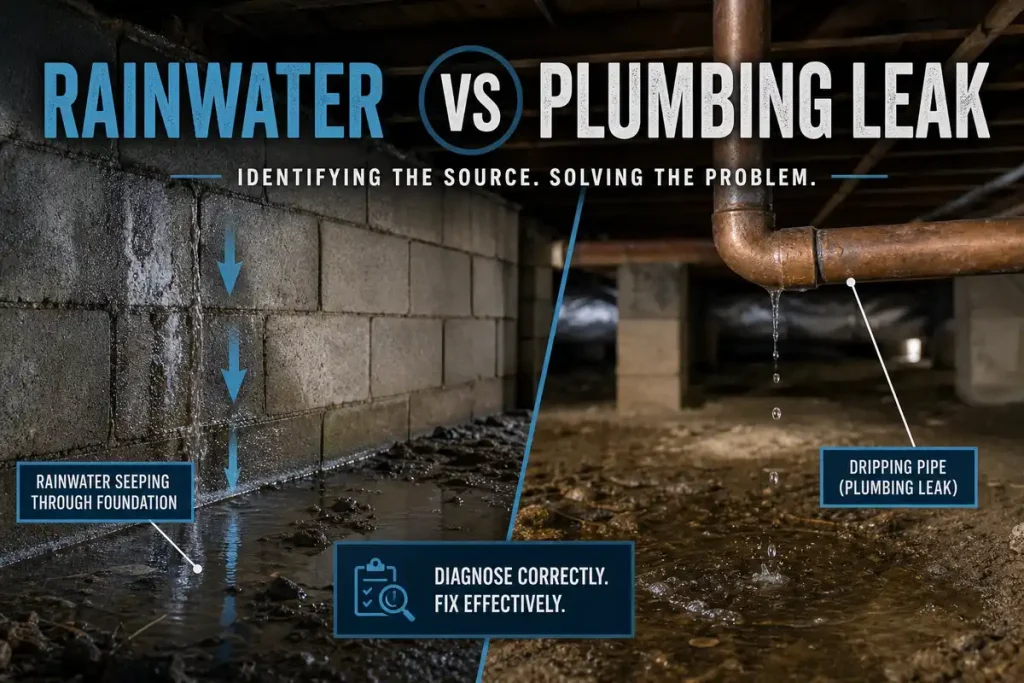
Water in a crawlspace gets expensive fast, but the source decides everything. In the rainwater vs plumbing leak crawlspace question, your best clue is not guesswork, it is pattern: where the water starts, when it appears, what it carries, and how it behaves over 24 to 48 hours.
Quick Overview of Rainwater Vs. Plumbing Leak in a Crawlspace
Water damage is one of the most common property claims in the United States. The Insurance Information Institute reports that about 1 in 60 insured homes files a claim each year for water damage or freezing, with an average claim severity above $13,000 in recent national data (Insurance Information Institute, 2023). That number frames the real issue: if you misidentify the source in your crawlspace, you waste time on the wrong repair and weaken your insurance position.
Rainwater enters from outside. Plumbing leaks start inside the building system. That distinction changes cleanup scope, source repair, mold risk, and coverage arguments. The comparison here uses five criteria: entry point, timing, water characteristics, location of damage, and inspection evidence.
Finding: If water tracks weather and perimeter intrusion, diagnose rainwater first. If moisture persists during dry conditions and follows pipe routes, treat it as a plumbing leak until testing proves otherwise.
Entry Point and Water Pattern
Professional inspections start with where the water physically enters. The International Association of Certified Home Inspectors identifies common crawlspace moisture sources as surface runoff, poor grading, plumbing leaks, groundwater intrusion, and HVAC condensate, with visible pattern mapping used as a primary field indicator (InterNACHI Standards and moisture guidance).
Rainwater usually arrives at the foundation edge through failed grading, short downspouts, open vents, wall cracks, or hydrostatic pressure pushing moisture through masonry. A plumbing leak starts at a supply line, drain line, water heater line, icemaker line, or condensate discharge. The limitation is obvious during a Louisville downpour: a storm can hide an active pipe leak by wetting everything at once.
Finding: Entry location is the fastest first filter, but storm overlap means source confirmation needs more than one clue.**
Rainwater Telltale Signs
Rainwater leaves a perimeter story. You see pooled water near foundation walls, wet soil bands along the outside edge, muddy splash marks, and insulation soaked near rim areas rather than under a single fixture group. If the same wet zone returns after every hard rain in St. Matthews or Middletown, exterior intrusion is the leading diagnosis.
The pattern often matches drainage failure. Overflowing gutters dump roof runoff beside the house, short downspout extensions saturate one corner, and sloped lots send water toward the crawlspace opening. If you keep asking why the problem returns after storms, the answer usually sits outside, not in the pipes. That pattern aligns with the causes explained in persistent post-storm crawlspace moisture.
Plumbing Leak Telltale Signs
Plumbing leaks leave a more concentrated footprint. Active dripping, fine spray from a pinhole, steady dampness under a bathroom, and clean staining near a pipe run point inward, not outward. Pressurized supply leaks create repeated wetting even when the weather is clear, while drain leaks often show up during showers, laundry, or dishwasher cycles.
The flow pattern matters. Rainwater surges with storms, then recedes. A pipe leak keeps feeding the same area, sometimes slowly, sometimes nonstop, until a shutoff or repair stops it.
Timing: When the Water Appears
The U.S. Environmental Protection Agency recommends documenting moisture events quickly because timing is a strong diagnostic clue and mold can begin developing within 24 to 48 hours on wet materials (EPA mold guidance). In plain terms, a timeline is not paperwork for later, it is part of the diagnosis now.
Rainwater appears during or right after storms. Plumbing leaks continue overnight, during sunny stretches, and across several dry days. A counter-finding matters here: sump discharge, irrigation overspray, and even a neighbor’s drainage problem can confuse the timeline if you only look once.
Finding: Water that follows weather points to rainwater, while water that ignores weather points to plumbing.**
Weather-Linked Moisture Pattern
If your crawlspace floods after a Louisville thunderstorm, document rainfall date, gutter overflow, downspout discharge points, and which foundation side gets wet first. NOAA rainfall records can support the weather timeline if a claim or contractor dispute develops (NOAA climate data). The stronger the storm-to-water correlation, the stronger the rainwater diagnosis.
This matters in neighborhoods with heavy runoff and older drainage layouts. A low rear lot in Jeffersontown or a tight side-yard in Old Louisville often shows the same sequence: hard rain, overflow at one corner, standing water near the wall, then rising humidity under the floor system.
Dry-Weather Moisture Pattern
If moisture stays active during clear weather, move plumbing to the top of the list. A supply leak often worsens when toilets refill, laundry runs, or a shower is used. A drain leak often appears only during use, which still separates it from rainwater because the trigger is occupancy, not weather.
A simple isolation step helps before professional testing: stop using the suspected fixture or shut off a branch line if safely accessible. If the damp area changes with interior water use, the crawlspace is telling you the source.
Water Appearance, Odor, and Residue
The IICRC S500 standard separates water losses by contamination category, and that distinction affects drying, removal, and sanitation requirements (IICRC S500 overview). The limitation is that rainwater does not stay clean once it moves through soil and a crawlspace. By the time you see it, contamination often increases.
Visual clues still help. Sediment, leaf debris, and earthy odor lean toward runoff. Clear water near a pressurized line leans toward supply plumbing. Foul odor, gray residue, or sewage evidence shifts the problem into drain or waste-line failure, which changes urgency immediately.
Finding: Appearance and odor do not prove the source alone, but residue type sharply narrows the likely cause and cleanup class.**
What Rainwater Usually Looks Like
Rainwater in a crawlspace usually looks dirty. You see muddy pooling, silt lines on piers or block walls, washed-in leaf fragments, and brown residue around the perimeter. The odor is earthy because the water traveled through soil before entering the structure.
Perimeter staining is one of the better clues. When the wall line is wet and the center stays drier until volume increases, exterior intrusion is the cleaner explanation.
What Plumbing Water Usually Looks Like
Supply-line leaks often start clear. Older galvanized systems can tint the water orange or brown from rust. Drain-line leaks add soap film, organic residue, or blackened staining, while failed waste lines create unmistakable sewage odor and demand far more aggressive containment.
Line type controls urgency. Clean supply water still requires fast drying. Drain or sewage water requires material removal, sanitation, and stricter safety procedures.
Location of Damage Inside the Crawlspace
Restoration technicians use moisture mapping to compare the wettest materials with the most likely source path. The Restoration Industry Association and IICRC field practices both center on locating the moisture gradient before deciding on demolition or drying scope (RIA technical resources).
Perimeter flooding, broad soil saturation, and multiple wet piers favor rainwater. Damage directly under kitchens, baths, laundry rooms, or mechanical systems favors plumbing. In older Louisville housing stock, overlap is common because retrofitted pipes run through already damp crawlspaces.
Finding: Damage location often settles the comparison faster than water color because building layout narrows the source path.**
Damage Pattern That Points to Rainwater
Rainwater typically wets the exterior edge first, then low spots, then larger ground areas as the event worsens. You see damp foundation walls, wet piers near the perimeter, and widespread humidity under the whole floor system. Blocked vents, negative grading, and missing extensions make the pattern worse.
Historic homes with chronic exterior moisture often develop a broader crawlspace humidity problem, not just standing water. That broader pattern connects directly to why older homes hold crawlspace moisture longer.
Damage Pattern That Points to a Plumbing Leak
A plumbing leak concentrates damage beneath the failing line or fixture group. Wet subfloor under a bathroom, soggy insulation below the laundry area, or a dark mold band along the main water line route all point inward. In houses with retrofitted plumbing, especially older Louisville homes, newer line paths often create visible wet corridors.
If the subfloor directly under one room starts cupping, staining, or softening, the source is often close to that room. That is why warning signs in wet subfloor sections deserve immediate attention.
Structural Impact and Mold Risk
The EPA states that mold can grow within 24 to 48 hours on wet materials, and wood-decay fungi accelerate when moisture stays elevated over time (EPA mold guidance). The limitation is that both rainwater and plumbing leaks can hit that timeline. Source type changes the damage pattern more than the mold clock.
Rainwater drives chronic humidity, repeated wet-dry cycles, and broad crawlspace deterioration. Plumbing leaks soak targeted materials continuously and often destroy subflooring and insulation faster in a smaller area. Both are serious. The difference is spread versus intensity.
Finding: Rainwater usually causes broader long-term damage, while plumbing leaks usually cause faster concentrated damage.**
How Rainwater Damages the Crawlspace Over Time
Repeated rain intrusion keeps resetting the problem. Wood absorbs moisture, insulation slumps, metal fasteners corrode, and masonry shows efflorescence as mineral salts move to the surface. Humid crawlspace air then migrates upward into living areas, raising indoor air quality concerns and attracting pests.
Exterior drainage failure is the reason the damage keeps returning. Until the runoff path changes, drying the crawlspace alone does not solve anything.
How Plumbing Leaks Escalate Faster in Targeted Areas
Pressurized leaks keep one area saturated around the clock. That constant wetting collapses insulation, darkens framing, and rapidly softens subfloor under occupied rooms. Hidden leaks are worse because damage spreads before surface symptoms appear upstairs.
In practical terms, plumbing leaks often outpace rainwater in one joist bay, one bathroom footprint, or one kitchen line route. Concentrated water wins the race to material failure.
Inspection Methods and Evidence You Need
The American Society of Home Inspectors and modern leak-detection trade practices rely on layered testing: visual mapping, moisture meter readings, thermal imaging, pressure testing, and camera inspection when drain failures are suspected (ASHI resources). One test rarely settles every case, especially in mixed-source losses.
For insurance, evidence quality matters almost as much as the diagnosis. Timestamped photos, moisture readings, plumber reports, and weather records create a causation file that holds up better than verbal descriptions.
Finding: The strongest diagnosis comes from overlapping evidence, not a single wet spot or one contractor opinion.**
Evidence That Supports a Rainwater Diagnosis
Rainwater evidence starts outside. Photograph grading toward the house, measure downspout discharge distance, document clogged gutters, note visible foundation gaps, and match the moisture event to a storm date. Soil saturation notes and perimeter wall staining strengthen the exterior-water case.
This record does two jobs. It guides the repair plan, and it supports your position when storm conditions contributed to the loss.
Evidence That Supports a Plumbing Leak Diagnosis
Plumbing evidence is more mechanical. A water meter movement test with all fixtures off, branch shutoff isolation, pressure loss testing, pipe inspection, and plumber documentation create a cleaner causation chain. If drain lines are involved, a camera scope often settles the argument.
Service records matter. So does a clear timeline showing when the leak was discovered and how fast mitigation started.
Cleanup, Drying, and Repair Scope
The IICRC S500 standard sets the baseline for water mitigation: stop the source, extract water, remove unsalvageable materials, dry to target moisture levels, and prevent secondary damage (IICRC S500 overview). The limitation is that a contaminated drain leak requires a different protocol than a clean supply leak.
Rainwater repairs focus on exterior control before interior drying holds. Plumbing repairs focus on isolating and fixing the line before restoration proceeds. If the source stays active, drying fails.
Finding: Source control comes first in both scenarios, but rainwater fixes begin outside and plumbing fixes begin at the line.**
Typical Rainwater Repair Path
The repair path starts with drainage correction. Extend downspouts, regrade soil, improve sump performance, seal obvious entry gaps, replace damaged vapor barrier, then dry the crawlspace. If the crawlspace system is outdated, comparing basic ground cover with full sealed systems helps frame the repair scope correctly.
Interior drying without exterior correction is wasted money. The site drainage issue keeps reloading the crawlspace.
Typical Plumbing Leak Repair Path
The plumbing path starts with leak isolation. Shut off the affected line, repair or replace the failed section, address drain or waste defects, remove contaminated materials if needed, then dry the affected framing and subfloor. If sewage is involved, disposal and sanitation expand the job quickly.
The order is simple: stop the leak, verify the repair, then restore the damage.
Insurance Coverage and Claim Position
The Insurance Information Institute explains that standard property policies generally cover sudden and accidental discharge of water from plumbing systems, while flood and surface water require different treatment and are commonly excluded without specific coverage (Insurance Information Institute). Exact policy language still controls.
That limitation matters for homeowners, landlords, and small commercial owners alike. A storm event near the property does not automatically create coverage for crawlspace seepage. A pipe burst does not guarantee payment if the carrier concludes long-term neglect.
Finding: Plumbing leaks usually receive a stronger initial coverage position than rainwater intrusion, but documentation decides close calls.**
How Rainwater Claims Are Typically Treated
Rainwater claims often run into exclusions for surface water, groundwater, or flood-related intrusion. If wind damage or a sudden covered building failure contributed, the claim position improves, but proof matters. Photos of storm conditions, overflow points, and same-day water entry are far more persuasive than a late report with no timeline.
For Louisville-area properties after severe spring weather, storm-date documentation is especially useful when a covered event and site vulnerability overlap.
How Plumbing Leak Claims Are Typically Treated
Sudden and accidental plumbing discharge usually gets better policy treatment than exterior seepage. The trouble starts when staining, rot, corrosion, or long-term leakage suggests a maintenance issue. Carriers look for evidence that the event was abrupt and promptly addressed.
Photos, plumber findings, meter readings, and a clear discovery timeline strengthen your file. Delay weakens it.
Pricing and Cost of Fixing Each Problem
National 2024 cost guides from Angi and HomeAdvisor place crawlspace water damage, drainage correction, leak repair, and subfloor replacement across a wide range because access, contamination level, and structural damage change everything (Angi cost guides, HomeAdvisor cost guides). The counter-finding is that historic foundations and low-clearance crawlspaces in Louisville push both totals upward fast.
Diagnosis often starts in the hundreds. Mitigation moves into the low thousands. Full source repair and restoration can rise sharply if structure, sewage, or drainage redesign is involved.
Finding: Rainwater often costs more in site correction, while plumbing leaks often cost more in targeted structural repair and contaminated cleanup.**
Typical Cost Drivers for Rainwater Problems
Rainwater costs climb when the problem extends beyond cleanup. Grading correction, trench or curtain drainage, sump upgrades, gutter work, and replacement vapor barriers can turn a “small water issue” into a larger site project. If the exterior source stays unresolved, recurring cleanup becomes the hidden cost.
That is why rainwater often looks cheaper on day one than it actually is.
Typical Cost Drivers for Plumbing Leaks
Plumbing costs depend on line type and access. A visible PEX repair under an open crawlspace stays contained. A failed drain under a bathroom, cast iron replacement, sewage cleanup, or subfloor repair under finished flooring expands quickly. Leak detection and plumber access often decide whether the job stays manageable.
With plumbing, the source repair can be small while the material damage is large.
Louisville-Specific Risk Factors
NOAA rainfall data, USGS soil and groundwater information, and Louisville MSD drainage conditions all point to a local reality: heavy spring storms, clay-heavy soils, freeze-thaw movement, and mixed-age housing increase crawlspace water problems across Jefferson County (NOAA, USGS Kentucky Water Science Center, Louisville MSD). Property-specific maintenance history still controls the final diagnosis.
Louisville properties do not fail in one uniform way. Old Louisville and Clifton often show foundation and gutter issues first. St. Matthews, Jeffersontown, and Middletown more often show lot drainage, sump, irrigation, or newer plumbing-system patterns.
Finding: Local climate and construction increase both risks, but neighborhood housing style changes which source is more likely.**
Why Older Louisville Homes Lean Toward Certain Failures
Older homes often combine stone or block foundations, aging gutters, retrofitted plumbing, and tight crawlspaces. That creates overlapping symptoms. Perimeter seepage, old masonry cracks, and newer pipe routes can all appear in the same wet crawlspace.
The separator is still pattern. Muddy perimeter staining points outside. Clean concentrated wetting beneath a fixture group points inside.
Why Newer Suburban and Small Commercial Properties Show Different Patterns
Newer suburban homes and small commercial buildings show different evidence. Long downspout runs, irrigation overspray, slab-to-crawl transitions, and sump discharge issues can mimic plumbing moisture. At the same time, newer PEX and PVC systems tend to produce cleaner, more localized leak patterns when failures occur.
Construction type shifts probability. Exterior water often spreads wider. Plumbing leaks still stay more focused.
Best Use Cases: When Rainwater Is the More Likely Culprit
Rainwater is the stronger diagnosis when moisture appears only during or after storms, especially if you see perimeter pooling, muddy residue, gutter overflow, and water entry on the downhill side of the structure. The source case gets stronger when multiple storm events produce the same wet pattern and dry weather brings clear improvement.
This scenario is common in low lots, homes with short downspouts, and older foundations with visible seepage lines. In those conditions, outside water is telling the same story every time.
Finding: If the evidence tracks rainfall, runoff, and perimeter entry, rainwater is the leading cause.**
Best Use Cases: When a Plumbing Leak Is the More Likely Culprit
A plumbing leak is the stronger diagnosis when the crawlspace stays wet in dry weather, water concentrates under bathrooms, kitchens, laundry rooms, or mechanical equipment, and meter movement continues with fixtures off. Active drips, pipe-route staining, and sewage odor move plumbing from possible to likely.
This pattern is especially strong when interior water use changes the severity. If a shower or washer cycle makes the area wetter, the pipes are naming themselves.
Finding: If moisture persists independent of storms and aligns with pipe routes or fixture groups, plumbing is the leading cause.**
Verdict: Which One Fits Your Crawlspace Symptoms Best?
For most crawlspace water problems that appear after Louisville storms and collect along foundation edges, rainwater is the better fit. For ongoing wetness during clear weather, especially under bathrooms, kitchens, laundry areas, or HVAC lines, plumbing leak is the better fit.
Here is the decisive rule: weather-linked, muddy, perimeter moisture equals rainwater. Dry-weather, localized, pipe-adjacent moisture equals plumbing. Insurance response is usually faster and cleaner for sudden plumbing discharge, but repair urgency is highest for whichever source is still active right now.
Final finding: Plumbing leaks usually demand the faster insurance move, but active rainwater intrusion demands the broader property fix.**
Yes. Fresh stormwater can appear fairly clear at entry, especially near a foundation gap. Once it crosses soil and crawlspace surfaces, it usually picks up silt, debris, and odor quickly. Pattern and timing still matter more than clarity alone.
No. Bad grading is common, but gutter overflow, short downspouts, foundation cracks, blocked drains, and hydrostatic pressure can produce the same result. Exterior inspection needs to cover the whole runoff path.
Start with timeline, location, and meter behavior. If water appears during dry weather, concentrates below a fixture area, or changes with interior water use, plumbing moves ahead. Moisture meters, thermal imaging, and pressure testing usually confirm it without opening finished walls first.
Standard policies often exclude surface water, groundwater, and flood-related intrusion unless specific coverage applies. A sudden plumbing leak usually gets better treatment. Exact coverage depends on policy language, exclusions, and endorsements.
Both can support mold growth within 24 to 48 hours if materials stay wet, according to EPA guidance. Plumbing leaks often damage a smaller area faster. Rainwater often creates a larger long-term humidity problem.
Photograph entry points, standing water, residue, affected rooms above, meter readings, weather dates, and any active drips. Save plumber reports, moisture readings, and storm records. Early documentation strengthens both diagnosis and claim position.

Read Our Reviews