
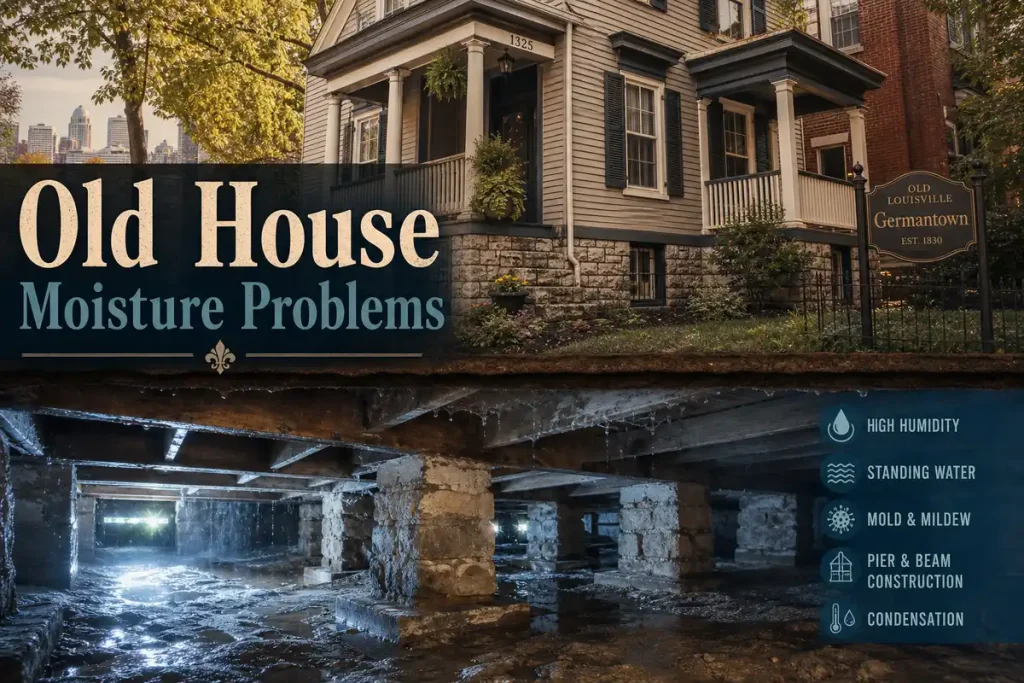
Old house crawlspace moisture is persistent dampness under your house, from water vapor, condensation, wet soil, leaks, or standing water that enters faster than it dries. In Louisville, that problem shows up constantly under older homes in Old Louisville, St. Matthews, Jeffersontown, Middletown, and the South End because aging foundations, humid summers, and drainage failures work together. If your floors smell musty, feel uneven, or stay humid after rain, the crawlspace is often the real source.
What Old House Crawlspace Moisture Means
The EPA defines moisture control as the front line of mold prevention inside buildings, stating plainly that mold grows where moisture remains (EPA, Mold Course Chapter 2). In an old house, crawlspace moisture means more than a puddle after a storm. It includes damp framing, humid air, condensation on ducts and pipes, wet insulation, and soil that keeps releasing vapor day after day.
That distinction matters because you are dealing with a building-system problem, not just a leak. Water reaches the crawlspace from the ground, the air, the plumbing, the roof drainage, and the foundation perimeter. Once it gets in, older construction often lacks the layers that stop it, such as sealed vapor barriers, modern footing drainage, and conditioned crawlspace design.
In practice, your crawlspace acts like the underside of a cooler left open in July. Moisture keeps entering, cool surfaces collect it, and materials stay wet longer than expected. The result is chronic dampness, even when no single failure looks dramatic.
Finding: Old house crawlspace moisture is a repeated moisture cycle under your home, not an isolated water event.
Why Older Houses Hold Moisture More Than Newer Houses
The U.S. housing stock is old by any standard. The 2023 American Community Survey from the U.S. Census Bureau indicates that a large share of owner-occupied homes in many Midwestern and Southern markets were built before modern air sealing, vapor control, and drainage details became routine. Around Louisville, that describes a huge number of properties, from brick homes in Old Louisville to ranches in the South End and postwar homes in first-ring suburbs.
Older houses hold moisture more than newer houses because many were built with vented crawlspaces, porous masonry, minimal ground cover, and site drainage that has shifted over decades. Add settled sidewalks, short downspouts, patched plumbing, and clay-heavy soils that drain slowly, and moisture gets repeated chances to enter. Newer homes are not automatically dry, but they are more likely to include better perimeter water management and tighter ground vapor control from the start.
The limitation is straightforward: age does not cause moisture by itself. An older house with corrected grading, sealed ground cover, repaired masonry, and controlled humidity performs far better than a neglected 1990s crawlspace.
Finding: Older houses trap more moisture because old construction and decades of wear reduce moisture control, not because age alone is defective.
Historic Construction Details That Work Against Moisture Control
Building Science Corporation has documented that vented crawlspaces in humid climates often perform poorly because outdoor air carries substantial moisture into cooler enclosed spaces (Building Science Corporation, Understanding Crawlspaces). That describes much of Kentucky summer weather exactly. Warm air enters through foundation vents, hits cooler framing, ductwork, and masonry, and water condenses.
Historic crawlspaces add more weak points. Fieldstone and older brick foundations absorb and release moisture. Pier-and-beam framing leaves open air pathways. Thin plastic, torn paper-faced insulation, or no ground cover at all leaves bare soil exposed. Porous masonry and dirt floors do not block water vapor. They feed it.
You also see old repair habits that never solved the real issue. A vent screen gets replaced, but the downspout still dumps beside the wall. Insulation gets stapled up again, but the soil under it stays wet. The assembly never really dries.
Finding: Older crawlspace assemblies invite moisture in through the ground, foundation walls, and outside air.
Deferred Maintenance Turns a Design Weakness Into a Moisture Trap
The National Association of Home Builders identifies site drainage, roof runoff management, and water control detailing as foundational to keeping below-grade and low-elevation spaces dry (NAHB, residential moisture guidance). In an older house, small maintenance failures stack up over time until the crawlspace becomes a permanent damp zone.
Clogged gutters overflow at the exact wall line. Grading settles back toward the house. Mortar joints crack. Utility penetrations stay open. Supply lines drip slowly for months. Drain lines leak only during heavy use, which makes them easy to miss. Each issue adds a little moisture, and the crawlspace has no margin left.
That is why the problem often feels mysterious. No single failure looks big enough, but the total water load is constant.
Finding: Deferred maintenance converts an older crawlspace from merely vulnerable to chronically wet.
Where Crawlspace Moisture Comes From in an Old House
EPA and CDC guidance both tie indoor mold risk directly to uncontrolled dampness, water intrusion, and persistent humidity (EPA, CDC). In old houses, crawlspace moisture usually comes from several sources at once: bulk water, soil vapor, humid outdoor air, plumbing leaks, and HVAC condensation. A one-time inspection can miss this because some entry paths only appear after a hard Louisville rain.
That matters if you are trying to diagnose the source. A crawlspace can be dry on Tuesday and soaked on Saturday after a storm band moves across Jefferson County. That is why sorting out storm runoff from an interior pipe issue changes the repair plan.
Finding: Old house crawlspace moisture usually has multiple sources, and timing after rain or humidity spikes affects what you find.
Ground Moisture Rising Through Bare Soil
The Department of Energy notes that uncovered earth in crawlspaces releases moisture continuously, raising humidity and wetting nearby materials (U.S. Department of Energy, crawlspace insulation and moisture guidance). Bare soil acts like a slow evaporator under your house. Water in the soil moves upward through capillary action and then enters the air as vapor.
If your crawlspace has missing plastic, loose plastic, or torn plastic, that vapor keeps reaching joists, insulation, and ductwork. Over time, the framing stays at elevated moisture content, and the space never really resets to dry.
Outside Water Entering From Drainage Failures
Louisville gets repeated heavy rain events across spring and summer, and clay-rich soils hold water against foundations longer than sandy soils. The National Weather Service and NOAA precipitation records consistently show intense rainfall episodes across Kentucky that overwhelm bad grading fast (NOAA Climate Data Online).
Short downspouts, overflowing gutters, negative grade, and runoff from neighboring lots send water straight to the foundation perimeter. In older neighborhoods, settled landscaping often hides this. If your crawlspace stays wet after a storm, the outside drainage pattern is usually the first place to look. That is exactly why persistent wetness after rain points to site water failures.
Humid Summer Air Entering Through Vents
Research from Advanced Energy and Building Science Corporation has challenged the old belief that venting always dries crawlspaces in humid climates (Advanced Energy crawlspace research, Building Science Corporation). In Louisville summer weather, outdoor air enters hot and wet. Inside the crawlspace, surfaces stay cooler. Once that incoming air reaches dew point, condensation forms on ducts, joists, pipes, and masonry.
The old logic sounded simple: more vents equal more drying. But dew point changes the math. If the outside air is wetter than the crawlspace air, ventilation imports moisture instead of removing it.
Interior Leaks From Plumbing, HVAC, and Appliances
Supply leaks, drain leaks, sweating cold-water lines, failed condensate lines, and uninsulated ducts add moisture year-round. These are steady sources, which makes them especially damaging. A tiny plumbing leak does not need to flood the space to keep wood damp enough for mold growth.
HVAC systems make this worse when ducts sweat in humid conditions or when return leaks pull crawlspace air into the system. The moisture then affects both the structure below and the air above.
Why the Moisture Gets Trapped Instead of Drying Out
ASHRAE guidance on humidity and condensation centers on a simple principle: moisture problems persist when wetting exceeds drying (ASHRAE moisture and humidity resources). Old crawlspaces fit that pattern exactly. Water gets in repeatedly, but drying stays weak because the space is cool, shaded, low to the ground, and often blocked by debris or sagging insulation.
Airflow alone does not solve this. In Kentucky summers, moving more humid outdoor air through vents can increase condensation. Drying fails when the incoming air carries more water than the materials can release.
Think of the crawlspace as a damp basement without the headroom. Limited air movement, low temperatures, and porous materials keep moisture parked in place.
Finding: Old crawlspaces trap moisture because water entry is frequent and natural drying is weak.
Vented Crawlspaces Often Import Humidity Instead of Removing It
The International Residential Code has long allowed vented crawlspaces, but building-science research in mixed-humid climates has shown that venting often underperforms compared with sealed and conditioned approaches when moisture is the main issue (ICC/IRC code resources, Building Science Corporation). During warm Louisville weather, vents act like intake openings for damp air.
The intended design assumed cross-ventilation would sweep moisture away. In real humid climates, the opposite often happens. Your crawlspace gets wetter in July even without rain.
Masonry, Wood, and Insulation Hold Moisture
Porous materials do not dry on command. Brick, block, mortar, wood, and fiberglass insulation all absorb and retain water. Wet batt insulation sags under the floor, presses against joists, and traps dampness where decay starts.
If you have concerns about soft floors above, warning signs below the subfloor often appear long before visible structural failure upstairs. By the time flooring feels springy, the crawlspace has usually stayed damp for a while.
Low Clearances and Poor Access Delay Detection
Low-clearance crawlspaces hide damage. A slow leak behind insulation or near a pier can continue for months without obvious symptoms upstairs. That delay expands the damage area and complicates documentation.
From an insurance standpoint, hidden moisture is a problem because sudden covered events and long-term neglect are handled differently. Poor access makes early documentation harder, especially after storms or plumbing discharges.
The Damage Old House Crawlspace Moisture Causes
EPA and CDC guidance both connect persistent dampness to mold growth and exposure concerns, while wood science data from the U.S. Forest Service links elevated moisture content to fungal decay conditions in wood (EPA, CDC, U.S. Forest Service wood handbook). Not every damp crawlspace shows visible mold immediately, but the damage starts before the black staining does.
Finding: Moisture under your house affects air quality, structural materials, pests, and operating costs even before the problem looks dramatic.
Mold, Mildew, and Musty Odor Moving Into Living Areas
The stack effect pulls air from lower parts of the house upward. If the crawlspace smells musty, that odor often reaches the living space through gaps around plumbing, wiring, floor registers, and framing joints. That is why a house in Middletown or St. Matthews can smell stale upstairs even when the source sits below the floor.
Microbial growth on joists, subflooring, and stored debris produces odor and airborne particles. Occupants often notice the result as a persistent smell, irritation, or heavier indoor humidity.
Wood Rot, Sagging Floors, and Foundation-related Damage
Chronic dampness raises wood moisture content, and decay fungi take over when wood stays wet long enough. Joists, beams, rim areas, sill plates, and subfloor panels weaken gradually. Floors start to sag. Doors stick. Interior cracks widen.
In pier-supported areas, wet soil and weakened wood together create movement. The issue looks like a floor problem, but the moisture cycle underneath is driving it.
Higher Energy Costs and HVAC Performance Loss
Wet insulation stops insulating well. Sweating ducts lose efficiency and add more moisture. HVAC equipment located in a damp crawlspace works harder to deliver the same comfort level.
You feel that upstairs as uneven temperatures, especially in bedrooms over crawlspaces. Utility bills rise, but the hidden cause is often moisture, not just old equipment.
Pests, Allergens, and Resale or Claim Complications
Termites, carpenter ants, rodents, and insects favor damp environments and wet wood. Moisture also supports allergens tied to dust mites and mold growth. For landlords and property managers, unresolved crawlspace conditions show up during turnovers, inspections, and disclosure discussions.
For resale and claims, documentation matters. Photos, moisture readings, rain-timing notes, and repair records all help establish whether the issue relates to a sudden event or long-term deferred maintenance.
Signs Your Old House Crawlspace Is Trapping Moisture
Competitor pages consistently focus on visible water, odor, mold, insulation failure, and comfort changes, and that aligns with EPA moisture guidance. Surface dryness on one day does not rule out recurring moisture after storms or humid stretches. Timing matters.
Finding: The best clues usually appear both inside the house and in the crawlspace, especially after rain or during peak summer humidity.
What You Notice Inside the House
Inside the house, the first signs are usually musty odor, cupped or uneven floors, higher indoor humidity, condensation on windows, and rooms that feel harder to cool. Allergy complaints often rise even when the problem seems hidden.
These are not random comfort issues. They point back to moisture and air movement from below.
What Shows up in the Crawlspace Itself
In the crawlspace, look for wet soil, standing water, fallen insulation, rusted fasteners, mold on framing, condensation on ductwork, damp masonry, and white mineral deposits called efflorescence. Those are direct signs that water is entering or failing to leave.
A dry-looking center area does not clear the space if the perimeter stays damp. The edges usually tell the real story.
What Changes After Rain or Summer Humidity
Some crawlspaces only reveal the source path after a storm or a stretch of muggy weather. Moisture mapping, photos, and repeat inspection timing make the source clearer. Water stains on piers, fresh mud lines, or new condensation on ducts often appear only then.
How to Fix the Cause, Not Just the Symptom
Building-science guidance is consistent on this point: source control outperforms repeated cleanup. Drying a crawlspace without stopping the water is just resetting the clock. Dehumidifiers help, but they do not replace drainage corrections or ground vapor control.
Finding: Real correction combines water management, vapor control, air control, drying, and repair of damaged materials.
Start Outside: Drainage, Gutters, Grading, and Discharge Points
Begin with roof and site water. Extend downspouts away from the foundation, correct negative grading, maintain gutters, and manage discharge so runoff does not return to the wall line. In Louisville lots with settled beds and clay soil, this step changes the whole moisture load fast.
Control Ground Vapor With a Sealed Vapor Barrier
A proper ground barrier covers the soil, overlaps at seams, seals at edges, and stays attached rather than loose on dirt. That difference matters. If you want the distinction clearly laid out, sealed ground systems and full enclosure are not the same fix.
Loose plastic underperforms because vapor still escapes at seams, piers, edges, and damage points. A sealed system cuts that off.
Seal Vents and Air Leaks When the Crawlspace Is Being Conditioned
In humid climates, vent closure and conditioned crawlspace strategies make sense when the assembly is being intentionally managed as part of the house. That means controlling outside air, sealing leakage paths, and pairing the strategy with vapor control and drainage.
Not every crawlspace gets the same approach. A vented crawlspace with no vapor barrier is one problem. A sealed and conditioned crawlspace is a different system entirely.
Repair Wet Materials and Manage Humidity
Replace damaged insulation, repair plumbing and condensate issues, insulate ducts and cold-water lines, remediate mold where contamination is present, and maintain humidity in line with accepted drying and restoration targets. IICRC S500 and S520 standards frame water damage restoration and mold remediation around source removal, controlled drying, and verification, not cosmetic cleanup alone (IICRC Standards).
Common Questions About Old House Crawlspace Moisture
Is Crawlspace Moisture Normal in an Old Louisville House?
Common, yes. Normal operating condition, no. Age explains why the issue shows up so often in Old Louisville, Jeffersontown, and similar areas, but EPA moisture guidance still treats persistent dampness as a mold and building-performance problem, not a condition to accept.
Does Opening Crawlspace Vents Help Dry It Out?
In humid Louisville summers, open vents often make it worse. Building-science research indicates that warm outdoor air entering a cooler crawlspace reaches dew point and condenses on surfaces instead of drying them.
Will a Dehumidifier Solve the Problem by Itself?
No. A dehumidifier helps after drainage failures, leaks, and ground vapor are controlled. If water keeps entering from soil, runoff, or plumbing, the machine is treating symptoms, not the cause.
When Does Crawlspace Moisture Become an Insurance Issue?
Insurance questions usually start when the moisture ties to a sudden discharge, storm-related intrusion, sewage backup, or documented secondary damage from a covered event. Long-term maintenance neglect usually falls outside that category. That is a practical rule, not legal advice.
Finding: Age explains why crawlspace moisture is common, but source control decides whether it stays manageable or becomes costly.
What Changes Once You Understand the Pattern
Once you understand old house crawlspace moisture as a system failure, the random symptoms stop looking random. Musty odor, sagging floors, wet insulation, and high humidity all point back to the same cycle: water enters, drying fails, materials stay wet. Break that cycle at the source, and the crawlspace stops driving problems through the rest of the house.

Read Our Reviews