
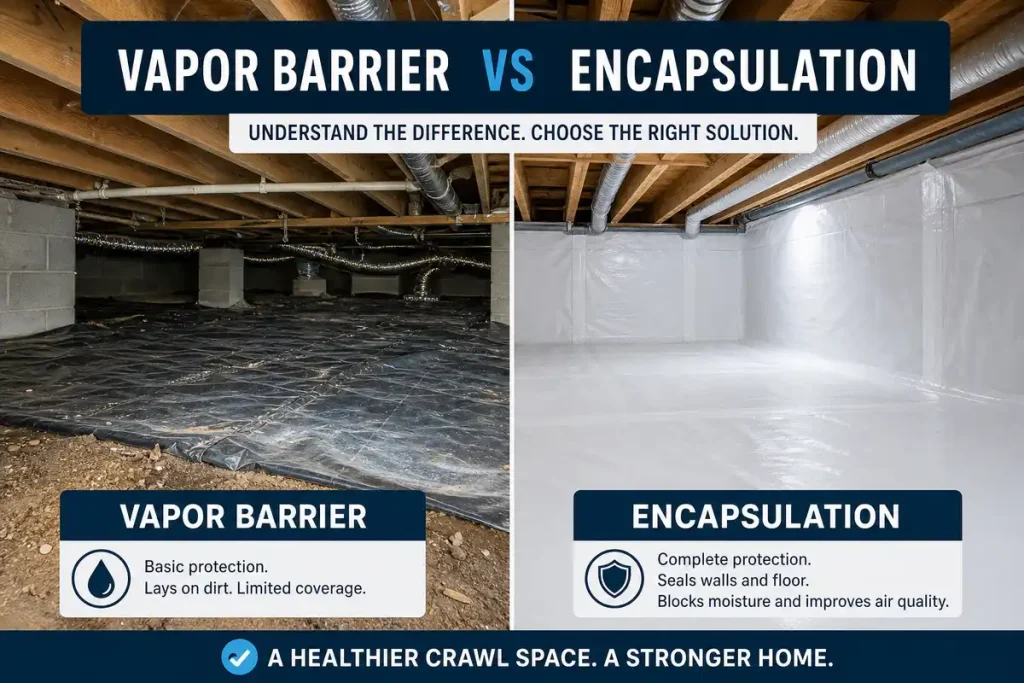
If you are comparing vapor barrier vs encapsulation, the biggest mistake is assuming both terms mean the same fix. They do not. In Louisville crawl spaces, especially in older homes near Old Louisville and vented crawl spaces in places like St. Matthews, Jeffersontown, and Middletown, that difference decides whether you solve moisture at the source or just cover one symptom. For professional help, contact Bear Restoration’s water damage restoration team.
For most properties with recurring dampness, musty odor, elevated humidity, mold concerns, or crawl-space ductwork, encapsulation is the better choice. A basic vapor barrier only wins when your problem is limited to ground moisture and the rest of the crawl space stays dry and stable.
Quick Overview: Vapor Barrier Vs. Encapsulation
The building science is straightforward. The U.S. Environmental Protection Agency explains that moisture control requires managing water entry, humidity, and condensation, not just covering exposed soil (EPA, 2024). That distinction defines this comparison.
A vapor barrier is a ground-cover liner, usually polyethylene, installed over exposed soil to reduce water vapor rising from the earth. It targets one moisture pathway: evaporation from the crawl space floor.
Encapsulation is a full crawl space control system. It includes a heavy liner over the floor, extends that liner up walls and around piers, seals seams, closes vents, improves drainage, and usually adds mechanical humidity control such as a dehumidifier or sump setup. The goal is not just to block vapor from the dirt. The goal is to create a controlled environment.
That matters in Louisville because summer humidity stays high, stormwater events are common, and older foundations often leak air as much as water. A sheet on the ground does not control humid outdoor air entering through vents, condensation on ducts, or damp masonry walls.
Finding: Encapsulation includes a vapor barrier, but a vapor barrier alone does not equal encapsulation.
What Each System Includes
Material scope is the real dividing line. The U.S. Department of Energy notes that sealed crawl spaces perform differently from vented crawl spaces because moisture and air movement are addressed together, not separately (DOE, Building America). That points directly to what gets installed.
A basic vapor barrier usually includes floor prep, plastic sheeting across the soil, overlapping seams, and limited fastening. In lower-cost installs, the plastic may be 6-mil material. Better installs use thicker reinforced liners, but the system still remains floor-only unless walls, piers, and openings are sealed too.
Encapsulation is broader. The liner is typically thicker and more durable, often 10-mil to 20-mil reinforced material. It covers the ground, runs up foundation walls, wraps interior piers, and gets sealed at seams and edges. Crawl space vents are closed. Access doors are weather-sealed. Drainage matting may be installed under the liner in wet areas. If groundwater or storm seepage is part of the issue, a sump pump or perimeter drainage system becomes part of the assembly. In many Louisville homes, a dehumidifier finishes the job by controlling relative humidity after the space is sealed.
Insulation details also change. In a vented crawl space with a basic barrier, insulation is often left between floor joists, where it easily sags, absorbs moisture, and loses performance. In an encapsulated crawl space, the thermal boundary often shifts to the walls, keeping ducts and framing inside a more stable envelope.
The catch is that labels get abused. Plenty of contractors sell “encapsulation” when the install is really just plastic on the ground with a few taped seams. If the walls are open, vents stay active, and humidity is unmanaged, that is not full encapsulation.
Finding: The real difference is installation scope, not just the plastic on the floor.
Moisture Control Performance
Relative humidity above 60 percent supports mold growth and moisture-related deterioration, according to ASHRAE and EPA guidance on indoor environmental control (ASHRAE, EPA, 2024). That is the number that matters more than marketing language.
A vapor barrier reduces moisture evaporating from bare earth. If exposed soil is your main issue, that helps. In a dry or moderately damp crawl space, it can lower moisture load enough to prevent minor seasonal dampness.
But Louisville crawl spaces rarely deal with only one moisture source. Humid outdoor air enters through vents. Cool ductwork sweats in summer. Foundation walls transmit moisture. Rainwater finds weak grading, short downspouts, and low entries. If you have ever tried figuring out why a crawl space stays wet after hard rain, you already know floor plastic alone does not stop water moving through walls or air.
Encapsulation performs better because it controls multiple pathways at once. Sealed vents reduce humid-air infiltration. Wall coverage reduces moisture migration from masonry. Sealed seams reduce vapor bypass. Dehumidification keeps humidity within a target range, often below 60 percent and preferably closer to 50 to 55 percent. Drainage components address bulk water, which a vapor barrier by itself cannot handle.
There is one limitation that matters: neither option fixes exterior drainage failure or active plumbing leaks on its own. The International Code Council and building science guidance both point to site drainage as a primary line of defense (ICC, DOE, Building America). If gutters dump at the foundation or a supply line leaks under the house, both systems will underperform.
Finding: Encapsulation delivers stronger whole-space moisture control, while a vapor barrier only addresses one moisture source.
Mold and Air Quality Impact
EPA guidance states that mold grows where moisture persists, and cleanup without moisture correction fails (EPA, 2024). That principle decides this category fast.
A vapor barrier reduces one fuel source for mold by limiting soil evaporation. That is useful, but it leaves major mold conditions in place if the crawl space still breathes humid outdoor air and the walls remain damp. Musty odor often stays because the air itself is still uncontrolled.
Encapsulation changes the mold risk profile more substantially. Sealed vents reduce the inflow of warm, wet summer air. Covered walls reduce exposed damp surfaces. A dehumidifier keeps conditions out of the mold-friendly range. Air sealing also matters because stack effect pulls crawl-space air upward into living areas. In plain terms, what sits under your floor does not stay under your floor.
That matters even more in homes where odors reach bedrooms, closets, or first-floor returns. It also matters in rentals and small commercial properties where complaints repeat every humid season. If your crawl space has visible fungal growth already, though, encapsulation is not the first step. Contamination requires removal or remediation under accepted standards such as the IICRC S520 framework for professional mold remediation (IICRC).
If you are seeing warped flooring or soft spots above the crawl space, moisture has already moved past odor and into material damage. At that point, signs of damage beneath the subfloor deserve as much attention as the liner choice.
Finding: Encapsulation outperforms a vapor barrier for mold prevention because it controls both moisture and air movement.
Energy Efficiency and HVAC Performance
The U.S. Department of Energy indicates that uncontrolled air leakage and moisture undermine insulation performance and increase heating and cooling loads (DOE). In crawl-space homes, that penalty often shows up in HVAC runtime and duct condition.
A vented crawl space with a floor-only vapor barrier still exchanges air with the outdoors. In a Louisville summer, that means hot, wet air surrounds ductwork and floor framing. Fiberglass batts absorb moisture, slump, and stop insulating well. Metal ducts sweat. Flex ducts deteriorate faster. Your system works harder to overcome conditions below the floor.
Encapsulation improves efficiency because the crawl space becomes more thermally and moisture stable. Ducts stay in drier air. Insulation stays functional longer. The floor above feels less cold in winter and less muggy in summer. Energy savings vary by building shape, leakage, and equipment location, so no honest contractor should promise one universal number. But the directional advantage is clear and supported by sealed-crawl-space research from Building America and regional field studies.
There is one counterpoint. If your crawl space has no ducts, no major air leakage, and very limited humidity load, the energy payoff from encapsulation shrinks. In that narrow situation, a basic vapor barrier handles the soil vapor issue without buying a full system for an energy problem you do not have.
Finding: Encapsulation provides measurable energy and HVAC protection advantages that a vapor barrier alone does not match.
Structural Protection and Longevity
Wood moisture content drives long-term risk. The Forest Products Laboratory and building durability research tie prolonged elevated moisture to fungal decay, fastener corrosion, and wood movement (USDA Forest Products Laboratory). That is especially relevant in older Louisville housing stock.
A vapor barrier helps protect framing from soil vapor, but only indirectly. If the crawl space stays humid, joists, girders, subflooring, and sill plates still sit in damp air for months at a time. That is how you get cupped floors, insulation failure, rusted hangers, and the familiar soft, musty feel in old-house crawl spaces. If your property has brick foundations and decades of patchwork ventilation changes, the issue often runs deeper than exposed dirt. A closer look at why older homes hold crawl-space dampness so stubbornly explains why.
Encapsulation offers broader protection because it reduces sustained humidity across the full space, not just above the soil. That lowers the conditions that feed wood rot and corrosion. It also protects stored materials and service lines better. For landlords and small commercial owners, that matters because deferred crawl-space moisture tends to become a multi-trade repair later: flooring, insulation, HVAC, electrical, and odor treatment all at once.
No moisture-control system reverses damaged framing. If joists are already decayed or subfloor layers have delaminated, repairs still need to happen.
Finding: Encapsulation offers broader long-term structural protection because it reduces sustained humidity exposure across the entire crawl space.
Installation Complexity and Disruption
Installation scope affects downtime, labor, and access requirements. ASTM material guidance and professional remediation standards both point to substrate prep and proper sealing as performance drivers, not optional extras (ASTM International, IICRC).
A vapor barrier installation is faster. Debris is cleared, the ground is leveled as needed, liner is rolled out, seams overlap, and basic attachment is completed. In a straightforward crawl space, that can move quickly with limited disruption.
Encapsulation takes longer because more conditions must be corrected before sealing. Wet insulation often has to come out. Debris and old poly need removal. Pest entry points need attention. Wall surfaces need prep for attachment. Low-clearance sections slow labor. In Old Louisville properties with tight crawl spaces, rubble foundations, or irregular piers, the install gets more demanding fast. If standing water has been entering after storms, drainage corrections and sump work extend the schedule further.
The extra disruption is real. So is the reason for it. Encapsulation asks for more because it solves more.
Finding: A vapor barrier installs faster and with less disruption, while encapsulation requires more prep but delivers a more complete solution.
Maintenance and Failure Points
System durability depends on follow-up. EPA moisture guidance and manufacturer service recommendations both stress inspection and humidity verification after installation (EPA, 2024, Energy Star).
A vapor barrier has fewer components, so maintenance is simpler. You mainly watch for tears, loose seams, displaced sections, and standing water on top of or beneath the liner. The problem is hidden failure. A floor liner can look fine while humid air still circulates freely through vents and condensation continues above it.
Encapsulation adds maintenance items, especially dehumidifier filters, condensate drains, and sump pump testing. Yet as a system, it is often more durable because each component supports the others. Sealed seams matter more when humidity is controlled. A sump matters more when the liner directs water properly. A dehumidifier works better when vents are closed and access doors are sealed.
The limitation is simple: neglected encapsulation loses performance. Dehumidifiers need service. Pumps need testing. Humidity should be verified, not assumed.
Finding: A vapor barrier has fewer components to maintain, but encapsulation is more durable as a system when it is monitored properly.
Cost Comparison: Upfront Price vs Long-Term Value
Cost separates the two options immediately. HomeAdvisor and Angi cost ranges consistently place basic crawl-space vapor barriers well below full encapsulation, while encapsulation pricing rises with drainage, dehumidification, repairs, and liner thickness (Angi, 2025, HomeAdvisor).
A vapor barrier costs less because the material list and labor hours are smaller. If your crawl space is already fairly dry, that lower upfront number makes sense.
Encapsulation costs more because you are buying floor and wall coverage, sealing work, air control, and often water management equipment. If your property has repeated moisture odors, prior mold cleanup, wet insulation, or crawl-space ducts, that higher price usually returns better value by reducing recurring cleanup and repair costs. It also reduces the chance of paying twice, once for a cheap barrier and again later for full encapsulation after the problem persists.
Severe water intrusion raises the cost of both options. If runoff, plumbing leaks, or foundation seepage are active, the moisture source must be corrected first or bundled into the project.
Finding: A vapor barrier wins on upfront price, but encapsulation delivers stronger long-term value when moisture problems are recurring.
Insurance, Real Estate, and Documentation Considerations
Insurance carriers focus on cause of loss, maintenance history, and documentation, not just the presence of plastic in the crawl space. FEMA and major carrier guidance consistently distinguish sudden accidental water events from long-term seepage and neglected moisture conditions (FEMA, III).
A basic vapor barrier offers limited documentation value. It shows that you addressed soil moisture, but not that the crawl space was managed as a whole environment. If a later loss involves mold, wet insulation, or stormwater entry, a floor liner alone does not document humidity control, drainage correction, or sealed conditions very well.
Encapsulation presents a stronger record. Moisture readings, dehumidifier settings, sump installation records, photos of sealed walls and vents, and service logs all support a cleaner property history. That helps during resale too. Home inspectors and buyers tend to read a documented encapsulation system as a sign that crawl-space moisture was taken seriously.
The limitation is policy language. No system guarantees coverage. If the loss was excluded, repeated, or tied to deferred maintenance, the claim discussion stays tough regardless of liner type.
Finding: Encapsulation provides stronger documentation and property-condition support, but insurance outcomes still depend on the policy and loss event.
Best Fit for Louisville Homes and Buildings
Local conditions matter more than generic national advice. Louisville sits in a mixed-humidity, storm-prone zone with older brick housing, clay-heavy soils in many areas, and plenty of vented crawl spaces carrying HVAC lines.
In Old Louisville and similar historic neighborhoods, encapsulation usually makes more sense because older foundations leak air, hold seasonal dampness, and often hide prior repairs. In St. Matthews, Jeffersontown, and Middletown, postwar and suburban homes often have ductwork in the crawl space, which raises the value of humidity control. In South End working-class housing and rental properties, the deciding issue is often repeatability: if odors, wet insulation, and tenant complaints keep coming back, the lower-cost barrier stops being the cheaper option.
A simple vapor barrier fits a narrower set of Louisville properties: dry crawl spaces with exposed soil, no standing water, no odor transfer, no crawl-space HVAC, and no evidence of whole-space humidity problems.
Finding: Louisville properties with recurring moisture or air-quality issues benefit more from encapsulation than from a basic vapor barrier.
When to Choose a Vapor Barrier
Choose a vapor barrier when your crawl space problem is limited and verified. That means exposed soil is the main moisture source, humidity levels are otherwise stable, vents are not driving severe seasonal condensation, and there is no history of mold recurrence or significant odor transfer into living areas.
It also fits as an interim stabilization step when budget is tight and larger drainage or foundation work is scheduled later. In that role, the barrier helps reduce evaporation now without pretending to be a full environmental solution.
If your issue turns out to be stormwater entry versus a broken pipe, diagnosis comes first. A lot of owners confuse those two sources, and the fix changes fast once you separate rain entry from a plumbing leak under the house.
Finding: Choose a vapor barrier when your crawl space problem is limited, clearly diagnosed, and not tied to whole-space humidity.
When to Choose Encapsulation
Choose encapsulation when the crawl space affects more than the dirt floor. Persistent humidity, musty odor, visible condensation, mold recurrence, wet insulation, sweating ducts, and prior water events all point toward a whole-space problem.
That is especially true for rentals, multi-unit properties, and small commercial spaces where complaints repeat and deferred moisture control creates larger liability later. It also fits homes where long-term material protection matters more than landing the lowest first invoice.
If you have already cleaned, dried, sprayed, or patched the crawl space and the problem keeps returning every humid season, that pattern is the answer. The issue is environmental control, not just surface coverage.
Finding: Choose encapsulation when your crawl space affects air quality, structure, HVAC performance, or repeat water-damage risk.
Vapor Barrier Vs. Encapsulation: Side-by-Side Comparison Table
| Feature | Vapor Barrier | Encapsulation |
|---|---|---|
| Scope | Floor liner only | Full crawl space sealing system |
| Main purpose | Block ground vapor | Control moisture, air, and humidity |
| Floor coverage | Yes | Yes |
| Wall coverage | No | Yes |
| Seam sealing | Basic to moderate | Full system sealing |
| Vent sealing | No | Yes |
| Dehumidifier | No | Usually yes |
| Sump or drainage | Not included | Often included when needed |
| Mold prevention | Limited | Stronger |
| Air quality impact | Limited | Significant |
| Energy benefit | Small | Moderate to strong |
| HVAC protection | Limited | Stronger |
| Install time | Shorter | Longer |
| Maintenance | Simpler | More components |
| Upfront cost | Lower | Higher |
| Long-term value | Lower for recurring issues | Higher for recurring issues |
Finding: The table confirms that vapor barrier and encapsulation solve different levels of the same moisture problem.
Final Verdict: Which One Wins?
Encapsulation wins for most Louisville-area properties with real crawl-space moisture problems. It addresses the full environment: soil vapor, wall moisture, humid air infiltration, condensation, and drainage support. That broader control improves mold prevention, protects framing and ductwork, and gives you stronger documentation for maintenance, resale, and water-loss discussions.
A vapor barrier is still the right choice when the problem is small, specific, and confirmed to be ground moisture only. Outside that narrow lane, it is a partial fix.
The simple decision rule is this: if your crawl space has humidity, odor, ducts, repeat dampness, or a history of water events, choose encapsulation. If your crawl space is otherwise dry and just needs a ground liner, choose a vapor barrier.
No. A vapor barrier covers the ground to slow moisture evaporation from soil. Encapsulation includes that liner but also seals walls, seams, vents, and openings, then adds humidity or drainage control as needed.
No. Encapsulation prevents future mold conditions better than a basic barrier, but existing mold contamination still needs proper remediation under professional standards such as IICRC S520 before or during the project.
Only when ground moisture is the main issue and the crawl space stays otherwise dry, stable, and free of odor or condensation. If summer humidity, wet insulation, or musty air are part of the problem, a vapor barrier is not enough.
Yes, especially when ductwork runs through the crawl space. By reducing humid air infiltration and stabilizing conditions below the floor, encapsulation protects insulation and HVAC performance better than a floor-only barrier.
Encapsulation usually helps more because it documents broader moisture management. Inspectors and buyers can see a sealed system, humidity control, and drainage measures rather than a simple sheet of plastic on the ground.
Coverage depends on your policy and the cause of loss. Sudden covered water events are handled differently from long-term seepage or deferred maintenance. Documentation, moisture readings, and repair records strengthen your position, but no liner system guarantees payment.

Read Our Reviews