
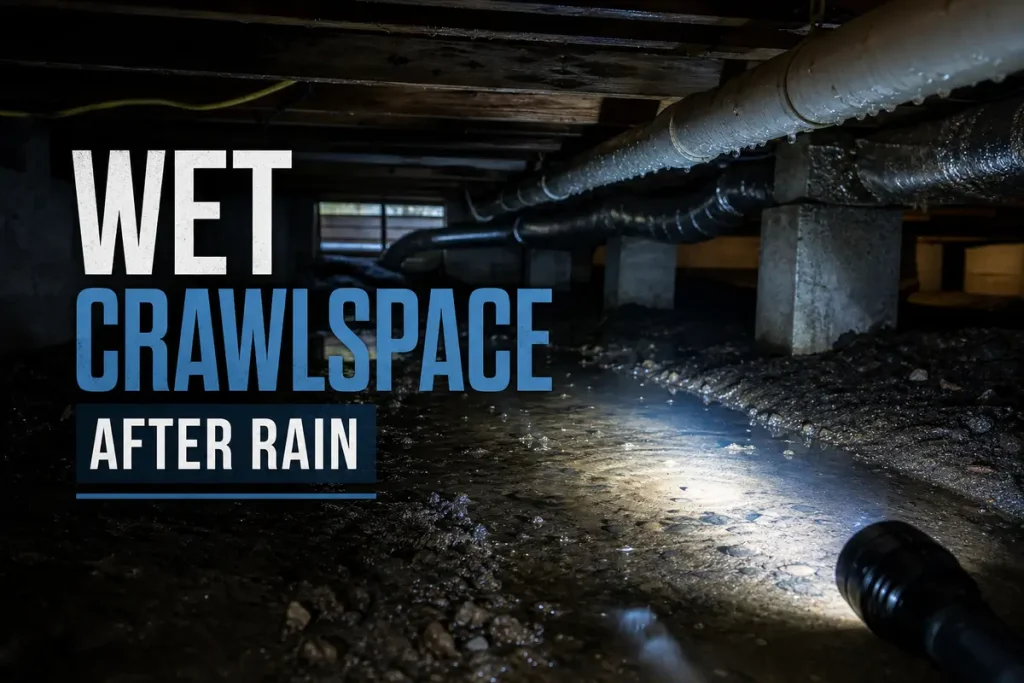
“Why is my crawlspace wet after rain” has a direct answer: water is getting under your home, or staying trapped there, because drainage and moisture controls are failing. In Louisville, where hard downpours, clay-heavy soils, older foundations, and low spots near creeks are common, persistent crawlspace moisture after rain is a building problem, not a harmless quirk.
Why Your Crawlspace Stays Wet After It Rains
A crawlspace stays wet after rain when water enters faster than your property can shed it, or when humid air condenses faster than the space can dry. The usual chain is simple: roof runoff lands too close to the foundation, soil stays saturated, pressure builds at the wall and footing, and moisture pushes through joints, block, vents, doors, or exposed earth.
The EPA’s moisture control guidance indicates that damp spaces support mold and material damage quickly once water is allowed to linger. The CDC also points to persistent indoor dampness as a building-health issue, not just a comfort issue. That matters if your house sits in St. Matthews, Jeffersontown, Middletown, Old Louisville, or a lower South End lot where runoff patterns and soil conditions keep repeating the same problem.
Finding: A wet crawlspace after rain means water management is failing somewhere, and the source usually starts outside.
Is It Normal for a Crawlspace to Be Wet After Rain?
No. Standing water, damp soil, wet insulation, dripping ducts, and condensation that remains 24 to 72 hours after rain indicate a moisture problem. Brief surface dampness right after a storm can happen, especially during a Louisville cloudburst, but ongoing wetness is not normal building performance.
Older housing stock increases exposure, especially where crawlspaces have vented foundations, aging mortar joints, or short downspouts. But age does not excuse the condition. A 1920s house in Old Louisville still needs to move water away from the structure.
Finding: Wetness that remains after the storm passes is a defect, not a normal feature of an older home.
How Much Moisture Is Too Much?
Too much moisture starts well before you see a deep puddle. Warning signs include muddy soil, visible water, musty odor, rusted metal fasteners, darkened framing, sagging insulation, and elevated wood moisture content. The USDA Forest Products Laboratory documents that decay risk rises when wood stays above roughly 20 percent moisture content, while the EPA states mold can grow on damp materials within 24 to 48 hours.
A crawlspace should stay dry enough to prevent mold growth and wood decay, not merely dry enough to avoid visible puddles. That difference matters.
Finding: If your crawlspace smells musty, stains wood, wets insulation, or stays damp for days, moisture is already above a safe threshold.
Why Your Crawlspace Gets Wet When It Rains
Rain exposes site drainage and foundation weaknesses first, then humidity-control failures second. The most common causes are poor exterior drainage, saturated soil and groundwater pressure, direct foundation openings, and interior condensation in vented crawlspaces.
Louisville conditions make this worse. Clay soils drain slowly, intense storms dump roof runoff fast, and older masonry foundations absorb and transmit moisture. If you own an older home, this deeper look at why moisture lingers under aging houses adds useful context.
Finding: Most wet crawlspaces trace back to runoff and soil saturation, with humidity and condensation adding damage on top.
Poor Exterior Drainage and Gutter Discharge
The Federal Emergency Management Agency consistently emphasizes directing water away from foundations after storms. Overflowing gutters, short downspouts, clogged underground drains, and negative grading dump concentrated roof water beside your crawlspace wall. A 1,500 square foot roof sheds hundreds of gallons during a heavy storm. If that water lands at the footing, the crawlspace gets wet.
This is one of the most common real-world failures in Louisville neighborhoods with mature trees and settled landscaping. Clean gutters and proper downspout extensions often fix more than any interior patch ever will.
Finding: When roof runoff lands near the foundation, your crawlspace becomes the collection point.
Groundwater, Hydrostatic Pressure, and High Soil Moisture
The American Society of Home Inspectors describes hydrostatic pressure as water pressure building in saturated soil against below-grade walls and footings. After repeated rain, the surrounding soil stays loaded with water. That pressure forces moisture through porous block, cold joints, and floor-wall seams, even without a dramatic crack.
Low lots, creek-adjacent parcels, and homes near flood-prone corridors around Louisville face repeated recurrence. Surface water may disappear, but saturated ground remains.
Finding: If soil around your foundation stays soaked, water keeps pushing inward long after rainfall stops.
Foundation Cracks, Vents, Doors, and Utility Penetrations
Rain and saturated soil exploit every opening. Cracked block, deteriorated mortar, open vents, unsealed crawlspace doors, and pipe penetrations all create direct paths for water entry. Wind-driven rain reaches vent openings fast, and wet soil moves through wall seams just as easily.
Visible cracks are not the whole story. Hidden leakage at penetrations and joints is common, especially around older service lines. If the moisture source seems unclear, compare symptoms with how rain intrusion differs from a plumbing leak.
Finding: Direct openings matter, but hidden seams and penetrations often explain repeat wetness better than visible cracks alone.
Interior Humidity and Condensation Problems
Not all crawlspace wetness is seepage. In warm, wet weather, humid outdoor air enters a cooler vented crawlspace and condenses on ducts, pipes, joists, and subflooring. The Department of Energy notes that unsealed, vented crawlspaces in humid climates often accumulate moisture instead of drying out.
Condensation still damages wood and insulation. The difference is the pattern: wet ducts and widespread surface sweating point to humidity, while puddles at a wall usually point to water entry.
Finding: Condensation is not harmless moisture, but the fix is different from fixing runoff or seepage.
What a Wet Crawlspace Does to Your Property
Persistent crawlspace moisture damages structure, air quality, insulation, HVAC performance, and property records. It also affects claim handling. Sudden storm intrusion and long-term seepage are often treated very differently by insurers, so documentation matters from day one.
The Insurance Information Institute states that policy language usually separates sudden and accidental water damage from long-term maintenance issues. That is why dated photos, weather timing, and contractor findings matter.
Finding: A wet crawlspace is not a cleanup problem alone, it is a structure, health, and documentation problem.
Mold, Wood Rot, and Indoor Air Quality
The EPA states that mold needs moisture, and crawlspaces provide the dark organic surfaces it likes. Air from below does not stay below. Through stack effect, air moves upward into living areas, carrying odor and moisture with it. That is why a damp crawlspace often shows up as musty rooms and stale air upstairs.
Odor alone does not identify mold type or contamination scope. Moisture readings and inspection define the real condition.
Finding: A wet crawlspace affects the air above it, not just the space below your floor.
Insulation, HVAC, and Structural Damage
Wet insulation sags and stops insulating effectively. Corroded ducts lose efficiency and push humid air where you do not want it. Subfloors cup, joists soften, and sill plates deteriorate when high moisture stays in contact long enough. If floors feel spongy or uneven, review these signs of water damage working up into the subfloor.
The result is familiar: colder floors, musty rooms, and higher utility bills.
Finding: Moisture below the house turns into comfort, efficiency, and structural problems above it.
Insurance and Documentation Considerations
Document rainfall timing, take dated photos, record standing water depth, and save inspection notes and maintenance records. The IICRC S500 Standard sets the professional framework for water damage assessment, extraction, drying, and category-based response. That matters if storm water, sewage backup, or contaminated flooding becomes part of the loss.
Policy language controls coverage. Repair decisions should never depend on assumptions about reimbursement.
Finding: Good documentation strengthens claims and repair decisions, but the policy still controls the outcome.
How to Diagnose Why Your Crawlspace Stays Wet
A reliable diagnosis starts outside, moves to the foundation, and ends inside the crawlspace. Water usually begins uphill from where you finally see it.
Finding: The visible wet spot is often the endpoint, not the source.
Start Outside During or Right After Rain
Watch the property during active rainfall if possible. Look for gutter overflow, short downspout discharge, pooled water beside the house, mulch beds trapping runoff, patio or driveway slope toward the foundation, and bare-soil channels carrying water to one wall.
Active rain reveals water paths clearly. Dry-weather guesses do not.
Finding: Exterior observation during rain identifies the source faster than any interior-only inspection.
Inspect the Crawlspace for Water Patterns
Water patterns tell a story. Puddles along one wall point to runoff entry. Damp block walls and white mineral deposits point to seepage. Wet ducts with little floor water point to condensation. Uniformly damp soil points to groundwater or exposed-earth vapor.
Check for detached insulation, rust, stained piers, darkened framing, and efflorescence.
Finding: The shape and location of moisture usually identify the dominant cause.
Measure Moisture Instead of Guessing
Use a moisture meter, hygrometer, and dated photo log. Relative humidity, wood moisture content, and conditions 48 hours after rain provide far better evidence than visual impressions alone. One storm does not define a seasonal pattern, so repeated documentation improves accuracy.
Finding: Measurement turns a wet crawlspace from a guess into a defensible diagnosis.
How to Fix a Crawlspace That Stays Wet After Rain
Durable repair follows a sequence: control the source, remove water, then manage long-term humidity. If bulk water is entering, the fix starts outside.
Finding: Exterior water control outperforms interior patchwork when rain is the trigger.
Improve Grading, Gutters, and Downspouts First
Clean and repair gutters, extend downspouts well away from the house, and regrade soil so runoff drains away. If roof water is the main source, exterior drainage corrections solve the root issue better than interior-only work.
Finding: Move water away from the foundation first, because that is where most wet crawlspace problems begin.
Seal Entry Points and Repair Foundation Defects
Repair cracks, repoint mortar joints, seal utility penetrations, and tighten crawlspace doors and vent openings. Sealing works best after drainage corrections, because pressure-driven water defeats cosmetic patching.
Finding: Sealing helps, but it only lasts when outside water load is reduced first.
Install a Vapor Barrier or Full Encapsulation
A ground vapor barrier covers exposed soil. Full encapsulation goes further, covering walls, sealing seams, and pairing the space with conditioned air or dehumidification. In humid Kentucky conditions, encapsulation is often the stronger long-term choice for recurring humidity and mold history. But it fails if bulk water is still entering. This breakdown of the difference between ground cover and a sealed system explains the distinction clearly.
Finding: Encapsulation controls moisture well, but it is not a substitute for drainage correction.
Add Drainage Matting, Interior Drainage, or a Sump Pump
If standing water returns after exterior corrections, install interior drainage, a sump pit, a pump, and battery backup. Route discharge far from the foundation. Active water management is the right move when groundwater pressure remains high.
Finding: Recurring standing water requires collection and discharge, not just sealing and drying.
Control Humidity With Dehumidification and Maintenance
Use a crawlspace-rated dehumidifier once liquid water entry is controlled. Maintain condensate drains, inspect barriers, test pumps, and check discharge lines after major storms. A dehumidifier removes moisture from air, not water pushing through the wall.
Finding: Dehumidification finishes the job, but it never replaces drainage repair.
When You Need Professional Help
Call a specialist when you have standing water, visible mold, soft framing, sewage contamination, repeated post-storm wetness, or damage spreading into finished areas. Older Louisville homes, rentals, and mixed-use buildings benefit from documented inspection reports for maintenance history and claims support.
Finding: Repeated wetness after heavy rain is a professional water-intrusion problem, not a routine housekeeping issue.
Signs the Problem Is Beyond DIY
Electrical hazards, contaminated water, failing joists, recurring sump failure, and water that keeps returning after repairs all require immediate escalation. Repeated cleanup without source correction expands damage and cost.
Finding: If water keeps coming back, the repair plan is incomplete.
What to Ask During an Inspection
Ask where water is entering, what evidence supports that conclusion, what measurements were taken, what fixes address the cause versus the symptom, and how the condition should be documented for insurance or property records. That framework makes estimates easier to compare.
Finding: A good inspection explains the source with evidence, not assumptions.
Common Questions About a Wet Crawlspace After Rain
Is Standing Water in a Crawlspace Ever Okay?
No. Standing water means drainage has failed or water is actively entering, and it creates mold, decay, and structural risk.
Finding: Standing water is always a defect.
Why Does the Crawlspace Stay Wet Days After the Storm Ends?
Saturated soil, poor drainage, groundwater pressure, and trapped humidity keep moisture in place long after rainfall stops.
Finding: The rain ends first, but the soil and air stay wet longer.
Does Encapsulation Fix a Wet Crawlspace by Itself?
No. Encapsulation controls ground vapor and humidity well, but bulk water intrusion requires drainage and entry-point correction first.
Finding: Encapsulation manages moisture, not incoming water.
Will Homeowners Insurance Cover Water in the Crawlspace?
Coverage depends on policy language and whether the event was sudden and accidental versus long-term seepage or neglected maintenance.
Finding: Documentation helps, but coverage turns on the policy terms.

Read Our Reviews