
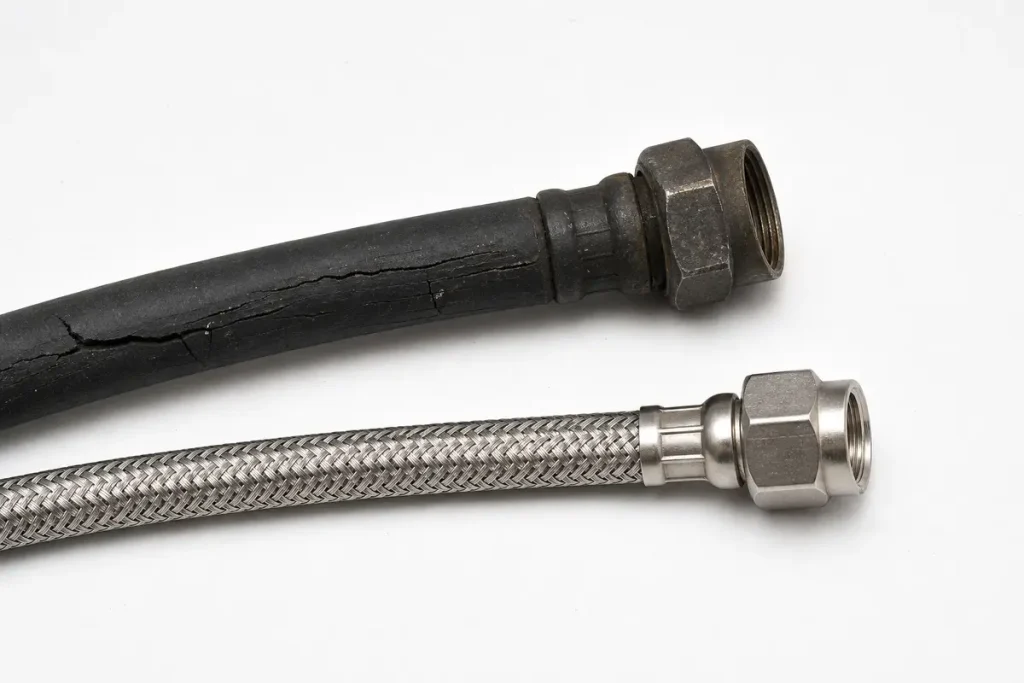
A washer hose is a cheap part with expensive consequences, which is exactly why rubber vs braided washer hose is not a minor maintenance question. Based on analysis of field failures, insurance-loss patterns, and restoration outcomes, braided stainless steel hoses fail less often than plain rubber hoses and deliver the stronger risk-return decision for Louisville properties.
Quick Overview of Rubber and Braided Washer Hoses
Plain rubber washer hoses are the older standard: a simple flexible rubber line with fittings on each end. Braided stainless steel hoses use an inner rubber, PVC, or nylon liner wrapped in a steel braid that limits swelling, improves abrasion resistance, and handles daily pressure more effectively. Bear Restoration’s water damage restoration experts can help navigate the process.
The core finding is direct. Braided hoses are the better standard. In laundry rooms across Louisville, that choice affects more than a repair bill. It affects downtime, mold exposure, flooring loss, drywall tear-out, tenant disruption, and insurance claim severity. In Old Louisville homes with wood framing and plaster, a supply failure travels fast. In East End finished laundry rooms, it ruins cabinets and trim. In South End rentals, it drives vacancy and turns one cheap neglected part into a turnover problem.
Failure Rates and Field Data
What the field data shows is consistent: flexible hoses fail often enough to justify scheduled replacement, and braided hoses hold up better than plain rubber under normal service. In a 356-hose study, 41 flexible hose assemblies failed within 11 years or less, roughly a 12% failure rate. That research also found that hot-water hoses were less reliable than cold-water hoses.
That 12% figure matters because it confirms the broader pattern reported by plumbers, insurers, and adjusters. Rubber hoses age out faster. They crack, dry, and weaken sooner. Braided hoses still fail, but they generally last longer and resist the expansion and rupture issues that plain rubber handles poorly.
For operators managing rentals or small commercial units, the business outcome is simple: fewer failures means fewer emergency calls, fewer remediation invoices, and less claim friction.
Material Strength and How Each Hose Ages
Rubber hoses deteriorate in predictable ways. The material loses flexibility, becomes brittle, develops surface cracking, and weakens internally under heat and constant pressure. Detergent exposure and warm, enclosed laundry rooms speed that process.
Braided hoses improve on that design by adding a steel outer layer around the inner liner. That braid helps contain expansion and resists the swelling that often precedes rupture in plain rubber. It also stands up better to incidental contact and minor movement behind the washer.
But the recommendation is not based on the myth that braided hoses are permanent. The research is clear: braided hoses still depend on an inner elastomeric liner, and the weakest link is the elastomeric hose. The braid lowers failure frequency. It does not eliminate failure.
Pressure, Heat, and Daily Load on the Hose
Washer hoses live under constant load, even when the appliance is off. They stay pressurized day and night, absorb vibration during fill cycles and spin cycles, and deal with repeated temperature swings. That daily stress separates short-life materials from longer-life ones.
Heat is the biggest divider. Hot-water lines fail sooner because elevated temperature accelerates rubber aging. The liner hardens faster, oxidation progresses faster, and weak sections become leak points sooner. In high-use households, that timeline compresses further.
Pressure widens the gap too. A hose failure at 70 psi can discharge up to 650 gallons per hour. That is why supply-side failures create such severe losses compared with many drain issues. For related appliance-side problems, signs of a leaking pump assembly belong in a different category. Supply hoses fail under pressure. That difference drives damage severity.
Where Failures Actually Happen
Many owners picture a hose simply bursting in the middle. That happens, but it is not the whole story. Failures often occur at the coupling, the crimp, or the inner liner near the fitting. Slow leaks at threaded connections are also common and often ignored until baseboards stain or subfloors soften.
Insurance-oriented reporting has also pointed to coupling failure as a recurring weak point, not just mid-hose rupture. That matters because material choice alone does not control the full risk profile. A braided hose with a bad crimp, twisted run, or damaged washer still leaks. A rubber hose installed cleanly still remains the weaker long-term option, but installation quality changes outcomes for both.
Installation Risk: Kinks, Clearance, and Fittings
Field failures often start with bad placement. A washer shoved too tightly against the wall forces both hoses into a hard bend. That bend stresses the liner, weakens the fitting area, and shortens service life. The practical standard is about 4 inches of clearance behind the machine so the hoses can arc naturally instead of folding.
Over-torqued fittings create another problem. Tightening past the seal point distorts washers and damages threads. Reused rubber washers create slow seepage. Misaligned fittings tempt installers to force the connection, which loads the hose sideways from day one.
Braided hoses tolerate real-world installation abuse better than plain rubber, but neither survives chronic kinking or poor alignment for long.
Lifespan and Replacement Schedule
Rubber hoses commonly age out at 3 to 5 years. Braided hoses usually land in the 5 to 10 year range, but the stronger replacement recommendation is sooner than the outer range suggests. Based on analysis of the available research, the best planning interval is 5 to 7 years, with the formal study pointing to an optimal replacement interval of 6 to 7 years.
That schedule produces the highest ROI maintenance result. Replacing hoses on time costs very little, avoids emergency drying and reconstruction, and lowers the odds of tenant displacement or owner out-of-pocket loss. For a more detailed maintenance timeline, scheduled hose replacement guidance belongs on every landlord checklist.
Damage Severity and Insurance Exposure
The financial downside is wildly disproportionate to the cost of the part. Insurance reporting has tied washer hose failures to about $170 million in property damage across the United States and Canada. Average claims are often cited around $11,000 to $13,000, while unattended losses run into six figures once flooring, drywall, insulation, cabinetry, and mold remediation are involved.
Coverage also depends on how the loss happened. Sudden bursts are generally treated more favorably than long-term neglected leaks. Slow seepage, mold growth from delayed discovery, and maintenance-related deterioration create harder claim conversations and more denied line items.
In two-story homes, the severity jumps again. Water from a failed supply line can load a ceiling cavity fast enough to cause structural sagging. That pattern looks very different from a minor puddle, and upper-level laundry leaks that soak the ceiling below regularly become demolition jobs.
Pricing and Total Cost of Ownership
The price comparison is easy. Basic rubber hoses are cheaper upfront. Braided hoses cost more. But total cost of ownership strongly favors braided because the loss profile is not even close.
Industry guidance regularly places replacement cost around $10 to $15 per hose, while claim values start in the low five figures and climb sharply once dry time, reconstruction, and mold work are added. For owners focused on ROI, braided hoses are the low-cost upgrade that reduces claim frequency, occupancy disruption, and restoration expense.
The recommendation is straightforward: no serious property owner should choose a weaker hose to save a few dollars.
Best Fit by Property Type and Use Case
For Louisville properties, braided hoses are the operating standard. Historic homes need tighter loss control because water travels through older assemblies quickly. Suburban homes often have finished laundry spaces with higher material-loss value. Rental properties and small commercial settings carry even more exposure because machines run unattended more often and replacement timing gets missed more often.
When Rubber Hoses Still Show Up
Rubber hoses still appear in older homes, low-budget turns, and inherited installations that stayed in place too long. That choice usually reflects short-term cost control, not lower long-term risk. In the field, rubber is often the hose already there, not the hose that should stay there.
When Braided Hoses Are the Better Standard
Braided hoses are the better standard for owner-occupied homes, rentals, multifamily buildings, and small commercial laundry spaces. They fail less often, last longer under pressure, and support better replacement economics. In operational terms, they reduce preventable water events. If a line does fail and the room floods, a fast response still matters, and the first six containment steps after a laundry room flood determine how much material can be saved.
The Lowest-Risk Setup Beyond Hose Type
The lowest-risk setup is not simply braided versus rubber. It is braided hoses, inspected every 6 to 12 months, paired with shutoff habits and leak detection or automatic shutoff protection.
Annual visual checks catch rusting, fraying, bulging, staining, and connection seepage before they become failures. Periodic professional assessment adds another layer, especially in rentals or older homes where access is tight and prior installation quality is questionable. Shutting off supply valves when the washer will sit unused for days materially reduces exposure. Automatic shutoff devices reduce loss severity even further.
Verdict: Which Fails Less?
Braided stainless steel washer hoses fail less often than rubber hoses. Based on analysis of service life, failure patterns, and damage economics, the recommendation is clear: braided hoses should be the standard specification for Louisville homes, rentals, and small commercial properties.
Aging hoses of either type should never stay in service until visible failure. The better operating decision is scheduled replacement, preferably on a 5 to 7 year cycle, with braided hoses paired with inspection, shutoff discipline, and leak-prevention measures. That combination delivers the best risk outcome and the lowest total cost over time.

Read Our Reviews