
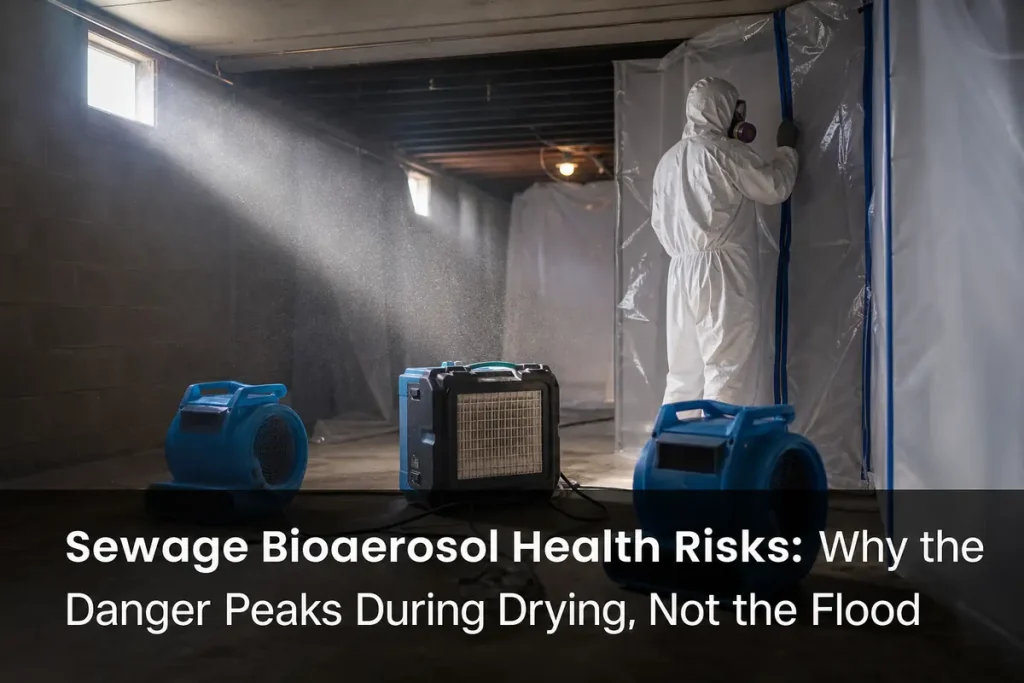
Sewage bioaerosol health risks reach their peak after the standing water is gone. As contaminated surfaces dry, bacteria and their cell fragments become light enough to ride air currents, and a single air mover pointed at undisinfected sewage residue can distribute that material through an entire home. The flood you can see is less dangerous to your lungs than the drying you cannot.
This is the least understood fact in residential sewage losses, and it changes homeowner behavior once it lands. The instinct after a backup in a Prospect two-story is to open windows, crank the HVAC fan, and aim every box fan in the house at the wet floor. Each of those moves feels productive. Two of the three actively make the exposure worse, and the science explains exactly why.
What Exactly Is a Bioaerosol and Why Does Drying Create It?
A bioaerosol is any airborne particle of biological origin: whole bacteria, fungal spores, viruses, and fragments of dead cells. Wet contamination stays put because water is heavy and sticky. As moisture evaporates, particles shrink, lose their liquid anchor, and lift into the air with ordinary foot traffic and airflow. Drying is literally the launch mechanism.
The particle sizes involved are the concerning part. Many bioaerosols fall in the range below 10 microns, small enough to bypass the nose's filtration and reach deep lung tissue. NIOSH, which studies occupational exposure at wastewater facilities, documents respiratory symptoms, gastrointestinal illness, and flu-like reactions among workers exposed to sewage aerosols. A drying residential backup is a small version of the same exposure environment, concentrated in the rooms where a family sleeps and eats.
What Are Endotoxins and Why Do Dead Bacteria Still Matter?
Endotoxins are fragments of the outer cell wall of gram-negative bacteria, the family that dominates sewage, and they are released in quantity when those cells die. Killing bacteria with disinfectant does not neutralize endotoxin. The fragments remain biologically active, and inhaling them triggers airway inflammation, fever-like symptoms, and asthma aggravation.
This is why disinfectant fog alone never closes a sewage job. You can achieve a technically successful kill and still leave a room loaded with inflammatory material. Research on organic dust exposure, much of it summarized in NIOSH flood cleanup guidance, links endotoxin inhalation to measurable lung function decline at surprisingly modest concentrations. Consequently, professional remediation treats removal as the primary control. Material that leaves the building in a sealed bag cannot aerosolize into anyone's lungs, which is one more reason the ANSI/IICRC S500 Standard favors removing porous contaminated materials over treating them in place.
How Do Professionals Keep Bioaerosols Out of the Rest of the House?
Professionals control bioaerosols with containment, negative air pressure, and HEPA filtration, all established before demolition or drying begins. Plastic containment walls isolate the work zone, a HEPA-filtered negative air machine keeps air flowing into the zone rather than out of it, and the HVAC system stays off with returns sealed until clearance.
The order of operations does the rest. On a recent St. Matthews basement backup, our crew set containment and negative air first, removed the contaminated carpet, pad, and lower drywall in sealed bags second, cleaned and disinfected the remaining hard surfaces with full dwell time third, and only then deployed air movers and dehumidifiers. By the time high-velocity air touched those surfaces, there was nothing biologically dangerous left to launch. That sequence, containment before removal before disinfection before airflow, is the entire difference between drying a home and contaminating one.
What Should a Louisville Family Do Before the Crew Arrives?
Before help arrives, shut down the HVAC system, close the affected room, and keep children, elderly family members, and anyone with asthma or a compromised immune system away from the area. Skip the box fans entirely. These few moves cost nothing and meaningfully cut the household's exposure while the water sits.
Then get professionals moving, because time grows the biology. Bear Restoration, an IICRC Certified Firm (#70216409) founded by Emery and licensed in Kentucky (LIC-GBCL-24-00148), responds across Louisville, Prospect, St. Matthews, Middletown, Jeffersontown, and Shively with the containment equipment, HEPA filtration, and S500 training this class of loss demands. Call 502-200-6968 any hour, or read through our Louisville sewage cleanup process first. Our water damage restoration team runs the drying phase to documented standard, and our mold remediation specialists handle anything that got a head start. Protecting the structure is half the job. Protecting the air your family breathes is the other half.
Frequently Asked Questions
Who in the household is most at risk from sewage bioaerosols?
Children, the elderly, pregnant women, asthmatics, and anyone immunocompromised. If the affected area cannot be fully isolated, relocating vulnerable family members until clearance is the conservative call.
Can my HVAC system spread contamination from one flooded room?
Yes, and it is one of the fastest routes. A return grille in or near the affected area pulls bioaerosols into the ductwork and redistributes them house-wide, which is why the system stays off until the work zone is cleared.
Do air purifiers protect the family during a sewage cleanup?
A true HEPA unit in occupied rooms helps reduce drift, but it does not substitute for containment and negative air at the source. Think of it as a seatbelt, not a fix.

Read Our Reviews