
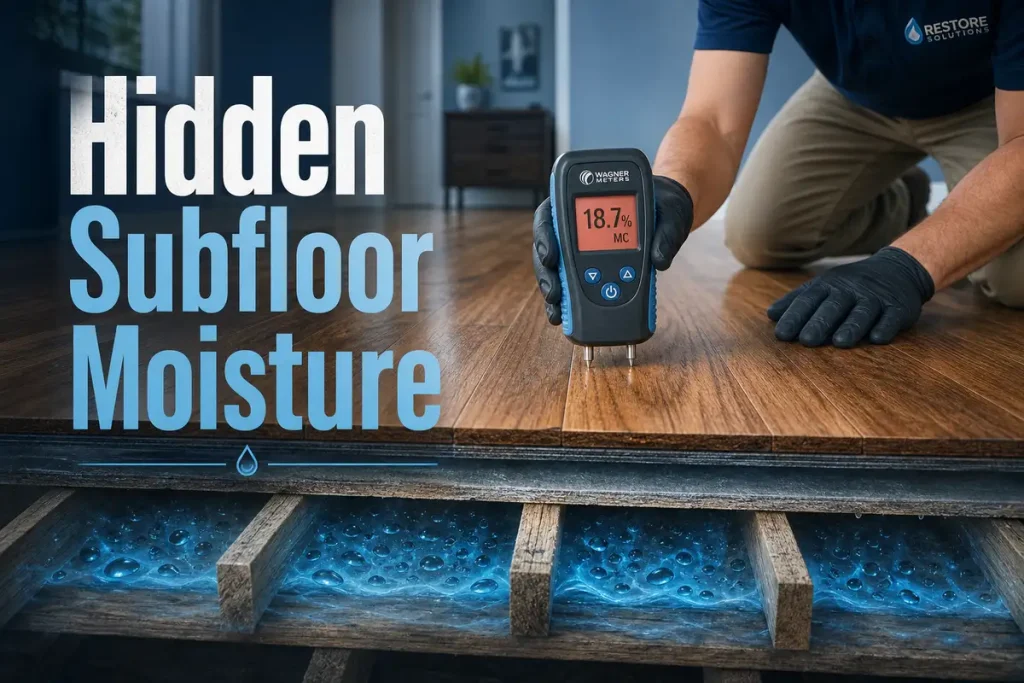
Subfloor moisture is water trapped in the structural layer under your finished floor, and it keeps causing damage long after the surface feels dry. According to the EPA’s indoor moisture and mold guidance, hidden moisture inside building materials keeps mold growth and material breakdown moving out of sight. If your Louisville property has had a leak, overflow, storm intrusion, or basement humidity problem, a dry-looking floor proves almost nothing.
Dry Floors Do Not Mean a Dry Subfloor
The EPA updated moisture guidance in 2023 to reinforce a basic truth: hidden dampness inside floors, walls, and insulation keeps damage active even after visible water disappears. What this means in practice is simple. Your floor can feel normal underfoot while the layer below stays wet, swells, weakens, and feeds mold.
Subfloor moisture means water held inside the plywood or OSB panel under hardwood, laminate, vinyl, tile, or carpet. In Louisville, that happens after appliance leaks, aging plumbing failures, storm-driven rain, wet basements, crawlspace humidity, and slow seepage around bathrooms and exterior doors. Historic homes in Old Louisville, newer basement-heavy homes in the East End, and rental properties with delayed maintenance in the South End all create different versions of the same problem: moisture gets in, then stays trapped.
The action that works is direct: schedule a moisture inspection instead of relying on touch alone.
What Subfloor Moisture Is and Where It Hides
According to APA, The Engineered Wood Association, wood structural panels absorb and release moisture based on surrounding conditions, and that moisture often gets trapped below the finished floor. Your subfloor is the structural deck under the visible surface. It carries weight, ties framing together, and gives flooring something stable to sit on.
Water rarely spreads in a neat circle. It travels into plywood seams, OSB edges, carpet pad, underlayment, around toilets, under cabinets, near exterior doors, and across concrete slabs where vapor keeps feeding the problem from below. That is why a small leak turns into a wide repair area before staining shows up.
A good way to think about it is this: your finished floor is paint on a car, your subfloor is the frame. If the frame stays wet, the shine on top does not matter. Pick the highest-risk room in your property and inspect that floor system first.
Plywood vs. OSB: Why the Material Changes the Damage Pattern
APA technical guidance and flooring trade standards consistently show that plywood and OSB fail differently when wet. Plywood tends to soften, separate in layers, and lose strength through delamination. OSB usually swells hardest at the edges, creating ridges and an uneven profile that telegraphs through finished flooring.
Upstairs, you notice the symptoms instead of the material science. Squeaks get louder. Floor transitions lift. A once-flat hallway starts feeling wavy. The move that works is to find out which subfloor material sits below the visible floor before approving repairs.
Why a Floor Looks Fine Even When the Structure Under It Is Wet
A 2022 update to IICRC drying standards stresses that visual dryness does not confirm material dryness. Surface evaporation happens first. Moisture deeper in the assembly stays trapped under vinyl, tile, engineered wood, rugs, underlayment, and finish layers that slow drying.
That is why fans alone do not solve hidden subfloor moisture. Air movement helps the top layer. It does not guarantee drying inside wood panels or below impermeable flooring. The same issue shows up in surface-level drying that leaves deeper materials wet, which is exactly where long-term subfloor damage starts.
Insist on documented moisture readings, not verbal reassurance that the floor “looks dry.”
Why Louisville Homes and Small Commercial Buildings Are Especially Vulnerable
According to NOAA climate data for Kentucky, humid summers, repeated heavy rain events, and storm-related water intrusion keep building materials wet longer. Add local building stock and the risk rises fast. Older homes often hide aging supply lines, crawlspace exposure, and patched repairs. Finished basements in suburban homes trap humidity against lower-level materials. Deferred maintenance in rental units turns small leaks into long-duration damage.
Here’s how to use that: after any water event, keep a dated record of indoor humidity, the leak source, and every drying step taken. That strengthens your insurance file and your repair decisions.
The Most Common Causes of Subfloor Moisture
The Insurance Information Institute continues to rank non-weather water damage among the most common property losses. Hidden subfloor moisture usually starts with a specific pathway: supply-line leaks, failed toilet wax rings, tub overflows, dishwasher leaks, refrigerator lines, roof intrusion, failed window seals, slab moisture, crawlspace dampness, sewage backups, or storm flooding.
The key point is not the list. The key point is that moisture keeps spreading until the pathway is stopped. Replacing flooring before tracing the source locks damage in place and leads to a second tear-out. Trace the moisture source before replacing any floor covering.
Slow Leaks Cause the Worst Hidden Damage
EPA mold guidance and restoration training both make the same point: long-duration moisture creates the strongest mold and rot conditions. A pinhole leak under a sink or behind a refrigerator does more structural damage than a one-time spill because the wood stays damp day after day.
You can spot duration clues without opening the whole floor. Musty odor, stained trim, loose flooring, recurring humidity, and darkened baseboards all point to repeat wetting instead of one isolated event. Check one appliance line and one bathroom fixture for active seepage this week.
High Humidity and Crawlspaces Keep Rewetting the Floor System
According to DOE home moisture guidance, vapor movement, wet crawlspaces, and high outdoor humidity keep wood moisture elevated even after cleanup. First floors over damp crawlspaces get hit hardest. If the space below stays wet, the subfloor above never truly dries.
That is especially common in older homes with poor drainage, missing vapor barriers, or open vents pulling humid air inside. Inspect the crawlspace or basement directly below the suspect room for damp soil, condensation, or musty air.
Signs Your Subfloor Has Moisture Damage
A 2024 moisture guidance summary from the National Wood Flooring Association notes that flooring symptoms often show up before structural failure becomes obvious. Watch for cupped hardwood, buckling planks, loose tile, cracked grout, peeling vinyl, soft spots, musty odor, dark staining, baseboard swelling, and recurring mold at floor edges.
Your finish floor is often the messenger, not the root problem. A warped board or lifted plank tells you stress is moving up from below. If your issue started after standing water, this lines up with what happens in hardwood floors after flooding, where hidden moisture keeps distorting the structure after surface cleanup.
Photograph any distortion now so you have a time-stamped baseline for repairs and insurance documentation.
Structural vs. Surface Symptoms
Builder and flooring guidance draws a clear line between cosmetic damage and structural breakdown. A stained board is a finish problem. A plank that moves, dips, or feels spongy points to subfloor failure underneath. Cleaning or repainting fixes appearance. It does not restore strength.
Press-test one suspected area for movement or softness before authorizing cosmetic repairs.
How Professionals Confirm Hidden Moisture
IICRC drying standards and restoration best practices rely on measurement, not guesswork. A proper inspection follows a sequence: find the source, measure affected materials, compare wet and dry zones, check below visible damage, and confirm drying targets before rebuild starts.
Insurance carriers expect proof. Meter readings, photos, and written scope notes support the claim and prevent disputes later about what got wet and what required removal. Ask any restoration contractor for meter readings and a written moisture map.
What Moisture Readings Actually Tell You
NWFA and IICRC-aligned training both treat readings as comparative evidence. One number by itself means very little. A useful reading compares the wet area to an unaffected area nearby and tracks how those numbers change over time.
That is the simplest version of this: you want a trend, not a snapshot. Request before-and-after readings for the same location during drying.
How Subfloor Moisture Is Fixed the Right Way
Restoration and flooring guidance consistently puts the sequence in this order: stop the source, remove trapped water, expose concealed layers when needed, dry to target, clean contamination, then decide what stays and what gets replaced. That order matters because rebuilding over wet material guarantees repeat damage.
Sewage, visible mold, and softened structural panels expand the scope fast. Drying is only part of the job. Do not reinstall flooring until subfloor dryness is documented in writing.
When Drying Is Enough and When Replacement Is Required
APA and flooring trade sources are blunt on this point: swollen edges, delamination, rot, persistent odor, and loss of fastener hold mean replacement. If the panel shape changed or the wood lost strength, drying alone does not restore performance.
Ask for a room-by-room salvage-versus-replace decision before work starts.
Sewage, Mold, and Category 3 Water Change Everything
The CDC and EPA both treat sewage and contaminated floodwater as a different class of hazard. Once black water hits the floor system, porous materials become a contamination problem, not just a moisture problem.
That changes the job from drying to controlled removal and cleanup. If sewage touched the floor system, stop foot traffic and get a contamination-qualified restoration team on site immediately.
How to Prevent Subfloor Moisture From Coming Back
DOE home performance guidance consistently shows that drainage, leak detection, humidity control, and crawlspace management beat repeat cosmetic repairs. Gutters and grading move water away. Plumbing checks catch slow leaks early. Indoor humidity control protects wood movement. Vapor barriers and drainage improvements keep lower spaces from rewetting the structure.
Prevention also helps your claim history. A documented maintenance record makes recurring losses easier to explain and harder to dispute. Install one leak detector near the highest-risk water source this week.
What to Do This Week if You Suspect Hidden Subfloor Moisture
A 2023 FEMA homeowner recovery guide emphasizes fast documentation and early mitigation after water damage. If your floor feels dry but smells musty, shifts underfoot, or shows cupping, swelling, or soft spots, treat it as an active subfloor problem until testing proves otherwise.
The move that works is not guessing, waiting, or replacing finish materials first. It is documenting the room, noting the source, and getting professional moisture readings tied to a written scope. Book a moisture inspection for the single worst room in your property this week.
It stays trapped until the source is stopped and the material reaches normal moisture levels again. Surface drying happens fast. Deep drying inside wood panels and under finished flooring takes much longer and requires measurement.
Sometimes, but not when impermeable flooring traps moisture below. Vinyl, tile, engineered flooring, and underlayment often block evaporation, which means selective removal is necessary to dry the structure correctly.
Coverage depends on the source and the policy language. Sudden accidental leaks often receive coverage. Long-term seepage, deferred maintenance, and repeated moisture problems often trigger disputes, which is why photos, dates, and moisture readings matter.
Wet subfloors create ideal mold conditions fast. The longer the material stays damp, the more likely microbial growth becomes. Odor, staining, and recurring edge growth are strong warning signs.
No. New flooring over damp material locks in moisture, ruins adhesives, distorts boards, and sets up a second failure. Dryness needs to be documented before rebuild starts.
A professional moisture inspection gives the clearest answer. Meter readings, comparison testing, and a moisture map tell you far more than touch, smell, or appearance alone.

Read Our Reviews