
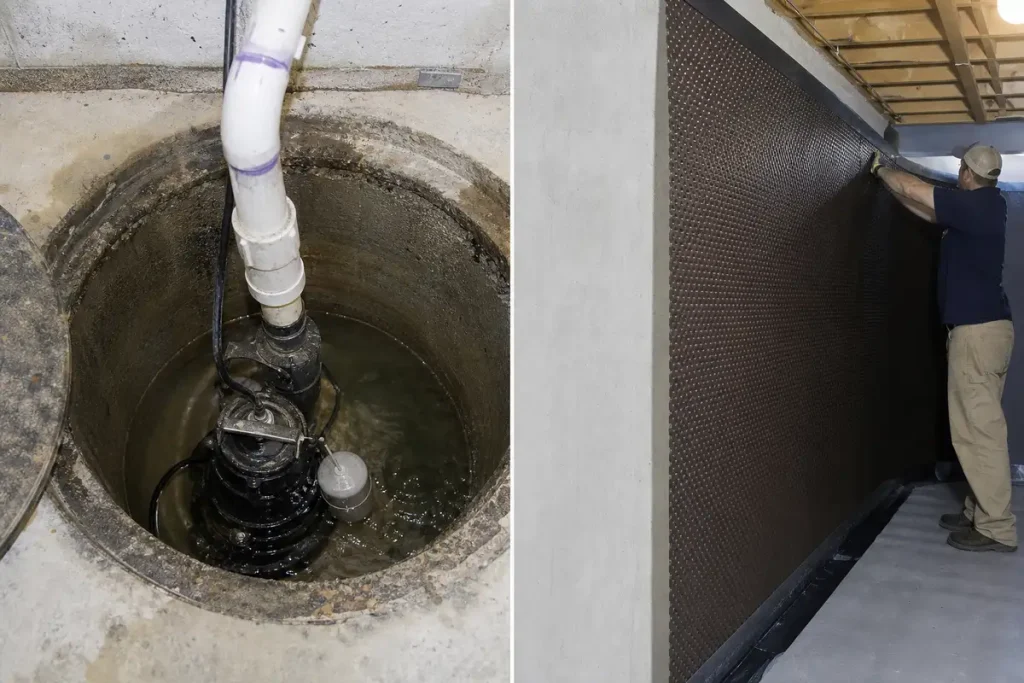
Demand for both sump pumps and waterproofing keeps climbing. The sump pumps market is growing fast, and waterproofing is a multibillion-dollar category too, which tells you one thing: basement water problems are common, expensive, and worth fixing correctly. In the sump pump vs waterproofing debate, the better fix depends on where the water starts, but if your goal is lasting protection, waterproofing wins and a combined system often performs best.
Quick Overview of Sump Pump Vs. Waterproofing
A 2026 Research and Markets report found sump pumps growing from $15.83 billion in 2025 to $17.67 billion in 2026. Fact.MR also values waterproofing membranes at $35.0 billion in 2025. What this means in practice: homeowners are not choosing between two random products. You are choosing between two very different strategies.
A sump pump removes water after it reaches a collection point. Waterproofing works to block, redirect, or manage water before it enters your basement or crawl space. That distinction decides everything. If water is pushing in through the wall, crack, or window, waterproofing is the move that works. If water is rising from below the slab under pressure, drainage with a sump system becomes the better answer.
How Each Fix Works
According to Research and Markets in 2026, sump pumps are designed to remove accumulated water from low-lying areas such as basements and crawl spaces. The mechanism is simple: water collects in a sump basin, the float rises, and the pump discharges water away from the home. That makes a sump pump an active removal system, not a barrier.
Fact.MR defines waterproofing membranes as barrier systems used on below-grade foundations to prevent water and moisture penetration. In plain English, waterproofing is about keeping water away from the wall, sealing vulnerable areas, managing drainage, and reducing the amount of water that ever gets the chance to enter.
Here’s the simplest version of this: sump pumps handle water that is already where you do not want it. Waterproofing tries to keep it from getting there.
Water Source: the Real Decision Maker
Basement Health identifies two main water-entry patterns: surface water through walls, windows, cracks, and penetrations, and groundwater through the slab or cove joint under hydrostatic pressure. That is the real decision maker, not brand names and not price tags.
If you see wall seepage, damp block walls, leaking window wells, or water following a crack down the face of the foundation, you are dealing with entry from the side. That points you toward waterproofing and exterior water control. If your floor gets wet at the perimeter joint or water appears from below with no visible wall leak, groundwater pressure is driving the problem. That points you toward drainage and a sump system.
If you need help pinpointing where basement moisture starts, start there before buying any fix. The source tells you what works.
Prevention Vs. Response
A 2023 MDPI study on waterproofing failures found watertightness problems rank among the most severe building issues because the damage spreads beyond the original leak. That is why prevention beats response when prevention is possible.
Waterproofing is the preventive move. It protects foundation walls, limits moisture intrusion, and reduces the chance of mold, wall deterioration, and repeated cleanup. A sump pump is the response move. It handles water after it has entered a drainage path or collection basin.
What this means for your house is straightforward: if you can stop water before it touches interior materials, do that. Pumping water away is useful, but stopping intrusion at the source protects more of the home.
Protection Against Hydrostatic Pressure
Basement Health explains that hydrostatic pressure forces groundwater through the slab or cove joint, and that drainage systems are the common solution because simple wall coatings fail under pressure. That point gets missed all the time.
If groundwater is building around your foundation, a paint-on coating is not enough. Pressure keeps pushing, coatings blister or break down, and the leak returns. Interior drainage relieves pressure by giving water somewhere controlled to go, then the sump pump removes it. Full exterior waterproofing changes the outcome further by reducing the water load against the foundation in the first place.
For hydrostatic pressure, drainage beats coatings. Exterior waterproofing plus drainage beats drainage alone.
Reliability During Heavy Rain and Power Outages
IndexBox reports that the pump market is shifting toward smart connectivity, battery monitoring, and remote alerts because reliability matters most during storm conditions. That is exactly when your system gets tested.
A sump pump has obvious failure points: power loss, a stuck float switch, clogged discharge lines, or plain neglect. During a Louisville thunderstorm, that matters. Passive waterproofing has no motor to fail, which makes it inherently more dependable as a barrier. But passive systems do not remove collected groundwater on their own.
The practical move is clear. If you rely on a sump pump, install battery backup, an alarm, and monitoring. If you rely only on a coating or sealant, expect disappointment when heavy groundwater pressure hits.
Installation Scope and Disruption
Mordor Intelligence notes that waterproofing systems often demand more labor, more skill, and longer installation windows than simpler pump-based work. You feel that difference during the project.
Interior sump installation usually means cutting a trench along part of the basement perimeter, placing drainage stone and pipe, installing a sump basin, then restoring the concrete. It is disruptive, but it stays inside the home and usually avoids full excavation.
Exterior waterproofing is bigger work. Soil gets excavated down to the footing, walls get cleaned and repaired, membranes or coatings get applied, drainage components get installed, and the area gets backfilled. On homes with tight lot lines, decks, porches, landscaping, or finished basements, scope and access matter a lot. If you are already dealing with drainage failures around the foundation, exterior work becomes more compelling because the problem starts outside.
Long-Term Protection for Foundation and Indoor Conditions
A 2023 MDPI study found that waterproofing failure often leads to repair costs far above the original installation cost. What this means in practice: the longer moisture keeps reaching the structure, the more expensive the problem becomes.
Waterproofing does more for the whole house. It reduces moisture against walls, helps protect finishes, lowers the chance of mold growth, improves basement usability, and limits long-term wear on masonry and framing near the foundation. A sump pump protects the floor from standing water, but it does not stop damp walls, humid air, or repeated wetting of materials above the drainage path.
If your goal is a drier, healthier, more usable lower level, source control beats cleanup.
Maintenance and Ongoing Upkeep
Basement Health recommends regular testing and maintenance for sump systems, plus battery backup and a sealed basin cover. That tells you exactly what ownership looks like after installation.
A sump pump needs attention. You need to test it, clean the pit, check the discharge line, confirm the float moves freely, and replace the pump when it reaches the end of its service life. Waterproofing has a lower-maintenance profile, but it is not a free pass. Gutters, downspouts, grading, and exterior drainage still need to move water away from the house.
The practical takeaway is simple: pumps are mechanical systems, so plan for upkeep. Waterproofing reduces dependence on maintenance-heavy equipment.
Pricing and Overall Value
The MDPI study found proper waterproofing often costs 1% to 3% upfront, while failure and repair can rise to 5% to 10% or more. Price matters, but cheap fixes usually cost more later.
A sump pump installation often costs less upfront than full exterior waterproofing. That makes it appealing, especially when you need a quick answer to active water. But if the real problem is exterior seepage, cracks, or grading, the cheaper option leaves the root cause untouched. You keep paying for moisture damage, pump maintenance, and recurring repairs.
The better value comes from matching the system to the source. If prevention solves the root issue, paying more once beats paying less over and over.
Best Use Cases for a Sump Pump
Research and Markets describes sump pumps as direct water-removal systems for basements and crawl spaces prone to flooding. That points to the clearest use case.
Choose a sump pump when water enters from below the slab, collects at the cove joint, or follows an interior drainage path by design. It also makes sense when your basement already has a perimeter drain system that needs a dependable discharge point. In those situations, a pump is not optional. It is the working heart of the drainage system.
If storm outages are a concern in Louisville, Jeffersontown, or Jeffersonville, pair the pump with battery backup and an alarm. Without backup power, your protection disappears at the worst possible time.
Best Use Cases for Waterproofing
Fact.MR defines waterproofing as a below-grade moisture barrier system, and that is exactly where it pulls ahead. Waterproofing is the better fix when water comes through foundation walls, wall cracks, pipe penetrations, window areas, or poor exterior grading.
It is also the better move when you want to protect the structure itself, not just keep water off the floor. If your basement is finished, stores valuables, or serves as living space, prevention matters even more. Stopping intrusion before it reaches drywall, flooring, insulation, and framing delivers stronger protection than waiting for a pump to react.
If your goal is prevention, waterproofing wins.
When You Need Both, Not One or the Other
Basement Health explains that hydrostatic pressure problems often require drainage pipe, stone, a sump basin, and a pump as part of a full system. That lines up with what works in real basements: many homes need both strategies.
If water is reaching your walls from the outside and pressure is also rising beneath the slab, choosing only one fix leaves part of the problem untouched. Exterior waterproofing reduces wall intrusion and outside water load. Interior drainage and a sump pump handle the groundwater that still collects below. Together, that gives you the strongest protection.
This is the decisive nuance: sump pumps and waterproofing are partners more often than competitors.
Sump Pump Vs. Waterproofing for Louisville-Area Homes
North America was the largest regional market for sump pumps in 2025, and that fits what you see across Louisville-area homes. Heavy rain, wet weather swings, clay-heavy soils, older foundations, and finished basements make water entry harder on homes in Louisville, Jeffersontown, Middletown, St. Matthews, Prospect, Crestwood, Hurstbourne, West Buechel, Shivley, and Jeffersonville.
In this region, diagnosis matters more because the same basement can have two problems at once: runoff against the wall and groundwater pressure under the floor. Older homes often have aging foundation walls, limited exterior drainage, and basements that were finished long after the house was built. That raises the cost of getting the diagnosis wrong.
Verdict: Which Fix Works Best?
Waterproofing is the better fix when your goal is to stop water intrusion at the source. A sump pump is the better fix when your main job is removing groundwater collected by drainage. Head to head, waterproofing is the overall winner for lasting basement protection because prevention protects more than a response system ever can.
But the best-performing answer for many wet basements is not sump pump vs waterproofing. It is waterproofing plus sump pump, chosen based on the actual entry path.
What to Do This Week
During the next rain, identify exactly where the water starts: wall, crack, window, cove joint, or slab. Then schedule a professional inspection based on that source. That one step gives you the right fix faster, and it keeps you from spending money on the wrong product label.

Read Our Reviews