
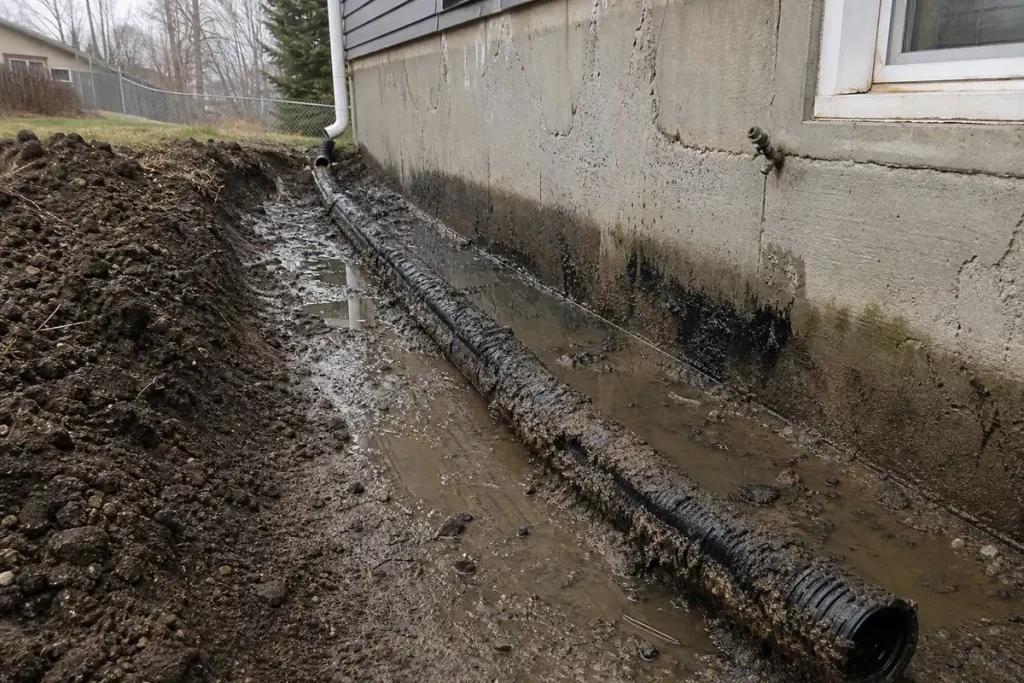
Foundation drainage problems are failures in the way water moves around your home, and they are one of the main reasons basements flood after heavy rain. According to the Insurance Information Institute and Triple-I claims data, 22.6% of home insurance claims come from water damage and freezing, with average losses around $15,400. That matters because basement flooding is usually not one leak or one crack. It is a drainage-system failure that lets water collect beside, above, or below your foundation instead of pushing it safely away.
What Foundation Drainage Problems Actually Mean
Insurance Information Institute claims data from 2019 through 2023 shows water damage is one of the most common and expensive home-loss categories in the country. What this means in practice is simple: if water keeps showing up in your basement, the real problem is almost always the route the water took to get there.Insurance Information Institute claims data from 2019 through 2023 shows water damage is one of the most common and expensive home-loss categories in the country.
Foundation drainage problems include any condition that traps or redirects water at your house instead of away from it. That includes yard slope, roof runoff, clogged or short downspouts, failed perimeter drains, sump pump issues, rising groundwater, and sewer backflow. Think of your property like a road system. If water has no clean exit path, it backs up at the lowest and weakest points, which is usually your basement.
The move that works is to treat water as a routing problem. Start by asking where the water lands, where it flows during rain, where it stalls, and where it gets forced below grade.
Why Basements Flood Even When Rainfall Totals Do Not Look Extreme
A 2026 Swedish study that analyzed 17 years of property-level flood reports found that 60-minute rainfall intensity predicted basement flooding better than total rainfall. That changes how you should think about storms in Louisville, Jeffersontown, Middletown,St. Matthews, Jeffersonville,Prospect, Shively,Crestwood, Hurstbourne, and West Buechel….
A fast, hard summer downpour can overload your drainage long before the storm total looks dramatic. One sharp cloudburst sends roof water, yard runoff, and street flow toward your home all at once. If your grading is flat, your downspouts are short, or your sump is weak, flooding starts in the first hour.
Here’s how to use it: stop judging risk by daily rainfall totals. Watch what your property does during the first heavy 30 to 60 minutes of rain.
The Main Drainage Failures That Send Water Into Your Basement
Flood research and municipal guidance point to the same pattern: water reaches basements through overlapping pathways, not one single defect. Surface runoff, groundwater, sewer surcharge, and structural seepage often stack on top of each other. That is why quick patch jobs fail so often.
Before spending money, identify the active pathway. If water enters at the cove joint where the wall meets the floor, you are usually dealing with groundwater pressure. If a floor drain backs up with dirty water, you are dealing with sewer or lateral problems. If water appears after gutters overflow, start outside. If you need a broader breakdown of why water keeps getting into a basement, that diagnosis comes before any real fix.
Poor Grading That Slopes Water Toward the House
University of Minnesota Extension guidance says the ground should slope away from the foundation at least 1 inch per foot for the first 6 feet. When the soil settles and tilts inward, runoff heads straight to the wall. Mulch beds piled too high, decorative edging, and soil mounded against siding make the problem worse by trapping water at the exact place you want it gone.
The simplest version of this is a grade check after rain. If water stands near the wall, if mulch washes into one low area, or if soil has sunk beside the house, your grading is wrong. Regrade the first several feet so water leaves the foundation immediately.
Gutters and Downspouts That Dump Roof Water at the Foundation
The University of Minnesota Extension notes that 1 inch of rain can dump about 1,250 gallons of water on a 2,000-square-foot roof. That is not a minor drainage load. It is a fast-moving water source that can overwhelm bad downspouts in minutes.
Clogged gutters overflow beside the wall. Downspouts that stop at the corner soak the backfill right above the footing. Buried leaders fail quietly because roots, sediment, or a crushed section blocks the line and sends roof water right back to the house.
Your practical step is direct and non-negotiable: extend every downspout at least 10 feet from the home and confirm the line is actually carrying water to daylight, a swale, or another safe outlet.
Failed Footing Drains, French Drains, or Perimeter Drain Tile
Naperville stormwater guidance explains that most basement homes rely on gravel backfill, perimeter drain tile, and a sump pump to control subsurface water. When that system fails, water collects at footing level and pushes against the wall and slab.
Common failures are predictable: corrugated pipe where smooth pipe belonged, no slope, clogged stone, root intrusion, collapsed pipe, or an outlet that never had a real discharge point. Some homes have old footing drains that simply dead-end or connect to outdated systems that no longer function.
The action that matters is verification. Find out whether your drain system has an outlet, where it goes, and whether water actually moves through it during storms.
Sump Pump Failure During the Exact Storm When You Need It
Municipal flood guidance consistently points to sump failure as a major basement-flood trigger. Pumps fail because the motor burns out, the float switch sticks, the pit fills with debris, the discharge line clogs or freezes, or the power goes out during the same storm driving groundwater upward.
That is the catch with sump systems: you only notice the failure after the basement is already taking water. If your setup depends on one old pump and no backup power, your protection disappears during outage-prone storms.
Test the pump by pouring water into the pit and watching a full cycle. Then confirm the discharge empties well away from your house, not next to the wall, not into a window well, and not into a connection that sends water back.
Hydrostatic Pressure and Rising Groundwater Beneath the Slab
Utilities Kingston identifies groundwater control as probably the biggest factor in keeping a basement dry. Hydrostatic pressure sounds technical, but the mechanism is plain. Saturated soil gets heavy and pushes water against and under your basement. That pressure forces water through floor cracks, wall cracks, and the cove joint.
This is why surface caulk fixes disappoint so many homeowners. If water is rising from below, sealing the visible seam does not remove the pressure. It only hides the path for a while.
If seepage starts where the wall meets the floor after storms, focus on groundwater control. Interior perimeter drainage, footing drain repair, and sump performance matter far more than cosmetic sealing.
Sewer Backup, Blocked Laterals, and Backflow Risks
A 2026 flood-risk study found that sewer system type affects basement flood outcomes because infrastructure layout changes how surcharging and backflow happen during storms. That matters in older neighborhoods where mixed or aging sewer infrastructure still creates basement risk.
Foundation seepage and sewer backup are not the same event. Seepage usually looks like clear groundwater at cracks, joints, or walls. Sewer backup often shows up through a floor drain, basement toilet, or shower, and the water is dirty or carries sewage. The fix is different too. Sewer problems call for lateral inspection, blockage removal, and often a backwater valve.
Your move is to identify the water source before choosing drainage work. If flooding includes sewage or drain backup, include the sewer lateral and backflow protection in the plan.
Signs Your Foundation Drainage System Is Failing
Insurance data shows how expensive even limited water intrusion becomes, and FEMA estimates that one inch of water can cause major interior losses. Visible flooding is the late-stage symptom. The earlier clues show up outside first, then along walls and floor joints inside.
Pattern recognition beats guesswork. Watch what repeats after every heavy rain.
Exterior Warning Signs Around the House
US Waterproofing notes that subtle warning signs often show up before a full basement flood. Outside, that includes standing water near the foundation, eroded mulch, washed-out downspout areas, overflowing gutters, soggy soil that stays wet, and window wells filling with water.
These signs matter because active flow tells you the real route. A dry inspection three days later hides it. The action is simple: inspect your lot during rain, especially around corners, low spots, porch edges, and below-grade windows.
Interior Warning Signs in the Basement
The American Society of Civil Engineers has highlighted basement failure rates as unusually high compared with other house components, with water as the main driver. Inside, drainage failure usually starts quietly: musty odor, damp walls, efflorescence, peeling paint, warped trim, puddling at cracks, and water at the cove joint.
Those clues are not cosmetic annoyances. They are location markers. Where water appears first often tells you which system failed first.
Mark the first wet area after the next storm. That one detail helps separate surface runoff, groundwater seepage, and drain backup.
The Drainage Fixes That Work Best
Research on basement flooding keeps arriving at the same conclusion: layered mitigation beats any single product. The move that works is to control the biggest water volume first at the surface, then handle subsurface water, then add backup protection for the failure points that remain.
That order saves money because it fixes the cause before the symptom. If you are comparing interior pumping against full moisture control, start with the water source and volume, not the sales pitch.
Regrade Soil and Correct Surface Drainage First
Naperville stormwater guidance says ground around the home, along with walkways and driveways, should slope away from the foundation. Settled soil, inward-pitched hardscape, and low spots near porches create repeat flooding because runoff collects against the wall instead of leaving the lot.
The action is to restore positive grade immediately. Surface water should move away from the foundation as soon as it lands.
Upgrade Gutter, Downspout, and Underground Leader Discharge
Municipal guidance and runoff-volume math make this straightforward: roof water has to leave the house area fast. Splash blocks help only when the grade already works. Buried lines help only when they are clear and actually discharge somewhere safe.
Run every downspout outlet far enough away that roof water cannot recycle into the backfill zone around your footing.
Install or Repair French Drains, Curtain Drains, or Footing Drains
Technical guidance separates these systems by depth and purpose. A curtain drain intercepts surface and shallow subsurface water before it reaches the foundation. A footing drain works deeper at the base of the wall to collect groundwater. Mixing those up leads to expensive failure.
Match the drain type to the water source. If runoff is moving downhill toward the house, intercept it upslope. If groundwater is pushing at footing level, repair or replace the perimeter footing drain.
Add Interior Drainage, a Reliable Sump Pump, and Battery Backup
Utilities Kingston recommends sump systems with proper maintenance and backup power because storms that flood basements also knock out electricity. For repeated seepage from below the slab, interior perimeter drainage tied to a sump is often the simplest version of this.
Pair the pump with battery backup so it still protects your basement during the outage that usually arrives with the worst storm.
Use Backwater Valves and Window Well Protection Where Needed
Municipal sewer guidance is clear on this point: use the protection that matches the entry route. A backwater valve blocks sewage from reversing into your basement through the sewer line. A window well cover or extension helps stop direct overflow at below-grade windows.
Install the right barrier for the route water is actually using, not the route a contractor guesses.
Mistakes That Make Foundation Drainage Problems Worse
Competitor coverage and technical sources keep landing on the same mistake: bad drainage work often moves water a few feet and calls it solved. That does nothing if the discharge still sits in the same saturated zone around your house.
Good drainage is about complete routing. Water needs a real exit.
Drains Installed Too Close to the Foundation or Without Proper Slope
Drain pipe placed too close to the wall or laid flat stores water beside the foundation instead of moving it away. Backfill hides the error until the next storm.
Verify slope and discharge before the trench is closed. Once buried, bad pipe geometry becomes an expensive mystery.
The Wrong Pipe, Stone, or Pipe Orientation
SERP results and technical guidance agree on the basics: clear stone drains better than compactable base stone, and pipe material and perforation layout matter. The trench has to move water, not trap fines and collapse flow.
Ask exactly what pipe and stone are going into the trench before approving the job.
Sump Discharge Sent Back to the House or Into the Wrong Connection
Naperville guidance warns that sump discharge should never point toward the foundation or into a window well, and foundation drains should not feed sanitary sewer connections. Bad discharge design creates repeat flooding and code problems at the same time.
Trace the entire discharge route from sump pit to final outlet. If the last ten feet are wrong, the whole system is wrong.
Foundation Drainage Problems in Louisville-Area Homes
The Swedish rainfall-intensity finding fits the Ohio Valley well because Louisville-area storms often hit hard and fast. Add compacted soils, clay-heavy areas, older basements, and aging drainage systems, and you get the exact mix that floods homes in Louisville, Jeffersontown, Middletown, St. Matthews, Jeffersonville, Prospect,Shively, Crestwood,Hurstbourne, and West Buechel.
Local risk rises when short downpours hit soil that drains slowly and infrastructure that already has weak points. That combination sends water sideways through the yard, down against the wall, and below the slab at the same time.
Older Homes and Mixed Infrastructure Raise the Stakes
Utilities Kingston warns that older homes may have no functioning foundation drainage at all, or systems degraded by sediment, collapse, and age. Older neighborhoods also carry more hidden variables: settled grading, patched gutters, aging sewer laterals, legacy footing-drain connections, and basement layouts built under older standards.
If your home is older, map your drainage and sewer connections before the next storm season. That single step removes a lot of guesswork when flooding starts.
Insurance, Documentation, and the Next Step to Take This Week
Triple-I reports that about 1 in 60 insured homes files a water damage or freezing claim each year, but policy language matters. Gradual leaks are often excluded. Sewer backup commonly needs a specific endorsement. Overland flood coverage is separate again.
That means documentation matters almost as much as repair. Record where water enters, whether it is clear or contaminated, whether the sump ran, whether the floor drain backed up, and what happened outside during the storm. If public drainage or sewer conditions appear involved, report the flooding pattern to your municipality.
What to Try This Week
During the next heavy rain, spend 10 minutes outside and trace exactly where roof water and yard runoff go. Watch the gutters, downspouts, low spots, window wells, driveway edges, and discharge points. That one inspection gives you the clearest starting point for fixing foundation drainage problems before they flood your basement again. You can contact us at Bear Restoration for dedicated and professional services.

Read Our Reviews