
Just as a skilled surgeon meticulously removes infection to promote healing, effective dehumidification is vital in water damage repair to restore your space. You need to understand the various techniques that can expedite moisture removal and prevent further issues. Utilizing industrial-grade dehumidifiers, air movers, and natural ventilation are just the beginning. What you might not realize is how important monitoring humidity levels can be in this process. Let’s explore these essential methods further. is vital in water damage repair to restore your space.
Key Takeaways
- Utilize industrial dehumidifiers for rapid humidity reduction and prevent secondary damage like mold growth and structural deterioration.
- Position air movers strategically to enhance airflow and facilitate moisture evaporation, creating a cross-flow pattern for uniform drying.
- Open windows and doors to promote natural ventilation and replace humid air with fresh air, ensuring ideal external conditions.
- Employ moisture meters to accurately evaluate water damage and confirm dryness, preventing further damage through targeted assessment.
- Implement mold prevention measures, including antimicrobial solutions and proper ventilation, while conducting routine monitoring of humidity levels.
Understanding the Importance of Dehumidification in Water Damage Repair
When dealing with water damage, understanding the role of dehumidification is vital for effective restoration. Dehumidification benefits include reducing excess moisture in the air, which is important for preventing mold growth and structural damage.
By effectively controlling moisture, you can safeguard your property and create a healthier environment. Implementing dehumidification techniques helps expedite the drying process, ensuring that affected areas return to their pre-damage condition quickly.
It’s important to monitor humidity levels consistently, as maintaining ideal moisture control not only protects your belongings but also enhances indoor air quality. Incorporating industrial-grade dehumidifiers can enhance this process, allowing you to tackle even the most challenging water damage cases.
Utilizing Industrial Dehumidifiers for Effective Water Removal
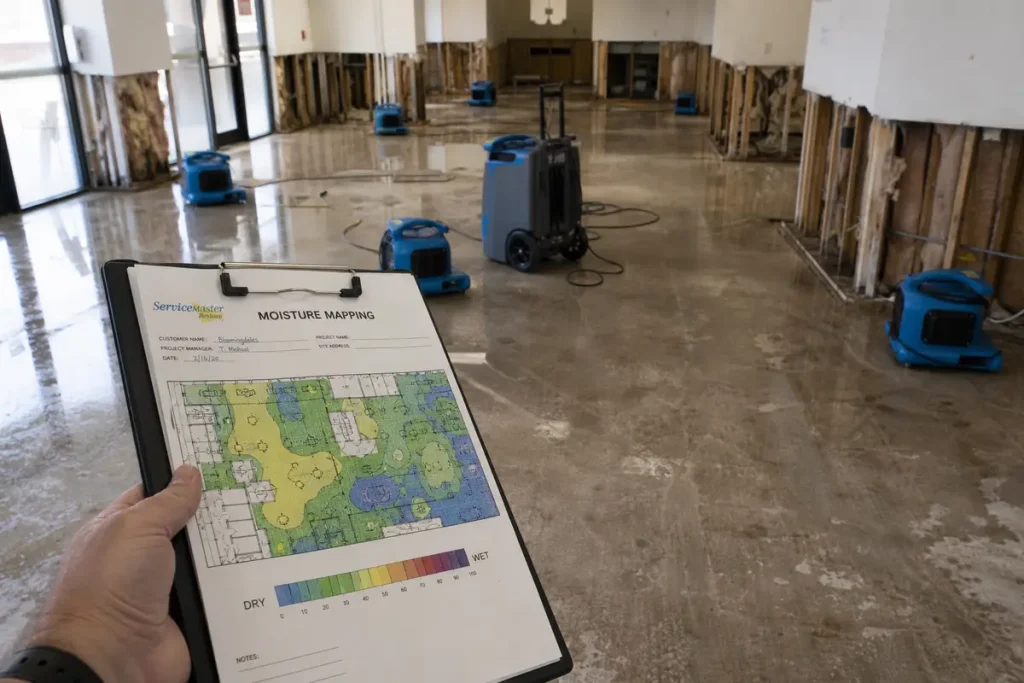
Utilizing industrial dehumidifiers is vital for effectively removing excess moisture during water damage restoration. These powerful machines are designed to handle large volumes of air, rapidly reducing humidity levels in affected spaces.
When you implement industrial dehumidifiers, you’re not just speeding up the drying process; you’re also preventing secondary damage, like mold growth and structural deterioration.
To maximize water extraction, it’s important to position the dehumidifiers strategically throughout the area. Make sure they’re placed in the most moisture-heavy locations, allowing for ideal airflow and efficiency.
Monitor the humidity levels regularly, adjusting the settings as needed to maintain a balance between extraction and energy consumption.
Incorporating industrial dehumidifiers into your water damage repair strategy not only streamlines the recovery process but also fosters a safer, healthier environment.
Natural Ventilation Techniques to Aid in Drying
To enhance drying after water damage, you can effectively use natural ventilation techniques.
Opening windows and doors creates airflow that helps dissipate moisture, while strategically placed fans can further accelerate this process.
Opening Windows and Doors
Opening windows and doors can greatly enhance the drying process during water damage repair, as natural ventilation promotes air circulation and moisture evaporation. By strategically openings, you manage airflow effectively, allowing fresh air to replace humid air trapped indoors.
This technique aids in temperature control, as lower outdoor temperatures can help cool down moist areas, further accelerating drying.
When considering this approach, verify external conditions are ideal—avoid high humidity days. Monitor the airflow direction, adjusting openings to create a cross-breeze that maximizes moisture removal.
Additionally, be mindful of the surrounding environment; noise and pollutants might limit this method’s effectiveness. By integrating this simple yet powerful technique, you’re taking a significant step toward efficient water damage recovery, fostering a healthier indoor atmosphere.
Utilizing Fans Effectively
While natural ventilation is essential, strategically placing fans can greatly enhance the drying process during water damage repair.
Begin by identifying the wettest areas in the space and position fans to promote ideal airflow direction. Aim fans toward damp surfaces, ensuring they circulate air effectively and reduce humidity levels.
Consider fan placement near windows or doors to draw in fresh air while expelling moist air outside. Adjusting the angle of the fans can further improve airflow, allowing for a more uniform drying effect throughout the area.
Remember, the goal is to create a cross-ventilation system that accelerates evaporation.
Employing Air Movers to Accelerate the Drying Process
Air movers play an important role in expediting the drying process following water damage, as they enhance airflow and facilitate moisture evaporation. By strategically positioning air movers throughout the affected area, you can greatly improve air circulation, which is vital for effective moisture control.
These devices generate high-velocity airflow, directing it toward wet surfaces, thereby promoting rapid drying. To maximize their effectiveness, make certain that air movers are placed at angles that create a cross-flow pattern, allowing air to reach all corners of the space.
This technique not only accelerates evaporation but also reduces the potential for mold growth by minimizing residual moisture. Regularly adjust the position of the air movers as drying progresses, making sure that air consistently flows over damp areas.
Implementing Moisture Meters for Accurate Monitoring
Moisture meters are essential tools for accurately evaluating water damage and ensuring effective dehumidification.
You’ll find various types of moisture meters, each suited for different materials and conditions, which can greatly impact your repair strategy.
Understanding how to read and interpret moisture meter results allows you to monitor progress and make informed decisions throughout the drying process.
Importance of Moisture Meters
Effective water damage repair hinges on accurate moisture monitoring, making moisture meters indispensable tools in the restoration process.
By utilizing moisture meters, you can guarantee precise measurements of moisture content in various materials, which is crucial for effective dehumidification.
Correct moisture meter calibration is essential, as it guarantees reliable readings that inform your restoration strategies.
Understanding moisture meter applications allows you to assess different surfaces, including wood, drywall, and concrete, guaranteeing you address all affected areas.
This targeted approach not only speeds up the drying process but also prevents further damage, fostering a sense of security among stakeholders.
Embracing these tools enhances your effectiveness in water damage repair, solidifying your expertise in the field.
Types of Moisture Meters
Understanding the different types of moisture meters is essential for implementing accurate monitoring during water damage repair.
You’ll typically encounter two main types: pin and pinless moisture meters. Pin meters utilize electrodes that penetrate materials, providing precise digital moisture readings, particularly in wood and drywall.
In contrast, pinless meters use electromagnetic sensors to assess moisture levels without damaging surfaces, making them ideal for broader areas.
Whichever type you choose, guarantee proper calibration techniques are followed to maintain accuracy. Regular calibration enhances reliability, allowing you to make informed decisions throughout the repair process.
Reading Moisture Meter Results
Accurate interpretation of moisture meter results is essential for successful water damage repair. To guarantee reliability, always begin with proper moisture meter calibration; this assures that your readings reflect true moisture levels.
When interpreting moisture readings, focus on specific areas of concern, comparing those values to baseline levels for your materials. Understand that different materials have varying moisture thresholds, so context is key.
Regularly monitor fluctuations to identify drying trends or potential issues. Document your findings to establish a clear timeline of moisture levels throughout the repair process.
Final Steps: Ensuring Complete Dryness and Preventing Mold Growth
Once you’ve completed the initial dehumidification process, ensuring complete dryness is essential to prevent mold growth.
Start by conducting final inspections of all affected areas. Use a moisture meter to confirm that moisture levels are within acceptable ranges, typically below 15%. Pay special attention to hidden spaces, such as behind walls and under carpets, where moisture can linger undetected.
After confirming dryness, implement mold prevention measures. This can include applying antimicrobial solutions to susceptible surfaces and ensuring proper ventilation in the area.
If you’re using fans or dehumidifiers, maintain them at ideal settings to facilitate airflow and moisture removal.
Finally, establish a routine for monitoring humidity levels in the future. By staying proactive, you create an environment that discourages mold growth, safeguarding your space and ensuring long-term health.
Your diligence in these final steps contributes considerably to a successful recovery process.
Dehumidification typically takes 24 to 48 hours, but your timeline can vary based on factors affecting moisture levels, such as temperature, humidity, and airflow. Monitoring these factors helps guarantee effective moisture removal during the process.
You’re living in a tropical rainforest, right? High humidity invites mold growth and respiratory issues that can trigger allergies and asthma. Keeping humidity in check is essential for your health and comfort. Don’t ignore it!
Yes, you can use home appliances like air conditioners and fans for moisture removal. They help reduce humidity levels by circulating air, but for best results, consider investing in a dedicated dehumidifier for efficient moisture control.
To determine if your home’s completely dry, use moisture detection tools alongside drying equipment. Check for hidden dampness in walls and floors; consistent readings below 15% indicate dryness, ensuring a safe, healthy living environment.
If you smell mold, consider it a smoke signal for trouble. Start mold detection by inspecting damp areas, then guarantee proper ventilation to aid mold prevention. Act quickly to protect your health and home’s integrity.
Don’t risk further damage to your property. Bear Restoration‘s ‘s IICRC-certified team is available 24/7 for emergency restoration in Louisville, KY and surrounding areas.
Learn about our Structural Drying Services service →

Read Our Reviews