
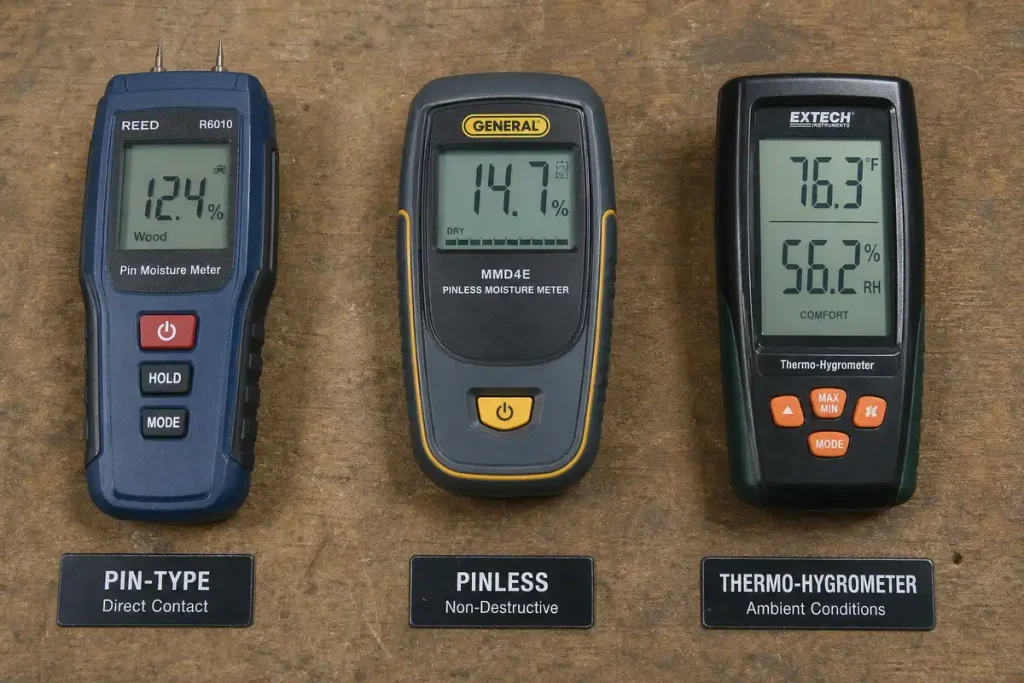
If you have ever found a musty baseboard after a hard Louisville rain or stared at a stained ceiling after an upstairs leak, you already know why understanding moisture meter types matters. A moisture meter is a tool that helps you find and measure hidden water inside materials before damage spreads, and the right type saves you from bad repair calls, missed wet areas, and shaky insurance documentation.
Moisture Meter Types at a Glance
You do not need a deep electronics background to make sense of moisture meters. You just need to know what each type is built to do.
This guide covers the main moisture meter types, pin, pinless, combination, and specialty models, then shows you where each one fits in real property problems. That means walls after storm intrusion, subfloors after a dishwasher leak, plaster in an Old Louisville home, and concrete in a damp basement.
Here’s the short version:
- Pin meters give precise spot checks
- Pinless meters scan fast over larger areas
- Combo meters do both jobs well
- Specialty meters handle narrow, specific materials
- Technique matters as much as the tool
How Moisture Meters Work
A moisture meter estimates how much water sits inside a material. Pin meters do that by measuring electrical resistance, which means how strongly the material resists a small current. Wet material resists less. Pinless meters use an electromagnetic signal to scan below the surface and compare density changes caused by moisture.
The numbers on the screen only make sense when you know the scale. Moisture content usually refers to a percentage reading, most often used for wood. A relative reading is a comparison scale, not a true percentage, used to show whether one area is wetter than another. Scanning depth tells you how far below the surface the meter is reading.
What a Moisture Reading Really Tells You
Some meters display wood moisture content as a percentage-style number. Others give a relative reading that helps you find wet zones fast. Both are useful, but they are not interchangeable.
Here’s the thing: a number alone never tells the full story unless you know the material being tested. A reading of 18 means one thing in framing lumber and something very different on a drywall scan scale. Treat the number as evidence, not a verdict.
Why Material Type Changes the Reading
Drywall, plaster, hardwood, concrete, and insulation all respond differently because density, thickness, and composition change the signal. A plaster wall in Old Louisville often includes wood lath, uneven repairs, and decades of paint. A newer East End wall is usually simpler drywall over studs and insulation. Same leak, different reading behavior.
The catch is what sits behind the surface also affects the result. Metal corner bead, foil-backed insulation, pipes, or tile adhesive can push readings up or distort a scan.
The Main Moisture Meter Types Explained
https://www.youtube.com/watch?v=2DUcteBbucM
This is the part most people search for, and the answer is straightforward: most building checks come down to pin, pinless, or a combination of both.
Pin Moisture Meters
A pin meter uses two metal probes inserted into the material. It measures resistance between those points, which gives you a targeted reading at that spot and depth.
That makes pin meters especially strong for wood framing, trim, subfloors, sill plates, and cabinetry. If you need to know whether a baseboard is still wet or a floor joist has dried enough to stay in place, a pin meter gives you a direct answer. The tradeoff is obvious. It leaves tiny holes and takes longer when you need to map a whole wall or room.
Pinless Moisture Meters
A pinless meter scans below the surface without puncturing it. That makes it the best choice for finished hardwood, painted drywall, plaster, and broad wall or floor checks after leaks.
Speed is the big advantage. You can move across a ceiling or basement wall quickly and spot the wet spread instead of testing one tiny point at a time. If you want a deeper explanation of how non-invasive scanning reads hidden moisture, the underlying idea is capacitance, which is just a way of sensing moisture through changes in an electromagnetic field. The catch is interpretation. Density, thickness, and nearby materials influence the result.
All-in-One and Combination Meters
Combination meters give you both functions in one tool. You scan first with the pinless side, then confirm suspicious areas with pins.
For repeated property checks, post-loss inspections, and claim documentation, this is the most practical setup. You move faster, document better, and avoid guessing. If you manage rentals or small commercial spaces, a combo meter earns its keep quickly.
Specialty Moisture Meters
Some meters are built for very specific materials, such as concrete, soil, hay, grain, or firewood. Infrared-assisted inspection tools also help identify temperature patterns linked to moisture.
Those tools have a place, but not all meters belong in building damage work. A plant meter is useless on a wet basement wall. A firewood meter is not the right tool for sewage-damaged subflooring. Match the meter to the job, not the label on the package.
Pin Vs. Pinless: Which One Should You Use?
Choosing between pin and pinless is less about preference and more about surface type, finish condition, and what decision you need to make next.
Best Choice for Walls, Ceilings, and Finished Surfaces
Pinless meters usually win on walls and ceilings. After roof leaks, storm-driven rain, or fire suppression water, you need to scan large areas fast without poking hundreds of holes in painted surfaces.
Think of it like using a flashlight in a dark room instead of inspecting one square inch at a time. You see the pattern first. That is especially useful when checking plaster, paneling, finished hardwood, or signs of moisture trapped where you cannot see it.
Best Choice for Wood, Trim, and Targeted Verification
Pin meters are stronger when precision matters more than speed. If you are checking framing lumber, baseboards, cabinets, subfloors, or trim, pins give you a focused answer at the exact spot you test.
That matters when deciding whether a material stays, needs more drying, or needs replacement. A warped oak floor and a soaked pine subfloor do not get the same treatment, and a broad scan alone is not enough to make that call.
Best Choice for Insurance Documentation and Repair Decisions
For documentation, a combination meter is hard to beat. Scan the spread, confirm the hot spots, then log repeat readings over several days.
Cleaner records support better repair decisions and stronger claim files. You can show where the damage extends, whether drying is working, and which materials remain affected after storm, sewage, or appliance-related water losses.
Choosing the Right Moisture Meter for Your Property
Ignore flashy marketing for a minute. The right meter depends on the kind of property you have and the problems you actually deal with.
For Historic Homes, Rentals, and Small Commercial Spaces
Older homes need a more careful approach. Plaster walls, layered repairs, dense hardwood, and aging framing all create uneven readings. In neighborhoods with older housing stock, one wall often tells the story of five different repairs over fifty years.
Rentals and storefronts bring another issue: speed. You need to check units between tenants, verify bathroom leaks, inspect around water heaters, and confirm that cleanup actually worked. That usually points to a combo meter, not a single-purpose tool.
Features That Actually Matter
Some features are worth paying for. Adjustable material settings help you avoid nonsense readings. A clear display, hold function, and min/max tracking make repeat checks easier. Calibration checks matter because even a good meter is only as good as its setup.
Deep and shallow scan modes are useful on mixed surfaces. Durable build quality matters more than fancy menus, especially if the meter lives in a truck, maintenance cart, or tool bag. The rest is mostly noise.
Accuracy, Calibration, and Brand Differences
Yes, different brands read differently. That is normal.
But brand loyalty is not what drives good results. Proper calibration, correct settings, and consistent technique matter more than the logo on the case. Accuracy comes from using the right meter on the right material in the right way. If you are already comparing inspection options, it helps to understand what a professional moisture check usually includes and costs.
How to Use a Moisture Meter Without Getting Misleading Readings
A good meter used badly gives you bad information fast. That is the real risk.
Step-by-Step Testing Basics
Start with a known dry reference area in the same building and on the same material. Then test the suspect area and compare. Check multiple points, not just the center of a stain. Move in a pattern and write the readings down.
In practice, that means scanning around windows, under sinks, near toilet flanges, along basement walls after heavy rain, and at the edges of visible stains. The edges often tell you more than the darkest spot.
Common Mistakes That Throw Off Readings
Pressing too hard, scanning over metal fasteners, ignoring wall cavities, and reading through thick finishes without adjusting for them all lead to bad data. So do foil-backed materials, salts, and dense substrates.
One mistake shows up constantly: relying on a single number. You need comparison points, repeat tests, and context. Without that, the meter becomes a false sense of certainty.
When a Meter Finds Moisture but Not the Full Problem
A moisture meter confirms wetness. It does not identify the exact leak source, and it does not diagnose mold on its own.
You still need the full picture: staining patterns, odor, leak tracing, and sometimes thermal imaging that helps trace hidden wet areas. In tighter spaces, looking inside a wall cavity without opening everything up can answer questions the meter cannot. A meter is a strong tool, not a complete damage assessment.
Moisture Meter Uses by Material and Damage Type
The best way to understand a meter is to tie it to the job in front of you.
Wood, Flooring, and Subfloors
Moisture meters help you decide if flooring can go back down, if warped boards are still active-wet, and if crawlspace framing or subfloors have dried enough after cleanup. That is a big deal after burst pipes, refrigerator line leaks, or sewage backups.
Wood holds and releases moisture differently than drywall. If you reinstall flooring too soon, you get cupping, buckling, and repeat work.
Drywall, Plaster, and Insulation Areas
After roof leaks, overflows, or wind-driven rain, meters help identify wet wall and ceiling sections fast. But finding a wet patch is only step one.
You still need to know whether insulation or framing behind that surface is holding moisture. Wet drywall dries one way. A soaked wall cavity dries another, and much slower.
Concrete, Basements, and Slabs
Concrete behaves differently because moisture moves through it gradually and often from below as well as above. A standard building meter helps identify suspect areas on basement walls or slab surfaces, but deeper concrete testing is often needed before new flooring goes down.
That matters in basements, slab-on-grade rooms, and lower-level commercial spaces where moisture problems keep coming back unless the source is handled correctly.
Moisture Meter FAQs
Are Moisture Meters Accurate?
A quality meter used correctly gives you reliable decision-making data. Accuracy improves when you match the meter type to the material, use the correct settings, and compare multiple readings instead of trusting one number.
What Is an Acceptable Moisture Reading in Walls?
Acceptable depends on the material and the meter scale. The best benchmark is a dry reference area in the same structure. Meaningful differences matter more than chasing one universal wall number.
Can a Moisture Meter Detect Mold?
No. A moisture meter detects wet materials and elevated moisture conditions. That helps you find areas where mold growth becomes more likely, especially after leaks or slow drying, but the meter does not identify mold itself.
Do You Need a Professional-grade Meter?
A homeowner-level meter is enough for basic checks around a leak, window, or basement wall. A better unit pays off fast after repeated losses, larger rentals, claim-related damage, or inspections across multiple units or commercial rooms.
How to Decide This Week
Use a pin meter for precision, a pinless meter for speed, and a combo meter if you want the smartest all-around choice. That is the simple answer.
Try one thing this week: test one known dry area and one suspect area in your home, rental, or building, write down the readings, and keep that baseline. Once you have that comparison, every future moisture check gets easier and a lot more useful.
Need Professional Help?
Don’t risk further damage to your property. Bear Restoration‘s IICRC-certified team is available 24/7 for emergency restoration in Louisville, KY and surrounding areas.

Read Our Reviews