
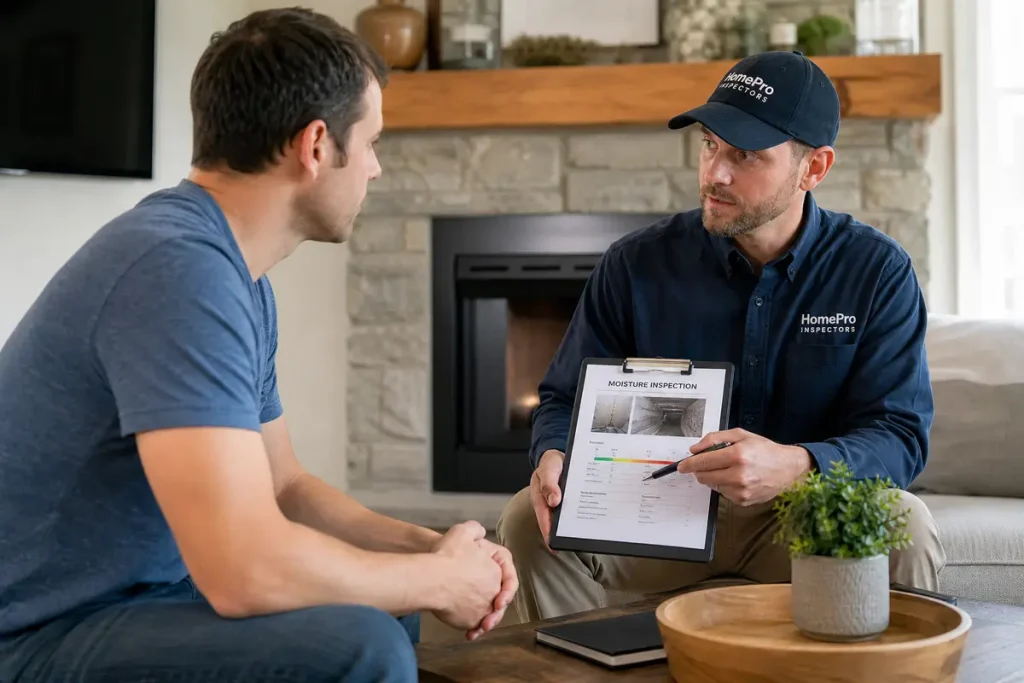
If you have a wet basement, a ceiling stain, or that stubborn musty smell that shows up after a hard Louisville rain, the first question is usually simple: what is the moisture inspection cost, and is it worth paying? It is, when you need real answers instead of a sales visit dressed up as an inspection. This guide breaks down what you’ll pay, what drives the price, and how to tell if a quote actually gives you useful information.
What a Moisture Inspection Actually Includes
A moisture inspection is a targeted check for unwanted water inside building materials and indoor spaces. You are paying for more than somebody glancing at a stain and saying, “Yep, that looks wet.” A real inspection includes a visual evaluation, moisture-meter readings on affected and nearby materials, source tracing, damage mapping, and, when needed, thermal imaging to spot temperature patterns that often point to hidden moisture.
That written report matters more than most people expect. It gives you a record of where elevated readings were found, how far the moisture spread, and what areas need drying, repair, or further testing. If you are dealing with tenants, insurance paperwork, or a contractor dispute, that documentation stops the conversation from turning into guesswork.
A free estimate for cleanup or repairs is different. That visit is designed to sell a service, not to diagnose the problem in a neutral, methodical way. Sometimes that is enough. Often it is not.
Moisture Inspection Vs. Mold Inspection Vs. Leak Detection
These services overlap, but they are not the same.
A moisture inspection looks for damp materials, active intrusion, and the path water has taken through the property. The goal is to find wet areas, define the spread, and support the next step, usually drying, repair, or further evaluation.
A mold inspection focuses on fungal growth and conditions that support it. That often includes visible mold assessment, air sampling, surface sampling, and lab analysis. If your main concern is odor, health symptoms, or suspected growth after a leak, that is a different scope from a straight moisture inspection. Timing matters too, especially because mold can start growing fast after a water event.
Leak detection is narrower. That service is built to locate the source, often a plumbing line, roof breach, window failure, or drain issue. If the question is “where is the water getting in,” leak detection is the sharper tool. If the question is “how far did the water spread,” moisture inspection is the better fit.
Average Moisture Inspection Cost in Louisville
In Louisville, a typical residential moisture inspection usually runs from about $225 to $650. Most standard single-family homes fall in the $300 to $500 range when the issue is limited to a few areas and the inspection includes meter readings and a basic written summary.
Small commercial spaces often land between $450 and $1,200. The jump comes from square footage, more rooms to check, higher ceilings, extra documentation, and the need to inspect around occupied business operations.
Local housing stock affects price more than people expect. An East End two-story built in the 2000s with open access and drywall walls is faster to inspect than an Old Louisville home with plaster, multiple additions, a cellar, and years of patchwork repairs. Older basements, crawlspaces, and finished lower levels take longer because water rarely stays where you first notice it.
Typical Price Ranges by Property Type
For a condo or smaller townhome, expect roughly $225 to $375. The footprint is smaller, the number of rooms is limited, and access is usually easier.
For a standard single-family home, expect about $300 to $500. That covers the kind of inspection most homeowners need when there is a ceiling stain, basement dampness, or suspected moisture around walls, flooring, or windows.
For a duplex, rental house, or multi-unit setup, pricing often lands between $400 and $750. Separate units, tenant coordination, and the need to document findings clearly for lease records raise the effort level.
For a small commercial property, expect $450 to $1,200 or more, depending on size and use. Offices are usually simpler than restaurants, retail spaces with rear storage rooms, or mixed-use buildings with aging roofs and utility runs.
What You Usually Get at Each Price Tier
At the low end, usually around $225 to $300, you get a basic inspection. That often includes a visual review, limited moisture checks in the problem area, and a verbal summary. It can be enough for an obvious, localized issue.
In the mid-range, around $300 to $500, you usually get the best value. Expect moisture-meter readings across affected and adjacent materials, thermal imaging where useful, source tracing, and a concise written report. If you want to understand why inspectors rely on imaging in the first place, seeing how hidden wet shows up through infrared scanning helps make sense of the price.
At the higher end, from $500 up, the inspection gets more detailed. That often includes room-by-room findings, photos, moisture maps, insurance-friendly documentation, and extra time spent on complicated or widespread problems. That level is common for rentals, real-estate disputes, storm losses, and small commercial claims.
What Drives the Price up or Down
Moisture inspection pricing is not random. The biggest cost drivers are scope, urgency, equipment, reporting, and how complicated the water problem is.
A low quote usually means one of three things: the inspection area is tiny, the reporting is minimal, or the visit is actually a lead-in for cleanup sales. A higher quote usually reflects more testing, more documentation, or more uncertainty about what is happening behind finishes.
Property Size, Access, and Building Age
A 900-square-foot condo is quicker to inspect than a 3,200-square-foot home with a basement, attic, attached garage, and two additions. That part is obvious.
Access is the catch. Tight crawlspaces, packed storage rooms, finished basements, and plaster walls slow everything down. A moisture issue in an open mechanical room is easy to evaluate. The same issue behind built-ins, inside a knee wall, or below old hardwood flooring takes more time and better tools.
Age matters too. Older Louisville homes often have layered repairs, hidden voids, masonry foundations, and less predictable construction. That means more time tracing the source and checking surrounding areas.
Type of Water Problem
A slow plumbing leak under a sink is usually straightforward. Basement seepage after a week of heavy rain is not. Roof intrusion, sewage backup, storm damage, and post-fire water exposure all expand the inspection because the source, spread pattern, and contamination level get more complicated.
Post-fire situations are a good example. Water from firefighting efforts often travels far beyond the burned room, dropping into wall cavities, lower floors, and concealed framing. Sewage is another category entirely because contamination changes the urgency and the safety protocols.
Emergency Scheduling and After-Hours Fees
Same-day response costs more. Weekend, evening, and holiday visits cost even more.
That price jump is justified when active intrusion is spreading and every hour adds damage. If water is still entering through the roof or a supply line just soaked part of the first floor, waiting for regular business hours is a bad way to save money. Emergency mapping helps contain the spread before repairs get bigger and uglier.
Reporting, Documentation, and Insurance Support
A verbal summary is cheaper because it takes less time. A detailed report with photos, readings, room-by-room notes, and moisture mapping costs more because it gives you something you can actually use.
That is especially true when insurance is involved. Adjusters, property managers, and tenants do not care much about a casual opinion. They care about documented findings. If you are already comparing inspection-related expenses, it also helps to understand what usually shows up in a broader damage evaluation.
Moisture Inspection Costs by Situation
https://www.youtube.com/watch?v=2DUcteBbucM
The smartest way to budget for a moisture inspection is to match the price to the problem you are actually dealing with. A ceiling ring after one storm is not priced the same way as a damp basement that has smelled off for six months.
Suspected Basement or Crawlspace Moisture
Expect roughly $300 to $650 for basement or crawlspace moisture inspections in Louisville. Lower-level spaces are notorious for hidden spread because concrete, masonry, insulation, and framing can all hold moisture differently. A wall can feel dry to the touch and still test wet below the surface.
This is especially common after heavy rains and fast temperature swings. In neighborhoods with older foundations and partial basements, the inspection usually needs more than a quick sweep. Meter readings, perimeter checks, and source tracing around walls, floors, and nearby plumbing all matter. If moisture has been sitting for a while, there is also a strong chance of water hiding where you cannot see it at first glance.
Roof Leak or Ceiling Stain Inspection
For a roof leak, attic issue, or ceiling stain inspection, expect about $250 to $500 for a typical home. If the stain is isolated and access to the attic is easy, the cost stays toward the lower end. If the path is unclear or the water traveled through multiple layers, the price moves up.
The visible stain is rarely the full story. Water enters at one point, runs along framing or drywall paper, and shows up somewhere else, like coffee dripping down the outside of a cup instead of the seam that leaked. That is why tracing the path matters more than measuring the stain.
Post-Storm, Sewage, or Fire Damage Moisture Checks
These inspections are more extensive and usually cost $400 to $900 for residential properties, with commercial spaces running higher. The reason is simple: the event affects more materials, more rooms, and more decisions.
After a storm, you need to know what got wet, what stayed dry, and what needs immediate mitigation. After sewage, contamination changes cleanup standards and reporting needs. After fire suppression, water often spreads vertically and laterally in ways that surprise property owners. These inspections also tie directly to insurance documentation, drying plans, and demolition decisions.
Is a Moisture Inspection Worth the Cost?
Yes, when you need facts before spending bigger money.
Paying a few hundred dollars to map the real extent of moisture is cheaper than tearing out the wrong wall, replacing flooring that was never wet, or ignoring wet materials that keep deteriorating behind a dry-looking surface. Moisture inspections save money because they narrow the problem.
When Paying for an Inspection Saves You Money
If you have a stain and do not know if it is old or active, an inspection gives you a real answer. If a cleanup company says an entire room needs demolition, an inspection can confirm whether the wet area is truly that large. If you own rental property, the report gives you documented condition records before and after repairs.
It also helps after mitigation. Drying equipment can run for days, but that does not guarantee materials are actually dry. Verification testing keeps you from paying for more drying than necessary, or from rebuilding too early.
When a Free Contractor Estimate Is Enough
Sometimes a free estimate does the job. If a supply line burst under a vanity, the cabinet base is swollen, and the repair path is obvious, you may not need a standalone moisture inspection first. The same goes for visible damage with a known source and no sign that water spread beyond the immediate area.
But the limit is clear. A free estimate usually stops at the obvious damage and the service being sold. It does not give you neutral documentation, detailed moisture mapping, or much protection if the scope changes later.
How to Compare Moisture Inspection Quotes
Comparing quotes on price alone is how people end up paying twice. You want to compare scope, tools, documentation, and turnaround.
A $249 quote that includes one room and no report is not cheaper than a $425 quote that covers adjacent areas, uses thermal imaging, and gives you written findings. It is just smaller.
Questions to Ask Before You Book
Ask exactly what areas are included. Ask whether the price covers only the visible problem room or also surrounding walls, ceilings, floors, and lower levels where water may have traveled. Ask what equipment is used, including moisture meters and thermal imaging.
Ask whether you get a written report, how fast you get it, and whether the documentation is detailed enough for insurance or tenant records. Ask if the quote includes only inspection, or if it turns into a sales call for drying or repairs. If hidden wall moisture is part of the concern, it also helps to understand how technicians confirm wet areas behind finished surfaces.
Red Flags in Low-Cost Quotes
Be cautious when pricing is vague, the scope is unclear, or the company cannot tell you how readings are taken. No moisture-meter readings is a major red flag. No written report is another.
Pressure to buy cleanup on the spot is a bad sign too. So is a quote that sounds cheap until extra rooms, thermal imaging, or documentation all cost more. The lowest number on the phone often turns into the highest invoice after the visit.
Ways to Keep Moisture Inspection Costs Under Control
You do not need to undercut the inspection to keep costs reasonable. You need to cut wasted time and avoid paying for scope you do not need.
A little prep goes a long way.
What to Do Before the Inspection
Write down when you first noticed the issue. Take photos of stains, damp spots, and any changes after rain or plumbing use. Make a short timeline of roof leaks, appliance failures, backup events, or prior repairs.
Clear access to the basement, sinks, utility room, water heater, attic hatch, and exterior areas tied to the problem. If an inspector spends twenty minutes moving storage bins in a South End basement before testing starts, you are paying for that time. Gather prior claim paperwork, invoices, and repair notes too.
Bundle Inspection With the Right Next Step
Bundling makes sense when the next step is obvious and time-sensitive, like inspection plus mitigation after active water intrusion. It also makes sense when you need drying verification after equipment comes out.
But if you need independent documentation for insurance, tenants, or a repair dispute, keeping inspection separate from cleanup protects your paper trail. That separation matters most when scope and responsibility are likely to be argued later.
Common Mistakes That End up Costing You More
https://www.youtube.com/watch?v=cQMJ4ych8B0
The biggest mistake is waiting because the surface looks dry. Moisture does not need to stay visible to keep damaging wood, drywall, insulation, and subflooring.
Another expensive mistake is treating a musty smell like a housekeeping problem instead of a moisture problem. Odor is often the first warning, not the last. Skipping documentation is another one. If repairs start before moisture is documented, it gets much harder to prove what was damaged and why.
And yes, choosing the cheapest option with no real testing usually backfires. If no readings are taken, no boundaries are mapped, and no report is provided, you did not buy clarity. You bought a guess.
How to Choose the Right Moisture Inspection Service in Louisville
The right service for Louisville is not just any company with a meter and a website. You want experience with the kinds of buildings and damage patterns common in this market.
That means familiarity with historic homes, aging basements, storm-related intrusion, rental turnover issues, and insurance-aware reporting. Local knowledge matters because water behaves differently in a sealed newer home than in a 100-year-old structure with plaster, masonry, and multiple renovation eras layered on top of each other.
Best Fit by Property Type and Use Case
For Old Louisville historic homes, prioritize experience with plaster walls, masonry basements, and hidden cavities. These buildings need patient inspection, not rushed assumptions.
For East End suburban houses, look for strong roof-leak, window-intrusion, and finished-basement evaluation. Newer homes are easier to access, but water still travels into insulation, subfloors, and wall cavities in ways that are easy to miss.
For South End rentals, clear documentation matters just as much as technical skill. You need reports that hold up for tenant communication, maintenance planning, and claim support.
For small commercial buildings, choose a service that understands occupancy concerns, faster reporting, and how to inspect without disrupting operations more than necessary.
Quick Cost Takeaways and Your Next Step
Most Louisville-area moisture inspection costs fall between $225 and $650 for residential properties, with higher pricing for complex losses, emergency scheduling, and detailed documentation. The real price drivers are property size, access, age, the type of water problem, and the level of reporting you need.
If the issue is small and obvious, a free estimate can be enough. If the source is unclear, the spread is hidden, or insurance, tenants, or repair disputes are involved, paying for a real inspection is the smarter move.
This week, get two itemized quotes and compare the scope, tools, and reporting line by line. That one step cuts through the noise fast.
Need Professional Help?
Don’t risk further damage to your property. Bear Restoration‘s IICRC-certified team is available 24/7 for emergency restoration in Louisville, KY and surrounding areas.
Learn about our Mold Inspection service →

Read Our Reviews