
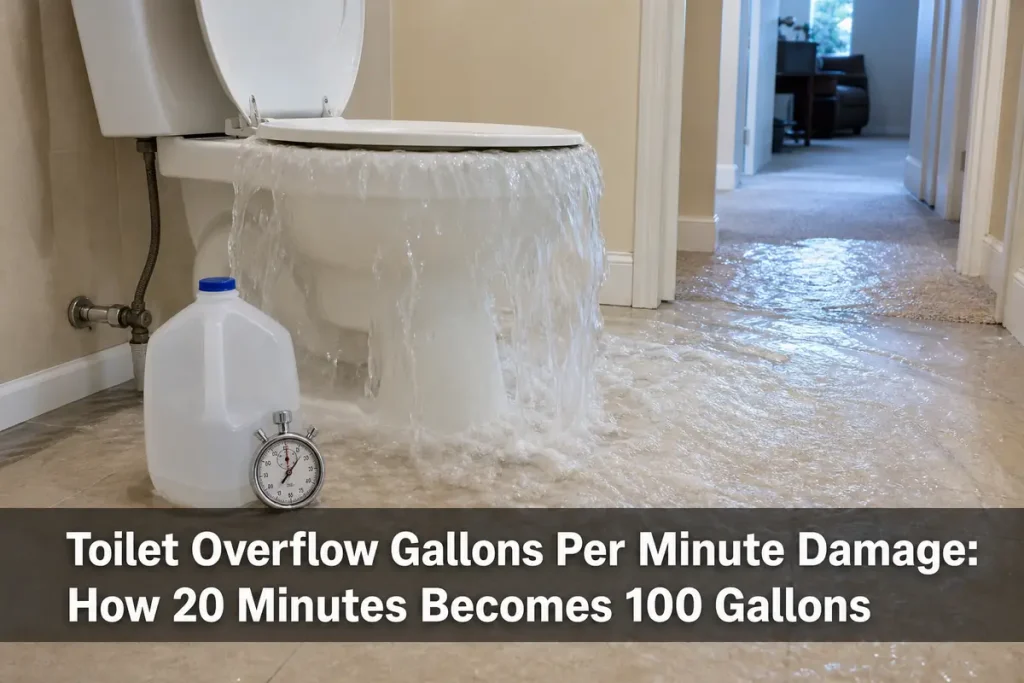
Toilet overflow gallons per minute damage comes down to flow rates almost nobody has memorized. A toilet supply line with a stuck fill valve feeds roughly 2 to 3 gallons per minute. A tub spout runs 4 to 7. A failed supply line sprays 4 to 8. At those rates, a bathroom left unattended for 20 minutes can put 50 to 150 gallons on the floor, and every gallon weighs 8.34 pounds.
The weight framing is deliberate, because it converts an abstract puddle into a structural load. One hundred gallons is 834 pounds of water searching for a way down, and a bathroom floor offers plenty of routes. In our jobs across St. Matthews and the surrounding neighborhoods, the overflow itself is rarely the story homeowners remember. The story is how far the water traveled while everyone thought it was contained to the tile.
How Fast Does an Overflow Actually Escape the Bathroom?
An overflow escapes the bathroom within the first few minutes, because standing water only needs a quarter inch of depth to flow under a door, through the gap at the base of a vanity, and into the heating register or plumbing penetrations in the floor. Tile and grout slow absorption, but they do not stop lateral flow toward every opening in the room.
The physics are simple gravity plus the reality that no bathroom floor is a sealed tub. Door thresholds, toe kicks, the ring gap around the toilet flange, and the cutouts where supply lines pass through the floor are all open channels. Consequently, by the time a mid-century St. Matthews bathroom holds a visible half inch, water is already moving through the floor system below it. A widely cited industry figure puts the average water damage claim in the five-figure range, and the delta between a small claim and a large one is usually measured in the minutes the water ran unattended, not the source that started it.
Why Can't Towels Keep Up With a Running Overflow?
Towels lose because absorption is a fixed capacity while an overflow is a continuous rate. A bath towel holds two to four pounds of water, roughly a quarter to half a gallon. Against a 3 gallon per minute overflow, an entire linen closet of towels represents about two minutes of flow. The barrier strategy fails on arithmetic before it fails on effort.
The correct first move is upstream of any towel: stop the flow. Every toilet has a shutoff valve at the wall, every tub has the main house shutoff as its backstop, and turning either takes seconds. In our experience, the households that fare best in overflow events are simply the ones where everyone knows where the valves are. That said, once the flow stops, the towels have a real job, and so does gravity's ledger. Whatever soaked through in those minutes is now inside the floor assembly, which is where the loss actually lives. This is why the ANSI/IICRC S500 Standard treats a stopped overflow as the beginning of assessment, not the end of the event.
Where Does the Water Go After It Penetrates the Floor?
After penetrating the floor, water follows the framing. It saturates the subfloor around the penetration points, runs along joist bays toward the low end of the structure, pools on the ceiling drywall below, and wicks into any wall cavity it crosses. First-floor bathrooms send the same water into the crawl space or basement instead.
The hidden inventory is what a moisture meter finds that eyes cannot. On a recent job, a tub overflow in a Jeffersontown two-story showed as a modest ceiling stain in the dining room below, yet mapping revealed wet insulation across three joist bays and moisture readings above dry standard six feet from the stain. The EPA's 24 to 48 hour mold window applies to every one of those hidden wet surfaces, and ceiling drywall carries its own deadline: saturated gypsum loses strength and can sag or fail under its own weight. Consequently, professional response front-loads two tasks, extraction and moisture mapping, because the map determines whether targeted drying can save the assembly or controlled demolition has to open it.
Who Responds to Overflow Water Damage in Louisville?
Bear Restoration, an IICRC Certified Firm (#70216409) founded by Emery and licensed in Kentucky (LIC-GBCL-24-00148), responds to overflow losses across Louisville, St. Matthews, Jeffersontown, Middletown, Shively, and Prospect with extraction, full moisture mapping, and documented structural drying.
If an overflow got past the towels in your home, assume the floor assembly is holding water the surface is not showing. Call 502-200-6968, or start with our Louisville water damage restoration page. Overflows involving toilet contents cross into contaminated territory that our sewage cleanup team handles under Category 3 protocol, and anything that sat wet through a weekend gets our mold remediation crew as the closer. The math of an overflow is fast. The response has to be faster.
Frequently Asked Questions
Where is the shutoff valve for an overflowing toilet?
On the supply line at the wall behind the toilet, usually a football-shaped or lever handle. Turn it clockwise to close. If it is seized, the main house shutoff is your backstop, so know both locations.
The overflow was only a few minutes. Do I still need an inspection?
If water pooled deeper than a thin film or reached the toilet base, walls, or vanity, yes. A few minutes at 3 gallons per minute is still enough volume to penetrate flange gaps and door thresholds.
Does it matter whether the bowl was clean when it overflowed?
Enormously. Tank or supply water is Category 1 and often allows in-place drying. Bowl contents make it Category 3, which changes the protocol, the removals, and the protective equipment.

Read Our Reviews