
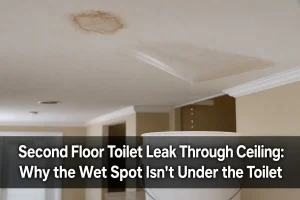
Second Floor Toilet Leak Through Ceiling: Why the Wet Spot Isn’t Under the Toilet
The wet ceiling spot is rarely under the leak. How a second floor toilet leak [...]
Aug

Toilet Overflow Gallons Per Minute Damage: How 20 Minutes Becomes 100 Gallons
How 20 minutes becomes 100 gallons. The toilet overflow gallons per minute damage math for [...]
Aug
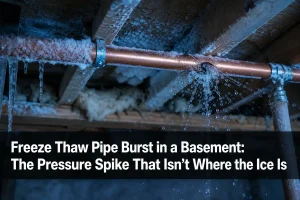
Freeze Thaw Pipe Burst in a Basement: The Pressure Spike That Isn’t Where the Ice Is
Pipes burst downstream of the ice, not at it. The freeze thaw pipe burst basement [...]
Aug

Efflorescence vs Active Water Seepage: Reading a Basement Wall Like a Building Scientist
White powder or wet wall? Efflorescence vs active water seepage diagnostics for Louisville block and [...]
Aug
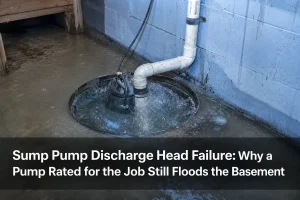
Sump Pump Discharge Head Failure: Why a Pump Rated for the Job Still Floods the Basement
A 3,000 GPH pump can deliver half that at real discharge head. Sump pump discharge [...]
Aug
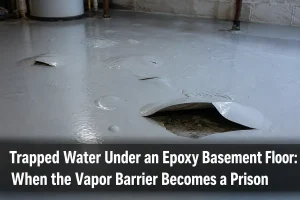
Trapped Water Under an Epoxy Basement Floor: When the Vapor Barrier Becomes a Prison
Trapped water under an epoxy basement floor can hide for weeks. Permeance science, delamination, and [...]
Aug
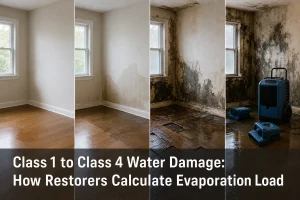
Class 1 to Class 4 Water Damage: How Restorers Calculate Evaporation Load
Class 1 to Class 4 water damage determines dehumidifier count and drying time. See the [...]
Aug
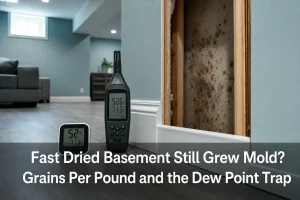
Fast Dried Basement Still Grew Mold? Grains Per Pound and the Dew Point Trap
A fast dried basement still grew mold because of grains per pound and dew point [...]
Aug
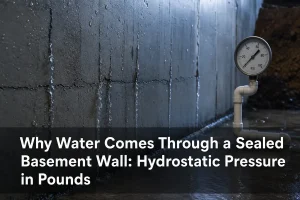
Why Water Comes Through a Sealed Basement Wall: Hydrostatic Pressure in Pounds
Water weighs 62.4 pounds per cubic foot. The hydrostatic pressure math behind why water comes [...]
Aug